Friday, 30 November 2012

REVIEW: What Richard Did (2012)


What Richard Did is the third feature film by director Lenny Abrahamson and his first since the phenomenal Garage made Abrahamson an international name in 2007. He has taken his time choosing his next film and with What Richard Did we get another insight into modern Ireland that is both universal and recognisably local.

Richard (Jack Reynor) is a successful rugby player who would seem to have the world in the palm of his hand. He is planning to go into rugby professionally, but also continue his studies at the same time. He is very popular and is surrounded by mates and people who look up to him, particularly Stephen and Cian (Gavin Drea and Fionn Walton). He starts a romance with Lara (Roisin Murphy) and looks set to enjoy a long, uncomplicated summer. However, his drunken actions during a brawl outside a house party one night might just ruin his life.

Abrahamson imbues the film with a very real sense of sympathy for Richard, just as he did with the social outcasts in Adam and Paul and Garage. Though the middle class milieu is totally different from those of his previous two films, Abrahamson nevertheless displays the same ability to lift the lid on a particular group of people and reveal the psychology beneath. Richard is a popular guy, but Abrahamson and Reynor present him as an ambiguous character from the very beginning. We often see Richard staring enigmatically at a sunset or at some scenery, the observational style and the ambiguity of the film’s title suggesting that there is a lot going on underneath the surface that Richard presents. When he is alone, Richard is subdued, almost immobile, as if constrained by some deep dissatisfaction or fear.

This may seem premature as all of this occurs before the event, midway through the film, which will alter Richard’s life forever. However, Abrahamson is more interested in his character than he is in conventional plotting and, as a result, it is clear that there is something mildly wrong with Richard before the unfortunate incident. This feature of What Richard Did is worth emphasising as it is emblematic of the film’s ability to suggest almost as much as it reveals, making it a film full of allusive possibilities. Indeed, the previous relationship between Richard and his eventual victim remains unclear throughout the film. It seems that there is some kind of a past between them but the film never bogs itself down in redundant specifics, preferring a richness of possibilities. As a result, What Richard Did is the kind of film that ought to be endlessly talked about.

However, Abrahamson, for all his allusive illusiveness, has not made a film full of ciphers. Most of the actors in the film are very good and the film has a very Cassavetes-feel to it, seeming semi-improvised and workshopped. Jack Reynor is fantastic, easily carrying the film with a performance that is keenly aware of both Richard’s sheer confidence and extroversion and his less definable, darker qualities. Of the adults, Richard’s father Peter (Lars Mikkelsen) is the most interesting, producing a fine study of ineffectual horror. The majority of the young actors are very good at presumably just being themselves with Sam Keeley and Patrick Gibson. Richard will eventually have a long awaited breakdown and Reynor’s performance and Abrahamson’s eye for harrowing realism make the scene a key moment.

Of course, the film will end somewhat inconclusively, but the drama that Abrahamson wrings from the film’s situation is utterly fascinating. The film’s final ten minutes are remarkable for the sheer volume of ideas and nuances that are presented. Defiant, having finally made a decision that he feels is the right one, Richard and Lara spend one last bittersweet night together. However, in the cold light of the morning, Richard has a change of heart and the romance of the night before is tarnished. All of this is conveyed practically without words and is a powerfully evocative depiction of indecision, quilt and fear. Similarly, the film’s final shot is a deeply effective conclusion albeit one without many answers.

Beneath the surface of What Richard Did, an ostensibly straightforward drama about guilt and the loss of innocence, is a complexity that defies easy answers and categories. Similarly, the story is told with a subtly that is only matched by some of the performances making the film as thematically rich as it is enthralling. To say too much about the film is to give too much away so suffice it to say that What Richard Did is the second great film from Ireland’s most important living filmmaker.


What Richard Did will be playing at the QFT from Friday 14th Dec to Thursday 20th Dec.
Tuesday, 27 November 2012

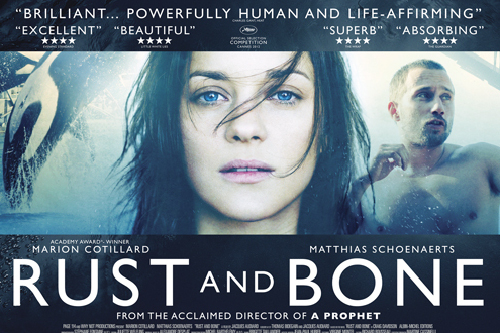
REVIEW: Rust and Bone (2012)


Rust and Bone is the sixth feature from writer-director Jacques Audiard, best known for his previous, the tough A Prophet. Rust and Bone feels like a return to the odd couple motif that gave his otherwise gritty 2001 crime film Read My Lips a heart. Whereas these previous two enlivened the tropes of the crime film through their extreme intensity and earthy realism, Rust and Bone is a bit of a departure, being mainly a romance between a disabled woman (Marion Cotillard) and a bare-knuckle boxer (Matthias Schoenaerts).

Unexpectedly put in charge of his young son Sam (Armand Verdure) after his mother disappears, the practically destitute Alain (Schoenaerts) moves to Antibes and begins to look for work. As a bouncer in a nightclub, he meets Stéphanie (Cotillard), a killer whale trainer. Following a horrible accident at her work, Stéphanie is disabled and a friendship develops between her and Alain. Meanwhile, Alain gets involved in bare-knuckle boxing for some quick cash.

Like Read My Lips and A Prophet, there is nothing especially new here in terms of the film’s plot, which is instead somewhat derivative. However, where the film excels is in Audiard’s ability to give potentially tired material a breath of fresh air. With a handheld camera and natural lighting, his films approach the material with an eye for realism and an honesty of focus. Though it can be manipulative, Rust and Bone is refreshingly uncritical and its emphasis on the emotions of the characters rather than on the developing plot mechanisms makes it surprisingly warm and heartfelt. Technically, the film rarely displays any meaningless stylistics, with Audiard typically preferring to shoot his characters in tight close-ups even when mobile. The film is not without its technical flourishes but, for the most part, the film stays with its characters and happily down to earth. As a result, the film’s contrivances become believable and Rust and Bone becomes a film that it is very easy to be taken away by.

Audiard is ably assisted here by some fantastic cinematography. Stéphane Fontaine, in his third collaboration with Audiard, proves equally adept at shooting intimate indoor scenes with a minimum of intrusive lighting set-ups and the large crowds scenes set in the sea park. Similarly, the film has many impressive lyrical sequences usually to do with the killer whales or with the bare-knuckle boxing, which are off-putting in terms of the film’s otherwise realist aesthetic but do manage to convey a certain beauty. The scenes early in the film set in the sea park are almost sickeningly tense as we are left waiting for something horrible to happen without being quite sure how or when. When the accident does occur, it is shocking precisely because it is unexpected, unseen and subtly presented. Similarly, the bare-knuckle boxing sequences are all horribly realistic, despite a few passages during which the film seems to poetise the violence.

However, the film is best during its slower and quieter moments between Cotillard and Schoenaerts and it is here that the performances get the chance to shine. They approach their characters with a large amount of understanding, often conveying a lot without saying very much. Similarly, they are far from one-note and both display moments of real cruelty, which the film bravely does not make apologies for, instead accepting that, in real life, there are never simply just heroes, villains and victims. Cotillard makes Stéphanie’s devastation queasily real but is also powerfully convincing as a woman tries to get herself back up after a life-shattering accident. One sequence in which Stéphanie begins to do her whale-training exercises for the first time since the accident is a moving and triumphant moment, only slightly sullied by Audiard’s bizarre decision to drown it out with Katy Perry song on the soundtrack. Schoenaerts is equally good in an intensely physical performance although, again, he is best when things are quiet. We are not always supposed to like him, but Schoenaerts is adept at portraying a hint of vulnerability even when he is at his most thuggish. His developing attraction to Stéphanie is well handled and his refusal to let her sit inside and mourn her legs could have been annoying and contrived but is instead surprisingly convincing. It is a tribute to the two lead actors that when the film is focused on them it is at its best.

The film is not without its flaws, often the result of a certain over-egging of the cake. Audiard sometimes moves into an oddly lyrical approach during the bare-knuckle boxing scenes, which feels like a bit of a misstep. The same is true for the use of Katy Perry during an emotionally significant moment that would have worked better without brash American pop. Similarly, the film’s final third does become less convincing and towards the end the film rushes to throw a variety of dramatic devices into the mix, none of which really come off. Cotillard is robbed of a real ending and Schoenaerts is given too many. One involving a frozen lake, while admittedly effective as it plays out, feels in retrospective to be a little too artificial and cheap. The ending also feels a little too optimistic, as everything seems to work out so well that it undercuts the film’s realism somewhat. However, the film is full of enough nice touches and enough honesty that these inconsistencies feel like quibbles.

Rust and Bone is a very good drama, marked by Audiard’s typical intensity and his ability to make recognisable material refreshingly new. Cotillard and Schoenaerts compliment Audiard’s directness with great performances, most likely a career best for both of them. The film is hardly perfect but is not an easy one to dismiss. 

Sunday, 25 November 2012

ARTICLE: Beneath The Earth Film Festival


Beneath The Earth is an internet-based film festival, which specializes in films that would otherwise be overlooked. The festival is designed to give its films an audience it would not otherwise have and to give the participating filmmakers a leg-up in the industry.

The film that was awarded Best Film was Ditching School to Whistle (directed by Ien Chi), a short documentary about Ien Chi and his journey to a Whistling Convention and what went on there. It was a well-made film about a subject few would know anything about. While not the most conventional of subjects, the film does manage to convey, to a degree, what the Whistling Convention means to some of those who attend. However, the film does not go into as much depth as it could have and the conclusions that Ien Chi comes to at the end of the film are not entirely convincing. As a portrait of people’s enthusiasm for whistling, it is illuminating, but the subject matter is nevertheless rather slight and deeper meanings are a little too hard to find. Ditching School to Whistle also won the Best Story award.

The Audience Award went to Taiwanese short The Double (Yu-Tong Weng), a strange short film that reflects on trauma and isolation, dreams and awakening sexuality. The camerawork can be off-putting, with many of the shots fragmenting faces and objects without much apparent purpose. Similarly fragmented was the narrative, which refuses to reveal the full story until the end. Overall, it is a little too long and sombre, but it is commendable for its seriousness and artistry, attributes that feature in most of the seven films in the festival. The Double also won Best Soundtrack.

Refuge (David Schmudde) picked up the Best Acting and Best Editing awards. Refuge is a good short that plays around with a complex narrative and a central mystery that is not revealed until the closing moments. It deals with such themes as guilt and expiation. It overdoes the narrative jumpiness to an extent as the viewer left confused for the majority of the running time as to what the point of the film is. However, when everything becomes clear, the film reveals itself to be an interesting and assured examination of guilt. That said, the stakes could have been a little higher and I’m not sure if the God-like stranger was the best way to carry the film through to its conclusion. Overall, it is an interesting film with only a few minor flaws and very well made.

Best Cinematography went to Extranjero (Dan Lumb and Crinan Campbell), a complex short film, presumably a story about immigration. It is let down by having too many ideas packed into too short a running time – five minutes. The end result is an interesting and well-made film that is somewhere close to incomprehensible. It is rather difficult to work out if the filmmakers had a point beyond the visual and editing stylistics.

The other three films were all interesting. Jackpot! (Tony Ducret) is an odd film with a story that verges on misogyny and a host of characters that are all deeply unlikeable. As a look at our celebrity-obsessed society, as a result, it works very well. However, some scenes feel a little stilted and the camerawork can be quite leering and the rap music video editing goes some way towards robbing the film of any seriousness. It’s a nasty little film but there is nothing wrong with that if something is being said – though I’m in two minds about whether or not the filmmakers intended to say anything. That said, it was the funniest, silliest and most ironic film in an otherwise largely sombre selection.

My two personal favourites were Stay Still (David J. Kelly), a gritty urban neo-noir in which the older of two siblings is forced to do a drug run for his mother’s lover. His younger brother, who is still relatively innocent, but not necessarily for long, follows him into the night. Refreshingly, there is a moral hue to the action, which is not all shouting and violence as these things can so often be. The dilemma here is the protection of the younger brother from the world around him even as that world slowly and inexorably infects him. The performances are all very good. However, the film is let down only by a few dream-like sequences, which undercut the grim premise, offering an escape that is otherwise impossible. There is also a degree of anti-climax at the end of the film, though the film is wise not to suggest an ending in which everything is fixed.

Drowned Out (Leo Claussen and Nicholas K. Lory) is impressive for a number of reasons. First of all, it is a feature-length film – the only one in the selection - that, for the most part, sustains itself. The premise is interesting and the film develops its simple idea well, moving through a number of tones and moods without losing its overall point. The performances are all good and the writing works well. The film is essentially about the disintegration of one man’s mind and, as a result, there is a lot of interior exploration, which is done with subtlety and understanding. However, especially towards the film’s end, there is a degree of ponderousness, particularly a point of view shot of the film’s protagonist HR climbing some stairs.  Overall, the film is a good exploration of isolation and it has a number of ambiguities that would sustain a second viewing.

As a viewer, the most interesting thing about this selection of films in the Beneath The Earth film festival is that they are all completely different in terms of influences, themes and approaches. There were a broad variety of ideas and techniques and every voice was unique. As well as that, they all work very well as first-tries, the filmmakers behind them all showing promise. To watch all seven films is to feel optimistic about the future generation of filmmakers and the quality of the films they will make.

All seven films are available until the 30th of November on the Beneath The Earth website.

http://beneathearth.com/watch/

Thursday, 22 November 2012

REVIEW: The Twilight Saga: Breaking Dawn: Part Two (2012)


The Twilight Saga, as it has named itself, is now over and the final film remains a victim of an undue opprobrium while other, much worse franchises (there are called cash cows when critics are being sniffy, franchises when they are not) receive much less flak, if not wholly unjustified adulation in the case of the lazy and meaningless The Dark Knight Rises (incidentally, now the final film in a trilogy, despite never having been planned that way). The hatred may stem more from male viewers having little time for films decidedly not aimed at them, a failure of insight and understanding on their part. And while it remains true that the thinking man’s (or woman's) franchise would be no franchise at all, the Twilight pentalogy remains a rare female-centric series that has ideas to burn.

The Twilight Saga: Breaking Dawn: Part Two, to give it it’s full double-colon name, begins with Bella (Kristen Stewart) waking up as a newborn vampire and finds herself very well adjusted to her new found superpowers. A plot involving the Volturi is soon to kick in, but the less explained the better. Plot, as in some of the best art cinema, is not necessarily something that the Twilight films paid all that much attention to – something that has always been grist to the critical mill even as they lauded the latest Godard or, yes, Paul Thomas Anderson.

Part Two is not the best of the series (Eclipse is), but the Bill Condon diptych comes a close second. Like Eclipse-director David Slade, Condon is not afraid to do both the softly lit slightly overdone romance sequences and the 12A boundary-stretching carnage, here with a full-on battle sequence full of head-ripping. And like Slade, he gets the balance right, tipping the scales to the favour of the romantic scenes, which are, after all, what distinguishes Twilight from all the male-centred dehumanised action spectacles. The plot is addressed often and a comically large number of new characters are introduced but the film is all too aware that it is the three leads that hold attention. In one sequence, some exposition involving traitor vampire Irina (Maggie Grace) is swiftly handled and the camera focuses in on Edward and his daughter Renesmee (played mostly by Mackenzie Foy following some dodgy CGI) playing piano. Here it is clear that Condon is aware that what Twilight does best is a kind of unpretentious romanticism unhindered by embarrassment or a need to please or, even, the knowing tongue-in-cheek sensibility through which much romance in Hollywood cinema is dealt with. This sequence also nicely recalls the moment in the first Twilight in which everything slows down to allow Debussy’s ‘Clair de Lune’ to take an evocative and unexpected precedence. Yes, it is corny, but one of the best things about the Twilight films is that they are not afraid to be corny. You may cringe initially, but they always manage to bring you in.

That said, there is as much to laugh at in Part Two as there is to be touched by, and the film is extremely funny and wantonly bizarre – there are few, if any, less conventional franchises/cash cows at the moment. The Jacob/Renesmee stuff is awkward but can raise a few laughs. Regrettably, Taylor Lautner has little to do in this film other than a very funny scene early on between him and Charlie (Billy Burke, also underused despite often being one of the best things about the series) and the battle sequence concludes with a very good surprise/joke. As always, the film does have its dodgy moments, the line about the Loch Ness monster being a step too far into silliness. And, as with the rest of the films, Part Two suffers from what is presumably a high degree of loyalty to the books, no doubt at the demand of the fans, which gives the film quite a few obstacles to overcome. However, part of the fun of the films is that they are far from perfect but they are always risk-taking, surprising and always strike a good balance between being ridiculous and funny and moving and romantic.

As for the message, this has always be the most misunderstood part of the films and this one will no doubt be no different. Bella has always been the strongest character in the films and in this one she is able to match the other characters physically. She takes to her newfound abilities without any problems and, as always, is remarkably adept. Eclipse ended brilliantly with a speech from Bella in which she addresses what the films have been about so far – her choice and her pursuit of self-definition – a scene, which also acts as the series’ rebuttal to its many critics. Part Two has a similar scene, this time coming from Edward, in which he apologizes to Bella for constantly underestimating her. The films have all centred on the idea of Bella’s single-mindedness and the fact that she knows better than anyone what is best for her and the fact that in every film and in every situation that the narrative throws at her, other characters tell her what to do – usually using the words “Stop” or “Don’t.” However, Bella is never dissuaded and always succeeds. When Edward apologizes to Bella for misunderstanding her, it is almost as if Edward is here embodying the film’s critics who often sanctimoniously complain about the film in terms of feminism and abstinence and of being a bad influence to legions of young women (a recent article by Periwinkle Jones is equally harsh and nonsensical). Many people have misunderstood Bella and the message that the films have been making about self-determination and self-expression. If not a feminist icon, Bella is at least a good influence and there aren't very many of them for young women in mainstream cinema. And, incidentally, Bella, and the film in general, are far from asexual.

Twilight, as a whole, and Part Two is no different, is thoroughly entertaining, unpretentious and bravely romantic. The performances are all good, with Michael Sheen great fun again and the three leads still playing it with the right degree of seriousness and honesty. Far from flawless, the films are all very touching tributes to young love in all its hopes and naiveté. But the films are also committed to speaking to young women, something that no other franchise really does.

REVIEW: The Master (2012)


Is there much point in mentioning that The Master has divided audiences and that it is the long-awaited new film from a writer-director who has previously offered some of the best films of 1997, 1999, 2002 and 2007? Much better to merely say what one thinks it is all about.

Joaquin Phoenix plays Freddie Quell, a recent WWII veteran in 1950 who is suffering from post-traumatic stress disorder. After a series of unsuccessful attempts to return to real life, Freddie jumps onto a yacht and stows away. He is suddenly introduced to the ship’s commander, Lancaster Dodd (Philip Seymour Hoffman), a “writer, doctor, nuclear physicist theoretical philosopher” and the man behind “The Cause”, a pseudo-religion that he has doctored up and is touring around the country to promote. Quell is quick to fall under Dodd’s wing, but how will he react when the indoctrination begins?

The links between the film and the life of L. Ron Hubbard and Scientology have been emphasised enough. The Master has its filmic antecedents in John Huston and Orson Welles – two big filmmaking personalities who excelled in 1940s Hollywood, but who also excelled in more outré films in the 1970s. John Huston gleefully played the repellent Noah Cross in Chinatown, a role that could also have inspired Daniel Plainview in There Will Be Blood. Huston’s very strange Wise Blood is also worth mentioning with its links between charlatans and religion. As for Orson Welles, one needs only to have seen his fantastic, mesmerizing F For Fake in order to be able to draw a lineage from the character Orson Welles presents himself as there to the character that Lancaster Dodd almost perfectly embodies – apart from when he is challenged and the whole brilliant façade crumbles into the very lack of restraint and animalism that he so detests. All that having been said, however, one film that exerts a most palpable influence on The Master is Paul Thomas Anderson’s previous, There Will Be Blood. The hype surrounding that film, as well as its own high quality, must have made it a tough one to top and The Master is almost self-consciously similar. One scene, in which Quell and Dodd go off in search of Dodd’s hidden manuscript in a rocky desert, can’t help but bring to mind the similarly harsh setting of There Will Be Blood. Jonny Greenwood’s score is equally an attempt to re-do what he did so well on the previous film. They work well as companion pieces with There Will Be Blood a look at greed and The Master a look at fakery, albeit with less of an emphasis on the perpetrator.

As in There Will Be Blood, the performances take centre stage with much of the film focussing on Joaquin Phoenix’s fantastically driven performance as a traumatized war veteran in search of a family. The film does go some way to revealing how, in the wake of the end of the war and with the influx of damaged veterans back into normal life, that dissatisfaction and isolation grew and a demand rose for such things as The Cause. Philip Seymour Hoffman is equally good as a man whose rampant knack for self-promotion has found him at the head of a movement, the intricacies of which he himself can be caught out on. Initiation into The Cause is marked by a deadening sadism, entrants are harangued into submission by endless repetition of utterly meaningless actions until a personality much stronger than their own tells them to stop as they have discovered the truth. Bewilderment and belief are intertwined irreparably so that when Quell finally sees Dodd for the charlatan that he is (in a scene that is remarkable for the blink-and-you’ll-miss-it quality of the exposition), the first thing that he does is half-heartedly beat up a fellow sceptic before he sits down and starts to cry. Though the film makes clear that The Cause did help Quell for a brief period of time and that more from the sense of belonging that the community gave him than the teachings themselves, the teachings of The Cause are both Quell’s entry and exit from the cult. The film concludes brilliantly with Quell performing a “processing” of his own (that being the questioning which is intended to bring out the true self of the subject and the beginning of their initiation into The Cause), though whether he is in fact becoming a second Dodd or is merely amusing himself, incredulous at how he had previously been taken in, the film refuses to say.

The film is not an easy watch and will probably have as many detractors as it will have supporters. There are too few challenging films that are as widely available and even fewer that are made with such confidence and artistry. Much of the joy of the film is in merely allowing yourself to be taken wherever the film and Anderson want to go, with many scenes being all about the performances and others being pleasingly confounding, safe in the knowledge that you are in the hands of a filmmaker who knows what he is doing. The Master is not as good as Magnolia and There Will Be Blood, maybe because cults and charlatanism is not as interesting as, respectively, loneliness and greed. However, Paul Thomas Anderson has managed to move away from the sometimes too-obvious influence of Martin Scorsese and Robert Altman and has become a rather unique voice in American independent cinema and is probably the only one of that rather hit-and-miss Sundance group not to do a film that could wholly be discounted from his filmography – Alexander Payne aside.

The Master rewards attention and intellectual investment, as well as, of course, emotional investment. There are a lot of things that the film leaves unanswered and an attentive audience can leave the screening with a lot to talk about. Indeed, this review might well be amended, if not entirely renounced, in the coming weeks – just as it took several weeks and a second viewing before There Will Be Blood came together. That said, The Master is a difficult film to recommend as it is entirely up to each individual’s predilection for unconventional and challenging cinema and those intrigued enough have probably already seen it by now. Ultimately, The Master is a difficult film to wholeheartedly like but as an example of how invigorating and rich cinema can still be, it is unsurpassed so far this year – This Is Not A Film maybe being the sole exception.  

REVIEW: The Commander (1988)


Directed by Antonio Margheriti, though here credited as Anthony M. Dawson, The Commander is the third in a triptych of Spaghetti War films, following Code Name: Wild Geese and Commando: Leopard. Co-produced by West Germany and Italy, the films were dubbed into English and, in true exploitation style, were initially cheap rip-offs of the Hollywood Wild Geese series.

Though perhaps near incomprehensible to the casual viewer (is there any other kind with this type of film?), the film deals primarily with the aftermath of a cruel South Asian warlord’s violent takeover of an existing corrupt establishment. He drives up the price of his drug shipments, which catches the attention of Colonel Mazzarini (a, even by his mostly low standards, slumming-it Lee Van Cleef). Mazzarini enlists a team of commandos (Lewis Collins and Manfred Lehmann amongst them) to get rid of the warlord. Somewhere along the way, some plastic surgery, a shipment of weapons, a camp Donald Pleasence and a floppy disc full of top secret information get wrapped up in the plot which strings together a series of double crosses and action sequences.

When Sergio Leone made A Fistful of Dollars, it is intended, from a financial point of view at the very least, as a quick and cheap Western rip-off that would be tricked into American cinemas and return a fast buck. Unexpectedly, the film became a hit and established itself as a classic in the emerging Spaghetti Western genre. Italian B movies have since gained a cult following, largely due more to their much higher quotient of sex and violence rather than their quality. Is there anyone who really prefers Lucio Fulci’s Zombie Flesh Eaters to Dawn of the Dead or Lamberto Bava’s Demons to The Evil Dead? What made Leone a rare breed was that his films were aesthetically innovative and much riskier than their often sodden American counterparts, to say nothing of the fact that many of his films attained the level of art. With Margheriti and The Commander, we have a Reagan-era action movie knock-off, which clearly aspires to be like films that weren’t any good in the first place.

In the 2000s, Quentin Tarantino took a break from making good films and started a campaign to popularise defunct exploitation and grindhouse films. Quickly tiring of turgid and egotistical knock-off homages like Kill Bill, Death Proof, Planet Terror and Machete, we moved into watching the real things, which goes some way towards explaining why anyone would release or watch The Commander. With tongue firmly in cheek and ready to watch everything with an ironic eye, an audience should find sleazy enjoyment in The Commander. But the film is a laugh-free mess of a film with unexciting action sequences, typically bad performances, clichés presented as if they were innovations, all put together by filmmakers who had no interested in stretching themselves. That is not to say that these kinds of films are all devoid of some guilty pleasures. Silent Night, Deadly Night, from the same label, is a good example of a dodgy, once-controversial film that nevertheless has some surprises of its own. But The Commander is one of those very poor films with which audiences will have to forgive too much and celebrate too little if they are ever going to make a case for its entertainment value.

Never mind that the film openly riffs on Vietnam and America’s military power and that America’s apparent right to intervene in other countries is presented uncritically and that the film is yet another tiresome example of the kind of extreme right-wing militarism that began to infect the multiplexes in the 1980s (Rambo: First Blood Part II, Commando). The film has enough flaws without getting into the politics behind it. The plot, if one exists, is near incomprehensible and the action sequences are cheap. The ending is presented as if it is clever, but it manages to be both contrived and predictable. The filmmakers’ tricks to hide the low budget are all transparent as when they cut away to an obviously decontextualised shot of a ball of flame in order to avoid having to blow up a real helicopter. Elsewhere, the model-work is distractingly obvious. Beyond this, the action sequences are rather repetitive, with someone firing, rolling and firing again, all with little or no visual flair. The characters are void of personality and the dialogue is either superfluous, such as one character’s annoyance about being told where to take a piss, or tin-eared. As bad cinema, that awful term, it excels.

Is a certain degree of quality not something that should be demanded of every film? Why celebrate dumb cinema as if lack of ambition and care were commendable? Is it common sense not to be taken in or is it just snobbery? The Commander raises many difficult and interesting questions, ones that are of particular interest now that it has been released on DVD.   

Friday, 16 November 2012

REVIEW: Elena (2012)


Elena is the third film from director Andrei Zvyagintsev (The Return and The Banishment), a slow drama that raises some difficult moral questions and contains some great performances.

Elena (Nadejda Markina) is a middle-aged housewife in modern day Russia, who has married up. Her husband Vladimir (Andrei Smirnov) is much richer than her and her family, including her son Sergei (Alexei Rozine) from a previous relationship and his family, whom Vladimir refuses to support financially. Elena and Vladimir barely communicate with controversial topics either avoided or addressed only in notes left next to his separate bed. When Sergei asks Elena to help fund his son Sasha’s (Igor Ogourstsov) university fees and hence avoid being drafted into the army, Elena has to get the money somehow and Vladimir won’t help.

Elena opens with a near two-minute shot, which recurs at the end of the film, showing the side of Elena and Vladimir’s flat as the sun rises in real time. It acts, much like the opening shot of Sofia Coppola’s Somewhere, somewhat comically, as the director’s shorthand for communicating to the audience that they had better get into a contemplative mood fairly soon, because the film won’t have any of the traditional Hollywood pleasures. Though the shot does have its aesthetic merits, it is quietly mesmerizing and quite beautiful in its way, it is a little too much of a director’s indulgence and a bit of an art house cliché, not unlike the shot that lingers on a nurse making a hospital bed after the patient has left. Elena establishes itself from the very beginning as an art house film, almost self-consciously.

However, the plot resembles more the pulp fiction of James M. Cain (note that Elena is a retired nurse), no surprise since Cain has influenced many writers and filmmakers all over the world, from Luchino Visconti to Albert Camus. The plot unravels slowly and methodically, with Zvyagintsev more interested in the moral and socio-political implications of Elena’s, and others’, acts. Though that is not to say that the film is cold and clinical, as Nadejda Markina proves more than capable of giving the drama an emotional power despite the distancing devices. Elena becomes, as a result, a beautifully visual film with an emotional heart and a contemplative and critical eye. What lets it down is really what Andrei Zvyagintsev and his co-writer Oleg Negin seem to want to say with it.

The film is dark at its core, suggesting that all humans are essentially self-serving and arrogant. Vladimir and his daughter Katerina (Elena Liadova) are emotional cripples and have nothing but contempt for the world and for the people in it. Sergei and Sasha are useless and stupid and do little of value. Sasha, it turns out is openly violent to those even lower down the social order than himself, in a visceral scene in which he and his mates battle a group of homeless men. And Elena, though seemingly so modest and charitable, ends up being the most morally compromised and criminal character. Zvyagintsev paints all of the characters critically but offers no real alternative or credo of his own. Worse still, he seems to openly side with Vladimir and Katerina, presenting them as emotionally cold and cynical, yet ultimately wise and articulate. In fact in one scene between Vladimir and Katerina, they come to an understanding and a rapprochement, one of the film’s few warm scenes. Their worldviews are grim and nihilistic but they find comfort in their agreement. On the other hand, Elena’s family are presented as stupid, practically monosyllabic or thuggish. When, by the end of the film, Vladimir and Katerina have been removed from the picture and Elena has ascended to prominence, bringing along Sergei and Sasha, it is hard not to feel that Zvyagintsev sees them as uncultured louts, represented through their constant watching of daytime television and drinking. There is more than an air of snobbery in this representation and the ending is an uncomfortable critique of class upward-mobility. It is difficult to tell how much of this to take seriously, but if the film had been made by, or at least championed by, a Conservative MP it would be critically mauled. One scene played for laughs, in which Sergei and his wife Tatiana (Evgenia Konushkina) announce that they are pregnant with yet another baby, seems to be illustrating the same ridiculous arguments made by John Ward in 2008.

Who says that the art house isn’t the place for right-wing films? Nevertheless, Elena is that strangest of films, that is modernist in form and full of great performances and made with an eye for composition and beauty and with an obvious artistic intent and yet manages to be if not stupid then poorly thought out. The argument it makes at the level of class is at the very least insensitive, but on a social level, the film is merely celebrating nihilism like it was fashionable. Zvyagintsev, through his many references to Andrei Tartovsky, is clearly interested in the idea of the director-philosopher, but he seems to celebrate nothing other than snobbery. Intellectual superiority seems to be his only value; one that he seems to believe is the preserve of the rich.

Wednesday, 14 November 2012

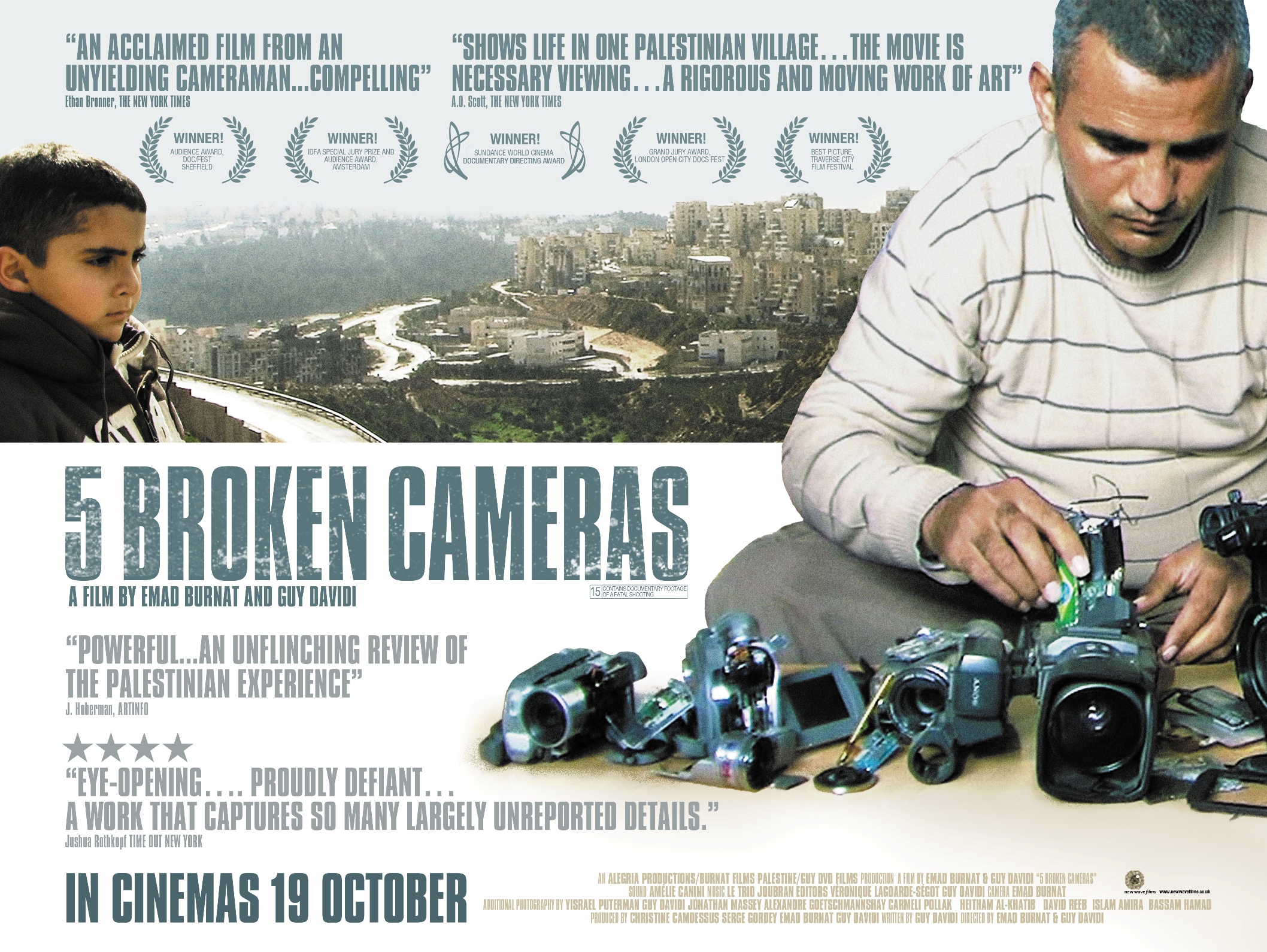
REVIEW: Five Broken Cameras (2012)


Five Broken Cameras is a documentary about the people of Bil’in, a small town in the Occupied Palestinian Territories, and their rebellion against the building of a separation wall that cuts them off from half of their farming land. Shot primarily by a Bil’in resident, Emad Burnat, who is also co-director and co-producer, the film is a remarkably pacifist look at resistance against oppression.

Filmed with six different cameras, the film charts the beginning of the resistance to the wall and the developing Jewish settlement of Modi’in Ilit in the West Bank between the years 2005 and 2010. The film also reveals how five of Burnat’s cameras were destroyed in the process of filming the resistance, often by bullets. Burnat also documents the first five years of the life of his fourth son, Gibreel, born on the day that the Jewish bulldozers moved into the town’s land.

As a testament to passive resistance, the film is surprisingly moving and a good introduction to the Israeli-Palestinian conflict for those who find it either too complicated or too hopeless. Instead of militarism, what Burnat’s film and the people of Bil’in represent is a grassroots campaign of resistance, which is about peace and co-existence and mutual respect, as opposed to Intifada and mass killings. Although the film is not primarily about the past, the building of a Jewish settlement on Bil’in land being an immediate and present-day problem, it does not deny the past. Burnat’s four sons reflect the past surprisingly well, with the first son born in a time of hope following the Oslo Peace Accords, the second three years later at a time of uncertainty after Oslo proved to have little effect if not to be entirely detrimental, the third son on the very day that the Second Intifada began. Gibreel, born on the day that the Jewish bulldozers arrived, ages tellingly over the course of the film, with ‘cartridge’ and ‘army’ being some of his first words. The sordid history of the conflict infects his childhood, robbing him of innocence much too soon. Hence, though the resistance is a just one, the film is also aware that there are always real complications. Towards the end, in a sequence that feels staged but no less effective, Gibreel will ask his father why he shouldn’t just kill Israeli soldiers.

The film is close to propaganda, especially in the editing and the addition of a post hoc voiceover, but its message is ultimately one of peace. The Bil’in movement begins as a small local effort but expands over the course of the film to an almost international movement, which also includes a mix of Westerners and Israeli activists. Burnat does not refuse to show the complexity of a movement that is more than merely an Israeli versus Palestinian one. In fact, the film was co-financed by Israel. And though the film paints the Israelis as the perpetrators and the oppressors with the force of propaganda, it is hardly manipulative as the facts remains damning enough. Again, towards the end, the film becomes more staged with celebratory images of his children at the seaside for the first time in some of their lives, but it is the film’s truth that bares it out. In fact, one of the sequences that push the film closest to the melodramatic clichés of Hollywood is horribly all too real. Ultimately, the film has an emotional force and a political resonance that recalls some of the late Edward W. Said’s writings on the subject, which advocate passive resistance, co-existence and understanding.

As an introduction to the conflict, the film is certainly useful because it does not show the too familiar Middle East of Western media. It is not a film of angry militarism and violence, but one of justifiable outrage, bravery and dedication. The film introduces some of the citizens of Bil’in, particularly Adeeb and Bassem, or “El-Phil” – The Elephant – as the town’s children affectionately call him, both outspoken and politically charged but also both entirely likable. The film has a remarkably human feel to it, despite all the politics and resistance. It becomes not so much a film about a particular grievance, but more a portrait of a small community’s resistance to a large invasive and faceless occupier, a classic American underdog story and not a million miles away from the recent Irish resistance documentary The Pipe. One sequence, in which Burnat is under house arrest recalls the brilliant This Is Not A Film. The film is also often very funny, with a strange sequence in which the villagers are amused by some chickens that are climbing a tree for no apparent reason. Adeeb’s rationale for the behaviour is “They have their freedom.” They are climbing the tree because they can, nothing is stopping them, a sentiment which speaks more for the film’s sense of the importance of freedom and self-determination than for its politics.  

Though it cannot help but be politically charged, Five Broken Cameras is ultimately a film about the resistance of villagers to the unlawful seizure of their land. It represents the resistance, and the broader conflict, in human terms first and foremost, refusing to allow rhetoric to muddy the waters in what is essentially a story of justifiable anguish at an excessive occupation. As with Said’s work, it is critical of more than just the Israelis, also taking a jab at the Palestinian Authority. As the years and the film progress, Burnat and his co-director Guy Davidi, become filmmakers, but it is during their more amateurish and rough-edged moments that a certain type of immediacy and power shines through.