Showing posts with label jean-paul belmondo. Show all posts

Sunday, 1 November 2015

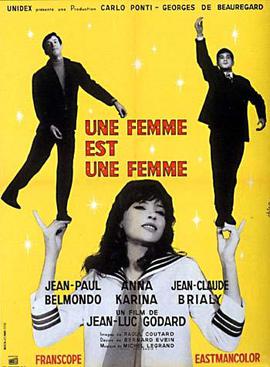
GODARD: Un Femme est une femme (1961)


Having improvised a feature debut with unprecedented artistic freedom and making a hit of it, and having made a follow-up which nearly ruined his filmmaking career in France, Godard moved straight on to Une Femme est une femme (released here as A Woman is a Woman), which may be seen as an uneasy synthesis of his previous two films as well as marking a further innovation in Godard’s cinema.

Une Femme est une femme was sold as an extravagant musical comedy in the Lubitsch mode, but it was a film that arguably challenged its audience much more than À bout de soufflé and Le Petit Soldat. Angela (Anna Karina) works in a strip club and is married to Emile (Jean-Claude Brialy). She decides that she wants a baby, but Emile is not interested, and insists that they get married first. In the ensuing argument, Angela announced that she will find someone else to give her a baby if her husband won’t. This declaration threatens to ruin their marriage, which is further complicated by the appearance of Emile’s best friend, Alfred (Jean-Paul Belmondo), who is more than happy to help Angela out.

A synopsis of the film may sound like the plot of a risqué musical comedy – indeed something that Lubitsch, named during the opening credits, might have made. However, Godard’s intentions seem to be more serious than that, even if the loud Hollywood musical score suggests different. The film begins with a challenging confusion of sound. Angela walks into a café, goes to the jukebox and puts on a record. As she leaves, she winks slyly at the camera. However, when she steps out of the café and onto the busy street, there is near total silence – no score and not even the sound of traffic and pedestrians, only the sound of Angela’s footsteps. The next shot has direct sound – engines, horns, shouting. We cut to a high angle shot and there is silence again and then the shrill opening bars of a sentimental score. These sudden juxtapositions in sound are jarring, bewildering, even irritating, and they will continue throughout the film, but they can be seen to serve a purpose.

Angela states early in the film that she wants to be in a musical – to move from talk and drama suddenly into an exuberant musical number and vice versa – and the film does play as a film that wants to be a musical, but has real life to contend with. The soundtrack then may represent a battle between the drudgery of the real and the emotions of the Hollywood film. Indeed, the first instance, when Angela leaves the music of the café for the silence of the street, feels foreboding and sad – something is lost. However, after this shot and the following shot with raw city sounds, we return to hope (and possibly inside the character’s mind) – the sound elevating the raw footage to something magical. These shots, right at the front of the film, makes it clear that the film is about the opposition between fiction and reality, music and silence, our dreams and our lives.

The seediness of real life and the innocence of the musical is brought out further inside the strip club. When Angela performs, Godard separates her singing from the other noises in the scene. We hear her sing in close-up, her voice as if in a vacuum, sounding young and vulnerable (despite even the sleazy lyrics). Between verses, Godard cuts in Angela’s point of view – seedy characters and the dingy club floor – and removes the sound, creating a distancing effect that further emphasises Angela’s vulnerability and the disparity between her honest performance and the shady setting. Then, of course, the music suddenly kicks in and it blares her out. When she sings again, the background noise again disappears. Godard was to perfect this disassociated POV shot (where we see a disparity between what the character feels and what they and others see) in much more powerful effect in his next film, but it is nonetheless a powerful moment here.

Much of the rest of the film has a looser, sillier tone than these two sadder, darker early moments. While the film is never entirely comic, it is of a lighter tone and one will eventually get the impression that Godard achieved what he was trying to do much more effectively in miniature (the two scenes discussed above) than in the rest of Une Femme est une femme. The film does revel in Karina’s performance, which got her a prize in the Berlin Film Festival, in a way that recalls Bruno trying to capture a beautiful and real image of Veronica through artifice in Le Petit Soldat. The film ends happily, with Angela and Emile reconciled, though it is hard to be convinced, knowing that Hollywood levity rarely wins out when faced with a much darker reality.

Une Femme est une femme was a box office failure, and much of the blame can be placed on Godard’s tinkering with the sound design. While it does offer several fantastic moments, it is overall a challenging and slightly confounding film. It would mark the first time Godard would film a marriage (the long sequence in Angela and Emile’s apartment detailing the ups and downs of a disagreement would be repeated in Le Mepris and La Femme mariée) and it is also possible to read an autobiographical exploration of Godard’s relationship with Karina in this film, given that Emile acts like an intellectual to Karina’s performer. As it is though, it is a slightly dated musical-without-the-musical-numbers but one that is certainly not without interest.


After Godard made Une Femme est une femme, he found himself without an idea, a situation that would be repeated several times in his career. However, what he came up with next would end up being another one of his best films – Vivre sa vie.


Sunday, 11 October 2015

GODARD: A bout de souffle (1960)


This review is the first of an intended series that will look at the feature films of Jean-Luc Godard, starting here with À bout de souffle and continuing through to the present, if I can manage to get a hold of some of his more obscure films. It should, I hope, be a reasonably comprehensive and largely chronological look at the work of one of the most important, innovative and challenging filmmakers.

À bout de souffle, then, is a story about Michel (Jean-Paul Belmondo), a small-time car thief who kills a policeman and is forced to hide out in Paris. While there, he tries to make contact with some fellow criminals and reconnect with former lover Patricia (Jean Seberg), an American student first seen selling the New York Herald Tribune on the Champs-Elysées.

The first five minutes of À bout de souffle is a great opening and clearly signals this film’s agenda – to break every rule in the book. The film uses a lot of jazz music in its score but the film itself is noticeably jazzy, moving along to its own rhythm, not afraid to throw in some discordance whenever possible. The film begins with a robbery, in which people look and nod and wave at each other but because Godard has not given us an establishing shot, we have no idea who is who and what is going on. Later, Godard will break the 180˚ rule, making a chase sequence look instead like an impending head-on collision. Michel, presumably making an escape having just stolen a car, will complain about cars overtaking him, wax lyrical about scenery and assess every women that he drives past. The music will be exciting when nothing exciting is onscreen and slow when it should be fast-paced. The confrontation with the policeman is so disjointed that the ensuing scene makes little sense (Michel is half inside his car, the policeman is walking down a lane, then Michel is standing on the lane, and the policeman, having been shot, is falling into some trees). We then have one of the many jump-cuts in the film, where we suddenly see Michel running through some fields, late at night, presumably being chased. Godard fades out here, deciding not to show the chase and the result. And all of this, and much more, occurs in the first five minutes.

When À bout de souffle first appeared in cinemas, these innovations were often taken as mere incompetence, but they are much more important than that. They make us, as an audience, realize how much there is in cinema that has been codified, how many rules there are for filming and editing and how reliant we are on these rules. Most of these rules came from Hollywood, where the traditional style was for invisible direction, lighting and editing. If the audience notices any of these things, then they have been distracted from the story, the characters or their popcorn. But Godard delights in his medium, as does is cinematographer Raoul Coutard and his editor Cécile Decugis, and here he shows how these rules are, effectively, a restraint on the possibilities of filmmaking. It needs hardly be said how influential this film is and how it made Godard the key filmmaker for a whole generation. À bout de souffle, then, is a great young film, every frame revealing a youthful energy and enthusiasm and, very possibly, a contempt for the older way of doing things.

This is true – and there are plenty of further examples that would be unnecessary to write down (just go watch it again if you’ve forgotten) – but it is not entirely what À bout de souffle is about. The term ‘À bout de souffle’ is frequently translated as ‘Breathless’, emphasising again that energy and youthfulness, but a more accurate translation is ‘End of Breath’ which is much more reminiscent of the terminal breath. Both Michel and Patricia are very tired of the world that they are in. Patricia has ambitions to write for a literary magazine and is an avid reader, but after an interview with the deeply obnoxious Parvulesco (played by Jean-Pierre Melville) she is thrown into a funk. Michel’s lifestyle seems exotic and exciting, modelled like the film itself on Hollywood gangster films (if you are wondering why Michel wipes his lips with his thumb so often, take another look at Bogie in The Big Sleep). However, we realize that Michel is even more tired than Patricia. In the end, Patricia glumly decides to return to her career (gained, it is suggested, by sleeping with or promising to sleep with her editor), choosing the path that everyone else has trod before her, while Michel is so fed up, he can’t even be bothered to get away from the police that he knows are coming. Look at the scene where Michel stops at a cinema and stands in silent tribute at a poster of Bogart (a poster for The Harder They Fall, mind, the last film Bogart made before he died), before wandering back into the world, a rare quiet moment in the film that feels leaden and sad. Or the moment during the usually upbeat extended bedroom scene where Michel sitting at the end of the bed and looks out of window and thinks about death, the camera observing him from behind and lingering on the moment. Putting the eye of a realist in the youth film genre, Godard reveals their empty heart, celebrating non-conformity at the same time that it encourages those who follow the rules. Like all Godard, there is a serious if not angry heart underneath all of the fun and games.

Godard had yet to find his style or his politics at the time he made À bout de souffle but the film remains rewarding nonetheless as an expression of a maverick young filmmaker who got the chance to make a film and was not going to waste it. Much darker than it would initially appear, À bout de souffle is not the epitome of cool as many praise it (one wonders how they deal with later Godard, if at all), but it is exuberant and thoroughly enjoyable. Much imitated but never truly repeated, it is a magnificent debut.