Showing posts with label usa. Show all posts

Friday, 4 March 2016

REVIEW: Room (2016)


Lenny Abrahamson has often had a fondness for outsiders (excepting his best film, What Richard Did, which focusses on an insider, albeit one who accidentally ousts himself) – indeed, to the level of fetish with his painful Frank. This has continued into his most mainstream film so far, Room, based on the novel by Emma Donoghue (here adapting her own book) itself in turn based on the Josef Fritzl case.

Ma (Brie Larson) and Jack (Jacob Tremblay) lived in Room, a small garden shed fitted as a domestic prison. Ma has been imprisoned in Room for eight years and Jack, who is five, was born there. The film charts their ability to cope and survive.

As off-putting as it is to consider a film, particularly one coming with all the bells and whistles of awards season marketing, based on so specific a case, in which there were real victims and real pain, Room largely manages to feel sincere and respectful. Donoghue and Abrahamson pursue their version through the eyes of a five-year old child who has no knowledge of the real horror of their situation. Any real abuse is seen by misdirection – seen through Jack’s perspective, we know what is going on even if Jack does not. Since the focus is so much on Jack, we can often forget that Ma (we find out her real name later in the film) is also a victim. Again, these scenes come through a degree of misdirection. When Ma, now Joy, comes home and back to her bedroom, untouched for eight years, Abrahamson knows to put the camera on her in this instance, bringing home sharply Joy’s own stolen years. It is a powerful little moment, done without show, but one that reminds us that Abrahamson does have his heart in the right place.

Even in one sequence in which the film slightly starts to lose its way, Abrahamson and Donoghue pull it back. In one extended sequence, Joy’s mother Nancy (Joan Allen) opens the house to a TV crew for an exclusive interview with Joy. The film takes pokes at the media, suggesting that they might be immoral scavengers after any kind of marketable human misery that might give the viewing public a little emotional kick (if not full-on freak show) to mull on over with their dinner. The thought is inescapable: the film itself could be tarred by its own brush. However, the film addresses instead the responses of those disinterested observers, which are often as damaging and traumatic as any kind of media intrusion. The interviewer chastises Joy for keeping Jack with her, suggesting that a better parent would have convinced their captor (Old Nick, played by Sean Bridgers as a very sad and lost human rather than as a monster) to anonymously leave the child in care where it could have a normal life. This, though a morally valid argument, is a cruel and coldly logical view of the situation and is not one that Joy ever considered. What the film is then calling for is not so much a renewed attempt to understand the victims of abuse, but merely that we remain compassionate and accepting. It is, again, a suggestion that the film is not just a shocking, headline grabbing cash-in, but one that actually addresses its subject matter in a constructive and positive way.

The performances are fantastic – Larson and Trembley keep the film feeling human rather than grandstanding. Even the film’s biggest moment – Jack in the back of the police car – is, although pure trailer fodder, sincerely focussed on the characters and the performances. Room feels compassionate as much for their performances as for Abrahamson’s distanced and empathic camera. Room’s greatest success is that it feels like a caring and human film for the majority of its running time, rather than a potentially damaging cash-in. It is a film about a mother’s love and the power and resilience of the human spirit, though one wonders why a version of the Fritzl case was such a necessary angle to address these fairly common themes, if indeed these themes were the primary motivations for writing the book and making the film. That said, Room is a film about the victims, preferring scenes of strength, weakness and recovery over empty histrionics. If one can’t fathom why anyone would make a film like this, it is equally difficult to fathom what cast and what filmmakers could have done it better.


Monday, 1 February 2016

REVIEW: Spotlight (2016)


Any film about investigative journalists will always have to survive a comparison with All The President’s Men – not least Spotlight, which features Ben Bradlee Jr, as played by John Slattery. Where other films revel in a clash between heroes and villains, Spotlight is a lot more subtle and a lot more engrossing.

Spotlight follows a group of investigative journalists for the Boston Globe as they uncover a huge scandal within the Boston establishment, which ends up uncovering a history of abuse inside the Roman Catholic Church on a global scale. The focus of the film is less on the crimes themselves, but more the efforts to uncover them. The team breaks into different tasks, each developing an element of this tightly constructed film’s chief target. Walter Robinson (Michael Keaton) battles an establishment who would prefer that the story go away, while Michael Rezendes (Mark Ruffalo) chases the evidence and a seemingly doomed victim’s lawsuit headed by embattled and disgruntled lawyer Mitchell Garabedian (Stanley Tucci). Meanwhile, Sacha Pfeiffer (Rachel McAdams) tracks down and interviews some victims.

After one film in which the filmmakers toned down their own material and another in which a filmmaker openly did not trust his own material, it is a relief to see a film of such confidence and skill.  Spotlight is as much a procedural as anything else, a slow burner that is nonetheless engrossing, not unlike, apologies, All The President’s Men. Every stumbling block and sudden revelation that comes Rezendes’ way is dramatic and interesting and Ruffalo runs around gamely. But the film is most disturbing when it tackles the ways in which the conspiracy of silence is maintained – decent men who suggest that there is nothing in the story, keeping the voices low so their wives don’t hear. There is even a mystery in the film as it is revealed that someone on the paper suppressed evidence of the abuse years ago. This, however, is not played up as a twist, but more as a disturbing and subtle portrayal of how easily the Church was able to get away with it for so long.

The film is not about the victims, though scenes of Pfeiffer interviewing some victims are presented with tact and respect. It is a film about investigative journalism and the ease with which the status quo can be maintained in the face of systematic abuse. The film dabbles with the tropes of the conspiracy thriller. Richard Jenkins plays Richard Snipe, an ex-priest and psychotherapist who states, chillingly, that the abuse is endemic within the priesthood, who is never seen and only heard through a telephone – being this film’s Deep Throat (another comparison). We frequently see shots of the homes of the victims with a massive church steeple towering imposingly over them – hardly subtle, but undeniably effective. One scene, in which a retired priest gladly admits his crimes to Pfeiffer, is as close as the film gets to thrilling, and it is nail-biting. Equally, the power of the Church, the resources they have to fight back, the good old men who are on their side, the silence and disinterest of the parties that should have revealed everything and the sheer scale of the abuse (shown starkly at the close of the film in a long list) give the film a sense of eeriness and danger.

Tom McCarthy, who played a journalist a lot less troubled by integrity in The Wire, films tightly and confidently. Spotlight is a rare film that relies on its material without fear or the misguided belief that the audience will understand the film better with an over the top score, a recognisable villain, a false dramatic arc. Indeed, the film doesn’t really have a villain and there is little in the film that is directly threatening, but that is what the best investigative journalism is – a chase, requiring patience and integrity, but in the end revealing something about all of us. Indeed, anger is ultimately not the film’s response, more a stunned sadness. What is ultimately so sobering about Spotlight in its representation of how the Church’s crimes were revealed, is how it took so long for the cover-up to break. Spotlight is as much a tribute to good journalism as it a warning about the secrecy and silence that surrounds any powerful social organisation.


Monday, 25 January 2016

REVIEW: The Big Short (2016)


Adam McKay may seem like a strange filmmaker to opt for an awards season biopic of the beginnings of the global economic meltdown of 2008, given his previous form as the director of Anchorman, Step Brothers and The Other Guys. Though it is clearly something close to his heart (remember the serious animated lecture that acted as an appendix to the not-awful The Other Guys), can a filmmaker like McKay pull off something so dense and complicated and, yes, serious.

The Big Short, a title that recalls more The Big Easy or The Big Lebowski than The Big Sleep, is about a few (all-male) groups who saw evidence of a housing bubble and who bet against the seemingly rock-solid housing market, reaping millions as millions lose homes and jobs. We have Michael Burry (a largely restrained Christian Bale), a solo financial wizard, who first sees the inevitable collapse due to the precarious way in which all of the banks had tied their money and capital up in potentially worthless mortgage bonds. His plan inspires others including Jared Vennett (Ryan Gosling) and Mark Baum (a quite good Steve Carell), who all tie up their funds in betting against the housing market.

The film traces the risks that these characters take, the pitfalls and the dark moments in which bankruptcy looms before the ultimate pay-off. Here, particularly in the Burry storyline, the film is closest to that other Michael Lewis adaptation, Moneyball, about the lone innovator who takes a serious risk and ends up triumphant and vindicated in the end. All fine with baseball (though that film was rather dull), but more troubling in the case of The Big Short. The film’s primary focus is on these financial traders who saw the fall coming and bet on it, making a quick buck in the process, which is not the greatest angle from which to address the serious greed and avarice that led to the economic collapse that ruined lives. The film does sort-of address this upside-down morality with Baum having doubts about what he has done, but ultimately the film strives to get an underdog triumph storyline out of something that can only be negative, if not fully misanthropic. Surely that misses the point about what this purely-financial collapse ought to represent.

The film does try to offer a serious critique of what brought about the collapse and the leniency of the response of the world’s governments. There is a running sense of disbelief at the stupidity of the bankers (how did they not know that this was going to happen? Did they really think this kind of policy was going to be sustainable?), that is nicely countered when we hear from Baum about the government’s bailouts, i.e. they knew that there were doing damage, but they were confident that the taxpayer would foot the bill and so simply didn’t care. The film does rouse your indignation, possibly even more effectively than the too-often misunderstood The Wolf of Wall Street. However, the film is not enough of a sustained critique. Though it will inspire a new ire in people who find the news boring, it is just not serious enough, working too hard to be an entertainment with heroes, an underdog storyline and a damaging, slightly desperate comedic strain that does it no favours. So we have Margot Robbie in a hot tub and Selena Gomez playing blackjack to explain CDO’s, stupid jokes that are wholly out of place and stupid pop culture montages. McKay seems to believe that too serious a critique will only confuse and irritate audiences, so he has tried to make the film as entertaining as possible, but it only makes it look foolish, hysterical and jumpy. Sadly, the filmmakers simply do not have enough trust in their material.

And that is it. The Big Short is a story of the outsider vindicated, which severely misses the point; it largely avoids the darker side to this story (the homelessness, the poverty) in favour of out-of-place comedy and easy pokes at villainy and greed; it lacks the intellectual heft to truly tackle its subject. It may be a good primer for the initiated, but with its hot tubs and poker games, it may feel like an insult to one’s intelligence. Though given how the collapse came about and the ease with which a stunning critique like The Wolf of Wall Street can be taken as a celebration and an inspiration, maybe that is what we deserve.


Monday, 28 December 2015

REVIEW: American Sniper (2015)


Having seen this film long after it was released and long after the media attention has passed, it is difficult to watch it without some of the critical commentary staying in mind. Most reviews – apart from the mainstream ones, for which the quality of a film is how exciting it is as a thriller or how moving a drama – dealt with the politics of the film, and seemed fairly split down the middle about where the film stood on its subject, Chris Kyle, a Navy SEAL sniper with 160 confirmed kills, and the Iraq war.

The reviews on this blog have of late verged into political commentary – particularly where war films set in Afghanistan or Iraq are concerned – and so American Sniper would seem to be the perfect film to indulge in further political ‘whingeing.’ Though, with this film, there is a stumbling block. Clint Eastwood has kept things fairly reserved in this film, the commentary or critique is essentially in the eye of the viewer and whether one finds American Sniper a glorifying or tragic and accusing spectacle is down to one’s own prejudice. As mine falls towards a distaste for this war, I will empathise the critique supposedly at the heart of the film.

Clint Eastwood is not a great filmmaker, though he is a very good one. His aesthetic (I imagine he would grunt derisively at the word, just as John Ford would have) is easy and unrushed, giving his films, particularly the later ones, a feeling of cool confidence. Where a film like Mystic River didn’t really work, its subject matter too traumatic for such level-headed treatment (this issue was somehow resolved by the time we get to Changeling), something as daft as Hereafter can be elevated by a convincing sadness and a judicious and effective use of Rachmaninoff’s Piano Concerto #2. His best film as director is, of course, Unforgiven, but Eastwood has always had a fondness for debunking myths and questioning how they come about and impact on reality from the time of his apprenticeship with Leone and Siegel (to whom Unforgiven is dedicated). This is present in Flags of Our Fathers, J.Edgar, Jersey Boys and now American Sniper (though a lot less visible in Invictus). Chris Kyle was even named ‘the Legend’ by his army buddies.

American Sniper, then, may take a less patriotic and optimistic look at Kyle and the Iraq war and America’s fascination with violence. Remember again that Eastwood has lately avoided any idea of redemptive violence – the final shoot-out of Unforgiven is a psychopathic bloodbath, the hanging at the end of Changeling is ugly no matter what the characters onscreen think, the promised shoot-out in Gran Torino is slyly taken away from the audience. The opening scene, in which Kyle’s sights are trained on a young boy running towards US soldiers with a grenade, is suddenly replaced by a sequence in which Kyle’s on edge father teaches him to hunt, drawing a parallel (and here I am reading the film as I want to) between America’s warmongering abroad and their glorification of guns and strength at home. We see Kyle’s pre-army days – all machismo and guns and faux-cowboy silliness – as being essentially leading to his signing up for the army – the direct causal link is, awkwardly, the advent of 9/11 but the seeds had been sown earlier. The film does not condemn Kyle for what he does, but more subtly criticizes a culture that too readily puts men in war without the support they need to survive it.

The depiction of the war is rightly ugly and violent and largely without context. Kyle’s different tours are numbered 1 to 4, but we are not given an insight into specific dates or events, making the war appear confused and seemingly endless. Eastwood never allows his audience to enjoy the action, instead making war hellish. Scenes of Kyle’s life on tour and back home on leave are intercut, creating a jarring shift in registers. Kyle’s confusion is heightened in a great sequence when, on leave, he suspects a jeep with closing in on him and his wife Taya (Sienna Miller) – a sequence shot and cut as if we really are back in Iraq. Eastwood does not hold back on the gruesomeness of the war, but he also never makes it heroic or positive. We are always aware that it is having a negative effect on Kyle.

The film complicates the audience’s enjoyment further by having Kyle’s first killing be a child. Further talk of Kyle having ‘popped his cherry’ in the next scene only feels thoroughly crass and further emphasises the issue of a culture that can normalise the murder of a child (later, an injured veteran will hit a target on a firing range and say, in triumph, “Damn, if that doesn’t feel like I got my balls back”, drawing another parallel between guns and sex). Another great sequence acts as a further counterpoint – a child approaches a murdered man’s rocket launcher and picks it up, Kyle, the child in his sights, begging him to drop it – a horrifying moment, brilliantly made. Where the previous scene had ended negatively, this scene ends positively, only further emphasising the horror and the loss that could have been. However, these critiques are not limited to the culture around Kyle. The final scene in the film – incongruously given a date - has Kyle approaching his wife with a gun. We are clearly set up to think that there is about to be some kind of horrible accident. It is a frightening scene and again emphasises the dangers of being so comfortable around a gun.

The film ends with this scene, making the tactful decision to not depict Kyle’s recent death, and actual footage of his funeral and a procession of American flags hung from overpasses, revealing that the film is primarily a tragedy of a man trapped by a gun-loving culture and its result, an endless war. American Sniper, then, is an anti-war film, in that war is only depicted as damaging. It suggests that the war is as much to do with the American gung-ho character by showing how perverse this character is. Too often misunderstood as a celebration of slaughter, it is more a grim attempt to show that America’s problem abroad have roots at home. That said, American Sniper continues the long tradition to American war films of showing the damage wrought on the American side and no other. For all its critiques, American Sniper remains a film that ignores the horrors of war for non-Americans – an ethno-centric view that is arguably just as damaging as an outright bloodthirsty celebration.


Monday, 21 December 2015

REVIEW: Macbeth (2015)


‘Macbeth’, the play, is difficult to get right. It isn’t that it’s a bad story – the warning about ‘vaulting ambition’ is, of course, still relevant, the trickery of the witches feels cruel and modern in its existentialism, the endless cycle of suspicion, jealousy and murder. But the play is not flawless. In place of character development, the play favours soliloquys about the tasks to be done – Macbeth too quickly turns to murder where most of us would not. The best film versions of the play are distanced. Orson Welles’ adaptation is Brechtian in how obviously stagey it is, while Kurosawa’s Throne of Blood is heightened beyond all recognition. Justin Kurzel’s new version strikes a balance between modern re-reading and overblown supernatural spectacle and doesn’t come off at all.

Michael Fassbender is a grieving Macbeth, who has just lost his only child (thus robbing the brutal, vengeful ambiguity of Macduff’s line “He has no children” in Act 4, Scene 3). He and his wife, Lady Macbeth (Marion Cotillard) then fall on the plan to assassinate King Duncan (a clueless David Thewlis) and set themselves up as king and queen, taking the idea from some deeply suspicious witches. Once crowned, however, the couple descend into bitterness and madness.

There isn’t much that really works with this new Macbeth. Fassbender plays the character mostly as a raving sociopath – the line ‘full of scorpions is my mind’ has never before sounded so sinister – but it doesn’t hold the film together, getting instead repetitive. We understand that the witches’ prophecy gives hope to a man who has lost an heir, but it isn’t convincing – especially when we see Macbeth putting Macduff’s family, including some youngsters, to the stake. Cotillard has one good scene, where she performs the ‘out damned spot’ soliloquy more as an act of sheer despair than of anything else. This works, but the film doesn’t have the material to make a believable transition from her earlier talk of smashing a baby off a wall (how this line works with a grieving parent is anyone’s guess) to this depression. Equally, Malcolm (Jack Reynor) and Macduff (Sean Harris) are left with little to do.

The battle scenes are admirably grotty and unheroic, but there is a feeling of dullness about them. They resemble too many other films (Braveheart, Gladiator, The Lord of the Rings and Game of Thrones and on and on) and they are not peopled with enough characters that we care about. The orange-tinting of some sequences and the sudden slo-mo don’t help, giving more a feeling of stylistic desperation.

Finally, the film emphasises the play’s secondary subtext about violence begetting violence (a cheap theme that has been used to praise such tawdry films as The Last House on the Left) over the warning about ambition, but it doesn’t do much with it beyond suggesting that all this violence and murder is a bit extreme and offering a silly ending with Fleance. This new adaptation then offers little that we haven’t seen before and many of its chief innovations don’t really work. Fassbender and Cotillard do fine work, but it is hard to credit them, given that they are playing characters that fundamentally do not make sense. By the end of the film, the characters are exhausted and fed up and it is not hard to feel their pain.


Saturday, 19 December 2015

REVIEW: Bridge of Spies (2015)


Is there another filmmaker quite like Steven Spielberg, where something painfully tacky is largely forgivable because it feels sincere, where even blunt, icky American patriotism can be taken as nothing worse than a paean to more innocent times (even if times were never innocent)? Nearly everything wrong with a good number of the serious Spielberg films is forgivable in some way or another. Saving Private Ryan is a very pro-war film (the focus on the horrors of war is there only to increase the sense of the heroic sacrifice made), but it is a very well made film and its nastier view of WWII, so often sentimentalised, is genuinely powerful. Lincoln is a talky film about the political process and virtually ignores all contributions towards the abolition of slavery by African-Americans and it is hopelessly patriotic and sentimental at others – particularly the beginning and the ending – yet it is thoroughly compelling. Bridge of Spies is a film you can pick apart, but it keeps you largely on-side while it plays out.

The film begins with the arrest of Rudolf Abel (Mark Rylance, clearly told to do Wolf Hall again), who is charged with being a Soviet spy. In an effort to make the American legal process look fair, insurance lawyer James B. Donovan (Tom Hanks) is hired to defend him before he is found guilty and killed. Donovan, almost despite himself, keeps Abel out of death row and they both become key players in a significant spy exchange between East and West Berlin.

Bridge of Spies works because it is a very well made film with a very well told story. It is a very classically told film, slow and reflective with well-rounded characters and a clear series of oppositions. Hanks gives a great performance, doing his normal everyman shtick with an element of tongue in cheek, near improvisatory glee. Rylance and Scott Shepherd, as Donovan’s CIA minder, have less to do, but stand out anyway. The rest of the cast is largely filled with less well known people (Alan Alda and Amy Ryan have tiny roles, too tiny in Ryan’s case), most of whom make a great impression. The film is well paced and holds your attention throughout, even when the story rambles between Abel’s trial and the introduction of Francis Gary Powers and the U-2 spy-plane in the middle section. The script is good, keeping the themes clear and interesting, and with enough humour to keep it reasonably funny throughout (the Coens doctored the script, but to pinpoint the best bits and suggest that they are their lines would be a disservice to Matt Charman and probably inaccurate given their invisible work in the awful Unbroken). One initially tacky early spiel about what makes Donovan and Hoffman (Irish and German respectively) American is saved by some nice anti-CIA ribbing.

Indeed, the film is somewhat ambiguous about where it stands on the Cold War. The film is clearly opposed to the Soviet Union – at one point, even using an ‘evil empire’ score that sounds like something written for Star Wars, at another, the public trial for espionage of Francis Gary Powers looks very Nazi. The Soviet and East Berlin negotiators are also clearly much more taciturn and untrustworthy than the American counterparts, and there is little talk of America’s aggression against the Soviet Union even as far as the U-2 spy-plane. That said, America does not come across as entirely virtuous. There is an element of mob rule about the reactions to Donovan defending Abel, saving Abel from the death penalty and their newfound fondness for Donovan after the spy exchange. The CIA are represented as sinister and a tad useless and their eagerness to abandon a second American prisoner in East Berlin, Frederic Pryor (Will Rogers), is clear. As with Lincoln, it is the ending that really lets Bridge of Spies down, with an overlong and painfully sentimental return to America, family and esteem for Donovan that is too self-congratulatory and twee. Depending on your sensibilities, this ending will be unforgivable, destroying all that came before, or it can be taken and, well, left.

However, the film, despite the patriotic presumptions barely offset by some few Cold War ambiguities, works. It is funny and likable and it looks fantastic. Early shots of Abel in his painting studio/ apartment/ headquarters are so well controlled and composed that they look instinctual, not intellectual. Even if the film’s story and characters hadn’t been as compelling as they were, the film would have remained watchable. One moment of a shooting at the Berlin Wall is genuinely shocking in its brutality and the final exchange on the bridge itself is remarkable.

It is possible to enjoy a film that one might disagree with totally, politically speaking, and yet still like it for other reasons. Bridge of Spies is a fantastic example of modern classical filmmaking, more sincere even than Carol, whose ‘50s aesthetics are lauded while those of Spies were met with rolled eyes. A real success for Hollywood, then, and worth celebrating because there hasn’t been one of those since, well, Lincoln.


Wednesday, 16 December 2015

REVIEW: Dreamcatcher (2015)


Few documentaries these days align themselves as concretely and directly with a particular cause or worldview as Dreamcatcher does. Most documentaries prefer to expose and to criticize without ever offering much in the way of alternatives or positives. Equally, many documentaries prefer hard-hitting action film camerawork and editing over stories about people eloquently and humanistically presented. Dreamcatcher then is a true documentary – a tough view of a world that needs fixed and a clear-sighted but non-judgemental view of the people on all sides of this world, an angry but compassionate, affectionate film about people and their world.

The film follows the Dreamcatcher Foundation, a Chicago-based movement that provides a framework for women to get out of sex work on their own terms and in their own time. The co-founders, Brenda Myers-Powell and Stephanie Daniels-Wilson, are both former sex workers themselves, are first seen driving around the streets of Chicago at night, offering help and assistance or simply condoms to anyone they find. Their approach to the problem is to act as a movement of solidarity, to support women who want to get out and to provide for them when they are ready.

Where many documentaries will have a political agenda and then find the people to fit, Dreamcatcher approaches the issue of sex work entirely from the perspective of the people both involved directly with the Dreamcatcher Foundation and those who came under their wing along the way. As a result, the film moves along with a world view that is totally undeniable and thoroughly authentic. Film culture is remarkably poor when it comes to the sex worker – they are common enough on screen, but they are usually confident and well-rounded and ultimately happy. Dreamcatcher has the effect of an angry polemic, but it is only angry as far as it makes the viewer angry – the film itself is relatively restrained, it does not even use much score to guide the viewer, rightly aware that the life stories told on screen are enough to make the point.

And these stories are powerful. In one shocking scene, Myers-Powell sits quietly in an after school meeting in which student after student offers up their experiences of sexual abuse and deprivation. We move from this to a scene of Myers-Powell in her day job, talking to sex workers in prison. The point is obvious – that sex work is not a choice but is being prosecuted as if it is – and powerful (there are still enough people in the world with delusions about the sex trade) but it is the stories of these women that is the focus, providing the true corrective. As much as Dreamcatcher is a film of solidarity, it is a film of collective action and experience.

Where other documentaries will settle for providing a villain for the audience to despise, Dreamcatcher and the founders of the Foundation itself do not settle for vilification. We also hear the story of Homer, Myers-Powell’s former pimp and now a key speaker in her organisation. Again, his story provides a further corrective, being another story of sexual abuse and economic deprivation, providing again a political point (the victimisers are often as much a victim of the cycle as the more obvious victims) through and because of a human story.

As a result, Dreamcatcher is a powerfully humanist film, addressing an argument in human terms where it has too often been presented in terms of statistics and criminality. Being a story of a grassroots movement and the good work that they do, the film provides more than a powerful push for change. It shows this change in motion and working. The film is not an easy watch but few films give as much hope.

Offering a view that cannot be ignored or belittled as well as providing an insight into how revolution can be achieved through collective action, Dreamcatcher is one of the most important political and humanistic documentaries ever made. It is an urgent and thoroughly moving film that bears witness and gives hope. Find it and see it.


Saturday, 12 December 2015

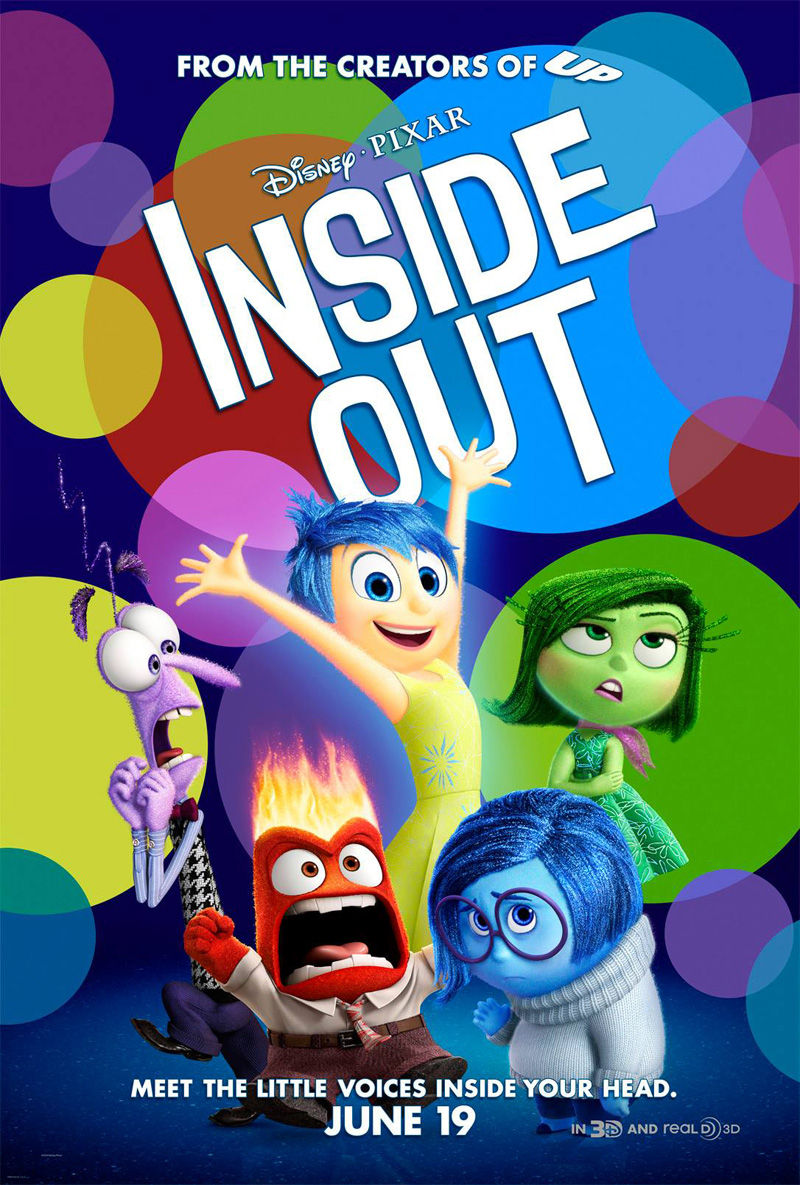
REVIEW: Inside Out (2015)


Inside Out is the new Pixar film (or at least it was until the recent The Good Dinosaur) and yet another highly regarded animation that both adults and children can watch and enjoy. But is it any good?

We are probably all familiar with the concept now, but to quickly reiterate – Inside Out takes place largely inside the head of eleven-year old named Riley, focussing on her emotions personified here as Joy, Sadness, Anger, Fear and Disgust. When Riley suddenly has to move house, this shock causes a major upset to her personality – before then, it had been developing smoothly with a strong emphasis on happiness. Joy and Sadness become trapped in Riley’s long term memory – leaving Anger, Fear and Disgust in charge (an obvious disaster). Joy and Sadness attempt to make it back into Riley’s consciousness before something terrible happens and Riley becomes changed forever.

It seems compulsory now to write about how clever the idea behind Inside Out is, and it is for the most part. In a rushed opening, we are shown the dynamics of this imagined head – from the emotions themselves to the long term memory bank, Imagination Land, the film studio that produces Riley’s dreams and the core memories that make Riley who she is. It is all very imaginative and it is well mapped out and easy to follow – each emotion is specifically coloured and any memories that they produced all equally colour-coded. However, a film cannot rest on the cleverness of its concept alone.

There are a few things that don’t add up – as silly as it might be to look into this too much. The film suggests that long term memories can be forgotten (visualized here as being dropped into a pit and bursting into ashes), but does not account for unexpected recall – the Proustian rush, if I was going to be pretentious (which is certainly the way this review is looking). Equally, as poignant as it might be to have Riley’s imaginary friend disappear into the pit and out of her memory (the theme of putting away childish things from Toy Story 3 is back in earnest in this film), it nonetheless doesn’t seem realistic that Riley, or anyone, would just forget the fact of an imaginary friend. More troubling is the fact that as Riley becomes more and more reserved and emotionally numb, ultimately deciding to run away from home, the film suggests that these sorts of problems are the result of someone’s Joy and Sadness being sucked accidently into one’s long term memory. Obviously the film is not supposed to be taken in this way, but it is a problem that the film’s whole concept only works if you ignore everything about it that doesn’t add up.

There are two other problems, which are more damaging. The concept is interesting, but it is unwieldy, and the storyline that has been used to showcase it isn’t very involving. The story is a rather tired re-run of the journey home with obstacles arc which has been done to death. Equally, the characters unsurprisingly are very one-note. Joy is irritating and hardly develops throughout the film, whereas the other four are barely better than caricatures. As far as drama and character, Inside Out offers less than even some of their less ambitious work, such as the Monsters films.

There are great moments in Inside Out. The mid-film, sudden trip into the heads of both of Riley’s parents are funny and welcome – they offer some insight into directions the film could have taken but didn’t. Equally, there are a few moving moments, particularly the revelation towards the end that one of Riley’s key core memories was not the result of Joy alone, but primarily Sadness. The film has a nice view about maturity involving the mix of all emotions, rather than the prevalence of the positive ones – a nice spoiler is noticeable in the scene inside the parents’ heads, in which the emotions are a team and are barely discernible beyond their colours.

Problematically, Inside Out is too much about a ‘clever’ idea and not enough about drama and character. With what it gains in imagination, it loses in those moments where other Pixar’s could hit you at some unexpected emotional level – see primarily Wall-E, Up and Toy Story 3. And with the limited range of the characters, you are never taught to care.


Wednesday, 9 December 2015

REVIEW: Carol (2015)


Those expecting another Sirk tribute from Todd Haynes may be disappointed. Carol, like his version of Mildred Pierce before it, is a different film entirely and has more than likely been mis-sold to the public. Carol is less a film of political outrage and more a stylish and slow paced film of mood and thought.

Therese (Rooney Mara, now miles away from that disinterested turn – though who could blame her – in that awful Nightmare on Elm Street remake) is a shopgirl who does a kindness to one of her customers, mailing her back her misplaced gloves. This customer, however, is Carol, a seductive and glamourous divorcee. Carol invites her to lunch as a thank you and an attraction begins to develop between the two women before they even know it.

Early in the film, we have a character who is watching Sunset Boulevard for the sixth time and who is taking notes, his subject the disparity between what is said by the characters and what is meant or felt. A signal then to the audience that Carol will be a film of quiet, meaningful silences and yearning emotion masquerading as mundane small talk. The relationship between Therese and Carol develops slowly, the two women’s reserve as much a fact of the morals of the time as of their own fear, shyness and confusion. It is an unlikely relationship that may not initially make much sense, but it develops convincingly. Haynes keeps his camera distanced, the women frequently kept inside window frames and doorways. Kept back like this, we are always aware that the characters are a little more than we can understand – like in Sunset Boulevard, we see the front but not the mind. And, especially with the ending, we know that they will continue to exist after the film.

The characters are rarely allowed to lose their composure, but when they do, it matters. Carol’s husband, Harge, who forces Carol to stop her ‘deviance’ by taking her child away from her, loses his hard skin with an impassioned but hopeless “I love her.” The same line, slightly altered (“I love you”), similarly breaks from Carol towards the end of the film and has a truly powerful effect.

There are other times, however, where the film overplays its hand. Carol stands up to Harge and two male custody lawyers in one barnstorming scene that trespasses onto the wrong side of tacky. The Hollywood cinema of 1950s had a lot of such moments, but transplanted here it feels too jokey, too winking and knowing – as if the film has, for a moment, lost its serious veneer. The film lifts the opening and closing bookending from Brief Encounter, which works well enough while the film is playing but is quite irritating afterwards (particularly if you rewatch Brief Encounter in between – the moment in that film is perfect and heart-breaking and ought not to have been repeated). Quite why the film needed such an overt homage is anyone’s guess. Equally, the sequence in which Carol and Therese go away for a trip to Carol’s home in upstate New York literalises the idea of the ‘tunnel of love’ in a way that feels overdetermined.

Carol then is a film both quiet and intense. It is slow and mannered, as much as a means for intellectual distanciation as an expression of suppressed emotion. The final scene, while moving, is so clearly meant to make a critic write the word ‘swoon’ that it becomes as much a success of form as it does a success in character or story or emotion. Carol then is a very good, well made and moving film, but it also has a degree of practised coldness to it, a feeling of technique where honesty ought to be. It will work on the mind, and with the critics, but will it stay in the heart?


Monday, 7 December 2015

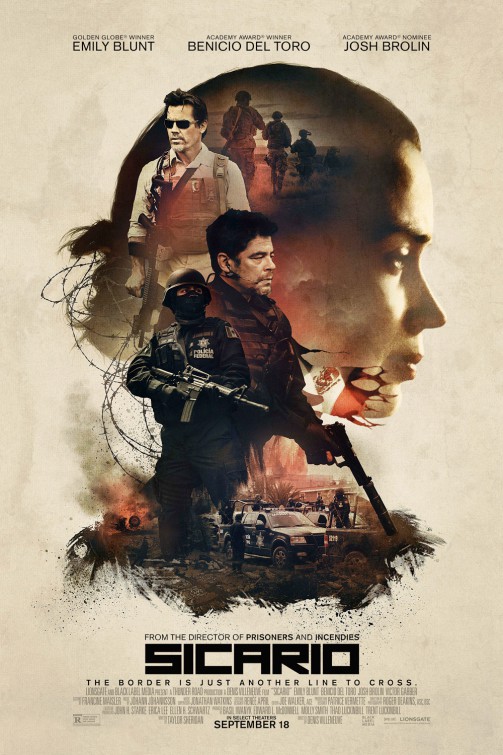
REVIEW: Sicario (2015)


In the heyday of the political thriller, which we will put as the 1970s for American cinema, ambiguities were often less moral in nature and more in terms of the extent of the problem. The Conversation, a masterpiece by the way, is ambiguous as to the exact nature and motivations of the forces ranged against poor old Harry Caul, but the film itself is less ambiguous about what it thinks of the culture of surveillance. We see the same questions of the nature of the crime and the criminals in The Parallax View and All The President’s Men. Those murky days were, ironically, a simpler time – the enemy was hidden and seemingly omnipotent, but they were not us. The films are never in doubt about what they felt were wrong with the world. Nowadays, however, this division is less clear, as are the films. Sicario sinks under some of the same issues that made something like Zero Dark Thirty such a hateful film.

Emily Blunt plays Kate Macer, an FBI agent recruited into a secret task force which aims to take down the leader of a Mexican cartel. Under Matt Graver (Josh Brolin) and the mysterious Alejandro (Benicio Del Toro), Kate is told to watch and learn. However, Matt and Alejandro may have other reasons for wanting Kate around, and they may not be trusted.

Sicario is a thriller about Mexican drug cartels, the American’s complicity in both the crimes and the general demand which funds and fuels the cartels, the moral ambiguities in policing across borders and outside the rules. It is a great-looking film, brilliantly shot by Roger Deakins, tightly directed by Denis Villeneuve and scored by Jóhann Jóhannsson. It moves at a good pace, which keeps it serious and largely engaging throughout (apart from a seriously poor coloured rubber band plot contrivance), a dense and complex plot that keeps you interested and some tough performances. It is effective, slightly shrill entertainment, with some fantastic, tense set pieces that largely hold the film together. As such, it is a very well made and watchable film. But…

Most political thrillers have a problem striking a decent balance between the complexity of their politic commentary and entertainment value. Sicario is dark and complex, even uncompromising, plot-wise, but it is hopelessly shallow in other ways. Its representation of Mexico is downright insulting – American agents casually climb to the roof of their compound on the Mexican border and watch gunfights and explosions in Mexico with binoculars. We do see short sequences detailing small aspects of American corruption (a few scenes) and complicity (one line), but we get a lot more focus on Americans getting the job done, state murder compared to finding a vaccine and talk of the ends justifying the means. Using Kate Macer as an audience surrogate, finding out as we do how the Mexican drug war ‘really’ works, the film makes its own world view clear. But since this is primarily a thriller, this world view is hopelessly inadequate to any real and true understanding of the problem and strongly stacks the deck to favour of the Americans as emotional identifiers for the audience. We are always standing on the American side of the border, looking at the Mexican drug war through the eyes of Americans. The film offers then a severe view of Mexico and a queasily ambiguous view of the Americans’ collusion with criminals and their willingness to break the rules. Where a fairer and more complex film might want to question this very American idea of the ends justifying the means, Sicario prefers to avoid this issue.

Sicario is a very well made film, but it remarkably shallow in terms of what it depicts. It is hard to work out what the film wants you to think of the Americans’ use of torture and their collusion with criminals who slaughter whole families. It represents this world as murky, dense and confusing, but does not dare offer an opinion, happy presumably that it is largely across the border and not here – a presumption that is self-serving and certainly not good enough. Where it should confront and shock but stand above the nastiness shown onscreen, Sicario instead remains mired in the same ambiguities as the film’s American characters. But when these ambiguities involve assassination and torture, that’s an uncomfortable place for a film of any sort to be.


Thursday, 19 November 2015

REVIEW: Mistress America (2015)


There have been so many reviews of Mistress America that use the word ‘screwball’ that there are now more than enough reviews commenting on the fact. It could be true that writing at length to connect the film to that subgenre is one of the easiest things to do when confronted by a film like this. What do you say about a decent, reasonably funny Noah Baumbach film?

Mistress America follows the fortunes of Tracy (Lola Kirke), who has just started college in New York but hasn’t yet been able to fit in and make any real friends. She wants to be a writer and to be accepted into a close-knit elitist college literary journal. Desperate, she takes up with her mother’s new fiancée’s daughter Brooke (Greta Gerwig) and they become great friends. Brooke is full of ideas for self-improvement and business, but she is also madcap and an exaggerator. Tracy spends more time with Brooke than at university and she goes everywhere with her, but does Tracy have an ulterior motive for doing this?

Baumbach and Gerwig’s previous co-writing venture was Frances Ha, which I found messy and distancing. Mistress America is an improvement, still messy but less embarrassed by sentiment. The previous film used a song like David Bowie’s ‘Modern Love’ but did nothing with it, whereas this film uses OMD’s ‘Souvenir’ to good, even emotional effect. Mistress America remains judgemental and one-note in much of its characterisation, but it is a little more open to emotion and unexpectedness. In a word, decent.

Towards the end of the film, there is a long set piece in which Tracy and Brooke travel to the house of a rich ex-boyfriend in order to try to get funding for a restaurant. This is where all those claims of ‘screwball’ come from. The film throws a series of unconnected, completely different characters into a house and watch them react off each other over an extended period of time. It is a device familiar from The Philadelphia Story or Holiday or Bringing Up Baby to name three screwball comedies at random (the fact that all three are Grant-Hepburn films is coincidental), and it really works here. It is a likable, funny, fast-paced, even exciting sequence, which elevates the rest of the film.


Mistress America does not have a particularly interesting story, the performances suffer somewhat from the under-developed characters and the film itself feels slight. But it remains a funny and a likable novella of a film. This may seem like faint praise, but Mistress America lifts elements of classical Hollywood and does something fresh and modern with them rather than simply offering a dull homage. As such, it is a likable throwback and one that would be worth repeating. So, apologises, but it is a good screwball comedy.


Tuesday, 17 November 2015

REVIEW: Me and Earl and the Dying Girl (2015) - SPOILERS


Me and Earl and the Dying Girl is an American indie film that sounds awful thanks to its title. Presumably intended as a mocking reference to all those Hollywood films that prefer to sentimentalize the death of young people but instead coming off as callous, the film manages to overcome its title for a good stretch by virtue of being funny.

Greg (the Me of the title, played by Thomas Mann – not of ‘Death in Venice’) is a high school student who has the place figured out. By avoiding cliques and by not making any particularly close friends, he has been able to avoid notice all the way through school. His only companion is Earl (the Earl of the title, played by RJ Cyler), with whom he makes short films based on classics of world cinema. Forced into it by his mother, he befriends Rachel (the Dying Girl of the title, played by Olivia Cooke), who has leukaemia.

Being an adaptation of a book, Greg speaks a lot in voiceover, explaining his views on the world around him and introducing every character. He also offers wry meta-comments on the film itself, reassuring the audience that this film is not a tacky romance story and will not offer some false redemptive coda. Taking the film this way, one could read it as an antidote to and a critique of the way Hollywood will give anything a marketable happy ending. One could, but there wouldn’t be much use in trying.

The film’s main benefit is that it is funny for a good stretch. Greg and Earl are obsessed with the films of Werner Herzog and are frequently seen watching Burden of Dreams. This obsession permeated into the way they view the world, best seen when Greg completes a college application form in the style of Herzog’s documentary voiceover (though arguably a better pastiche of this has been done by Herzog himself in the funnier Penguins of Madagascar). Many of their films – cheap Sweded versions of old classics based on bad puns like “Where’d he go?” for Vertigo – are amusing. There is a scene in which they accidently get high, which fills space pleasingly, and some nice little jokes - the family cat being called Cat Stevens, etc.

The problems with the film begin in earnest in the second half, but they appear in miniature throughout. Rachel’s mother, Denise (Molly Shannon), is presented a little too mockingly to be entirely fair. And director Alfonso Gomez-Rejon’s Wes Anderson style is irritatingly showy. Worse though is Greg’s repeated insistence that Rachel will not die at the end of the film – this is repeated so often that we know it can’t be true and it leaves an odd impression of the film trying its hardest to wring a little tension out of the whole situation, a touch too much manipulation for my liking. Equally, when Rachel does come to die, or indeed while she is dying, the film spends more time considering how this influences Greg on his way towards maturity, largely ignoring how it affects Rachel. It is strange to say but the film is ultimately about how a sick teenager’s death helped a young boy become a man, which is surely about as bad a message as any non-ironic Hollywood film. It doesn’t help that the film’s veneer of coolness breaks entirely, leaving the film just as self-important and tacky as any of those films it has been purportedly mocking. Considering the first half of the film after the second half, it seems that Me and Earl and the Dying Girl is really two separate films that don’t cohere particularly well. Which then takes us back to Gomez-Rejon and his preference for Anderson copycatting in place of any kind of structure or intention.

Trying to straddle the divide between cold stylistics and emotional honesty whilst also trying to avoid every sick teenager cliché, the film ends up looking like a bit of a mess. These problems are less obvious initially when the film is at least quite funny, but they become bigger the more the film attempts to be serious. It finishes up as just another film that knows how to imitate but never works out what it wanted to say.


See also:


Monday, 9 November 2015

REVIEW: Dear White People (2015)


Justin Simien’s Dear White People is a satire about the state of race relations in post-Obama America, its university setting acting as a microcosm for the rest of the US as well as recalling Spike Lee’s School Daze. Having said that, the film’s key precedent is another Lee film, the excellent satire Bamboozled, particularly its examination of the representation of blacks in American mass media.

The film is an Altmanesque multi-character film, with each protagonist representing a part of the film’s complex critique. Sam (Tessa Thompson) is an angry, political young woman – few enough of those in recent cinema – who presents a radio show called ‘Dear White People’, which, in snappy one-liners, challenges the presumptions of race relations in Winchester University and, hence, the US. Apparently by accident, she is elected into the student council, having run on the policy to abolish the university’s new policy of randomized housing allocation – an attempt to end segregation at the university but, as she sees it, having the effect of breaking up any collectivised black community. Her policies create various tensions within the school, both in the students and in the faculty.

Dear White People has some very intricate plotting – every character is positioned in such a way to play a particular role in the film’s socio-political critique. Each one displays an aspect of blackness that Sam has criticised. Troy (Brandon Bell), Sam’s ex-boyfriend and the one who loses his seat in the council to her, is ambitious and driven and willingly places himself under the thumb of Kurt (Kyle Gallner), the white leader of the most aristocratic house on campus, in order to get ahead. Meanwhile, vlogger Coco (Teyonah Parris) is equally happy to mock and use her own blackness in an effort to further her career on TV. And Lionel (Tyler James Williams), the sole black occupant of Kurt’s house thanks to the randomised housing policy, is barely black at all, stereotypically speaking, but he does notice the racism and fetishizing gaze of the whites.

The film then is about trying to be a black person in modern America, where white people think that racism is dead in America and frequently reply that the blacks have nothing to complain about since they have a black president. The film seemingly effortlessly lays bare the continuing prejudice and assumptions still prevalent in America. When one white caller challenges Sam on air about why there isn’t a ‘Dear Black People’, she replies that there is Fox News and reality shows on VH1. Ultimately, however, the film is primarily addressing a black audience, using Sam’s example of the ‘tip test’ (an unanswerable riddle best explained in the film itself) to lay bare the difficulty of being yourself and also being black. Like Bamboozled, the film is about stereotyping.

Dear White People is an eloquent political film, particularly one fast-paced conversation between Sam and her white lover Gabe (Justin Dobies), which covers everything from political cinema to stereotyping and self-stereotyping. Without getting into the nitty-gritty of every debate (see the film for that), where the film works best is in its representation of political argument without always offering an obvious stance for the audience. With no character being 100% right or 100% wrong, you are often left to come up with an opinion on these complex matters yourself. And lest you think that the film is all about argument for argument sake, it ends with a disturbing whites-only blackface frat party, which would look like a gambit too far on Simien’s part if the film didn’t end with newspaper cuttings showing similar real-life events. If anyone in the audience gets this far still believing in a post-racial America, this should finish that.

Simien’s film then is also about complacency as regards the racial question in America. If outright racism is gone, or at least no longer acceptable in the mainstream, racism still remains in more subtle ways, running from fetishism to mocking and stereotyping. The film is also as much about confusion, both political and personal, with few characters ultimately clear about who they are and how they should act. The performances, particularly Thompson’s, here are excellent – none of the characters feel like a mouthpiece and their shifting personalities are more to do with their confusion than with a script that has points to make. Funny, angry, fair and complex, Dear White People is a very promising debut for Simien and an important intervention about race in America.