Showing posts with label anna karina. Show all posts

Monday, 9 November 2015

GODARD: Vivre sa vie (1962)


Vivre sa vie is split novelistically into twelve distinct parts, each detailing Nana’s (Anna Karina) descent into prostitution through economic necessity and what happens after. No other Godard film, to my knowledge, is as committed to realism as this one is, both social and emotional and in terms of form. In some ways then, it can be considered the truest of Godard’s films and the saddest.

Nana is a young woman who harbours ambitions to be an actress. These dreams have not come into being and Nana, dissatisfied, leaves her husband Paul (Andre S. Labarthe) and tries to make it on her own. She has no cash and no one she knows can lend her any money – she has to cadge a cinema ticket of Paul and her landlady locks her out of her apartment. Following an unsuccessful attempt at petty crime, Nana is forced to take up prostitution.

Karina gives her best performance for Godard here, playing a woman who is still young but who knows even at this early stage that she has failed to do what she wants to do with her life. Karina brings out this frustration and disappointment and, after she becomes a prostitute, self-loathing brilliantly. In one scene, Nana rambles about her newfound economic independence and her responsibility for herself, pretending that she is happy, only for her face to suddenly dissolve into silent, choking unhappiness in the instant that she runs out of words. Then she silently watches a couple across the café. These two moments together are amongst the most moving that Godard ever achieved. We do not know what Nana is thinking when she looks at this couple – it could be that she is thinking of her own loneliness, it could be that, since the man seems to be a little cold, that she is thinking about her comfort depends on such taciturn men, showing her feelings of independence as a delusion. What is significant in this moment is that Godard holds back on the tricks and delivers a ‘straight’ moment of performance and drama.

Other parts of the film are more experimental, but the experimentation is muted here in favour of a depiction of the state of prostitution in France and the lot for the women who do it. One part of the film belongs squarely to documentary – Anna questions her pimp Raoul (Sady Rebbot) about the laws and practices of prostitution and he replies coldly and scientifically about how the job works and the laws that need to be followed. It is a dehumanising sequence, displaying how stark the options are for those who do this job. Godard frequently films Karina in close-up in profile and in low light, detailing stages of her descent in her face. This culminates in a scene towards the end of the film in which Godard reads in voiceover Poe’s ‘The Oval Portrait’ to Nana, a story and the theme of the film about a man who is an artist and the woman he loves. A brief insight into their marriage (on the rocks at this point) and an examination of how the films have got in the way of their love. It is also another example of a woman subjugated by a man. The film concludes then with a stark and sudden, powerfully undramatic sequence detailing Nana’s betrayal by Raoul and her death at the hands of two uncaring men. The film ends with her body on the street, the camera suddenly tilting down, giving Nana an ascension that nevertheless must remain ruthlessly in the gutter.

The battle between Nana’s emotions and the reality of her existence plays out underneath the main current of the film. We see Nana’s trying to overcome her self-disgust – just as we see attempts to live as if nothing is wrong despite the embarrassment of asking friends for money and trying to hide from her landlady. Her moments of happiness are rare and usually tainted. She dances alone to some music in a pool hall and despite her loneliness and the fact that the three men ignore her. We watch her dance, not caring if it’s sad, happy despite everything – and then Godard cuts to her POV – we see now the bare, ugly room, the unpleasantness of her journey and the faces of the men who ignore her. Like the singing scene in Une Femme est une femme, Godard shows the disconnect between how the character feels and where the character is, though here we are left more with the impression of denial rather than irrepressible joy. In another moment, we see her happy with a young man, a man she incidentally picks up at the pool hall. She talks of ending her life as a prostitute and returning to normality and yet we know she won’t be happy. The young man refuses to leave the apartment and prefers to read ‘The Oval Portrait’ to her from a book he has just happened to find. The only time Nana is happy without consequence is, intriguingly, when she goes to the cinema to see Dreyer’s The Passion of Joan of Arc and experiences a transcendent moment of (self-)recognition.


Vivre sa vie was an experimental film – its direct sound, long takes and lateral, arbitrary but direct camerawork were rarely seen – but here the technique and the form of the film work towards and heighten the film’s tragedy, rather than commenting ironically on it. Vivre sa vie is one of Godard’s most moving and soberest films, one in which it seems that Godard’s primary focus was on his wife’s performance and the plight of the prostitute. It would be foolish to read the film as feminist necessarily, but it does recognise the difficulties of an economically deprived woman who wants to be independent in a man’s world. In one moment, Nana is paid by a client who then wants another woman. Nana gets the woman for him and when she asks what she is to do, she is told to do nothing and just remain seated. Nana sits, immobilised, in low lighting and in profile and when the film’s theme plays, it is a quietly heart-breaking image of a woman in invisible chains.


Sunday, 1 November 2015

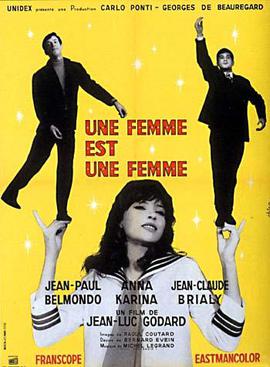
GODARD: Un Femme est une femme (1961)


Having improvised a feature debut with unprecedented artistic freedom and making a hit of it, and having made a follow-up which nearly ruined his filmmaking career in France, Godard moved straight on to Une Femme est une femme (released here as A Woman is a Woman), which may be seen as an uneasy synthesis of his previous two films as well as marking a further innovation in Godard’s cinema.

Une Femme est une femme was sold as an extravagant musical comedy in the Lubitsch mode, but it was a film that arguably challenged its audience much more than À bout de soufflé and Le Petit Soldat. Angela (Anna Karina) works in a strip club and is married to Emile (Jean-Claude Brialy). She decides that she wants a baby, but Emile is not interested, and insists that they get married first. In the ensuing argument, Angela announced that she will find someone else to give her a baby if her husband won’t. This declaration threatens to ruin their marriage, which is further complicated by the appearance of Emile’s best friend, Alfred (Jean-Paul Belmondo), who is more than happy to help Angela out.

A synopsis of the film may sound like the plot of a risqué musical comedy – indeed something that Lubitsch, named during the opening credits, might have made. However, Godard’s intentions seem to be more serious than that, even if the loud Hollywood musical score suggests different. The film begins with a challenging confusion of sound. Angela walks into a café, goes to the jukebox and puts on a record. As she leaves, she winks slyly at the camera. However, when she steps out of the café and onto the busy street, there is near total silence – no score and not even the sound of traffic and pedestrians, only the sound of Angela’s footsteps. The next shot has direct sound – engines, horns, shouting. We cut to a high angle shot and there is silence again and then the shrill opening bars of a sentimental score. These sudden juxtapositions in sound are jarring, bewildering, even irritating, and they will continue throughout the film, but they can be seen to serve a purpose.

Angela states early in the film that she wants to be in a musical – to move from talk and drama suddenly into an exuberant musical number and vice versa – and the film does play as a film that wants to be a musical, but has real life to contend with. The soundtrack then may represent a battle between the drudgery of the real and the emotions of the Hollywood film. Indeed, the first instance, when Angela leaves the music of the café for the silence of the street, feels foreboding and sad – something is lost. However, after this shot and the following shot with raw city sounds, we return to hope (and possibly inside the character’s mind) – the sound elevating the raw footage to something magical. These shots, right at the front of the film, makes it clear that the film is about the opposition between fiction and reality, music and silence, our dreams and our lives.

The seediness of real life and the innocence of the musical is brought out further inside the strip club. When Angela performs, Godard separates her singing from the other noises in the scene. We hear her sing in close-up, her voice as if in a vacuum, sounding young and vulnerable (despite even the sleazy lyrics). Between verses, Godard cuts in Angela’s point of view – seedy characters and the dingy club floor – and removes the sound, creating a distancing effect that further emphasises Angela’s vulnerability and the disparity between her honest performance and the shady setting. Then, of course, the music suddenly kicks in and it blares her out. When she sings again, the background noise again disappears. Godard was to perfect this disassociated POV shot (where we see a disparity between what the character feels and what they and others see) in much more powerful effect in his next film, but it is nonetheless a powerful moment here.

Much of the rest of the film has a looser, sillier tone than these two sadder, darker early moments. While the film is never entirely comic, it is of a lighter tone and one will eventually get the impression that Godard achieved what he was trying to do much more effectively in miniature (the two scenes discussed above) than in the rest of Une Femme est une femme. The film does revel in Karina’s performance, which got her a prize in the Berlin Film Festival, in a way that recalls Bruno trying to capture a beautiful and real image of Veronica through artifice in Le Petit Soldat. The film ends happily, with Angela and Emile reconciled, though it is hard to be convinced, knowing that Hollywood levity rarely wins out when faced with a much darker reality.

Une Femme est une femme was a box office failure, and much of the blame can be placed on Godard’s tinkering with the sound design. While it does offer several fantastic moments, it is overall a challenging and slightly confounding film. It would mark the first time Godard would film a marriage (the long sequence in Angela and Emile’s apartment detailing the ups and downs of a disagreement would be repeated in Le Mepris and La Femme mariée) and it is also possible to read an autobiographical exploration of Godard’s relationship with Karina in this film, given that Emile acts like an intellectual to Karina’s performer. As it is though, it is a slightly dated musical-without-the-musical-numbers but one that is certainly not without interest.


After Godard made Une Femme est une femme, he found himself without an idea, a situation that would be repeated several times in his career. However, what he came up with next would end up being another one of his best films – Vivre sa vie.


Monday, 19 October 2015

GODARD: Le Petit Soldat (1960)


If À bout de soufflé is the work of a young filmmaker, then Le Petit Soldat is as well. In many ways a surprising choice after À bout de soufflé, Le Petit Soldat is a dark and pessimistic film about the ongoing Algerian War of Independence, which ran from 1954 to 1962. The film was made in 1960 - it was banned for three years and ultimately released as Godard’s fourth film – and it can be considered his first political film and a bold attempt to address the crimes of his own country.

Bruno Forestier (Michel Subor) is a twenty-six year old secret agent working for a French paramilitary organisation in Geneva during the Algerian War of Independence. He does not seem to have many serious political convictions and seems to have wandered into his role. When he is ordered to kill Professor Palivoda, whose only crime it seems is to have not chosen a side, he refuses. Either from apathy or from the distraction of falling in love with Veronica (Anna Karina), he is unable to get away in time.

With Le Petit Soldat, Godard addresses politics for the first time, but instead of identifying himself with one side or another as he would later on, here he identifies himself with Bruno, a member of the French secret service who nonetheless has sympathies for the other side and talks about uniting Right and Left. He is horrified by the violence done on both sides, as is Godard. He opens the film in the aftermath of a French terrorist atrocity and will show both sides committing torture. Godard’s awareness that the French were guilty of violence and terrorism is the main reason the film was banned and is a brave and provocative statement for a young filmmaker to make against his own country in wartime.

However, Godard also suffers from Bruno’s confusion and apathy. Admitting that both sides have done evil, Bruno is left with nowhere to go and no one to help. The film has a pervasive sense of a murky world full of secret agents and double agents. Godard heightens this with many of the techniques from À bout de soufflé, using some disorientating jump cuts and a discordant score to increase the sense of Bruno’s, and the viewer’s, confusion – both political and moral. In one early scene on a train, Bruno listens in on a man telling a friend a long-winded joke. Godard cuts seemingly key sections of the joke, leaving the rest as mere gibberish. The two men are laughing away, but it means nothing to us and it leaves an odd alienating and eerie impression, furthered by the sound design throughout which isolates separate sounds and favours voices disembodied and layered over silence. The plotting, though fairly simple, is kept fairly discreet. Throughout the film, we are never quite sure what is happening and what is about to happen, Godard having achieved a wonderful (dis)harmony between form and content.

This film contains one of Godard’s most famous aphorisms – ‘Photography is truth, and cinema is truth 24 times per second’ – though it feels like a statement that has been taken wildly out of context, given the confusing and undecided nature of the rest of the film. Add also the fact that Bruno says this whilst trying to distract Veronica enough to contrive an ‘authentic’ photo of her. Rather than affirming cinema, Godard may instead be trying to interrogate truth. Bruno’s final monologue towards the end of the film is one of the key moments of the film, given that here we see the end result of Bruno’s involvement in this dark world. This diatribe, which moves from a refutation of nationalism to talk of having no convictions to the pointlessness of revolution to the inability to know oneself. After denying anyone’s ability to know what he is thinking, Bruno turns to the camera and tells us what exactly he is thinking, but even he cannot hold onto his thoughts for very long. He has been emptied. His dalliance with this dirty war (compared negatively to the seemingly more virtuous Spanish Civil War – a can of worms there) has left him with nothing, only total apathy and existential confusion. The scene ends with the image of people looking for truth (that word again) by sifting through words, eventually being left with only one – silence.

So key to the film’s sound design, this silence is also what prolongs Bruno’s torture at the hands of the FLN. Captured by the Algerians, they torture Bruno for information and he keeps quiet, without thoroughly understanding why. This torture sequence is the most famous sequence in the film and it is unremittingly bleak and disturbing. Moving from burning to near-drowning to waterboarding to electric shock, it is long, uncomfortable, drawn-out. Godard here had in mind Hannah Arendt’s famous phrase, the ‘banality of evil’ and so this sequence is fairly subdued, near-silent apart from Bruno’s voiceover, almost dull. It is horrible to watch and there is a strong sense that the torture is degrading for both of Bruno and his torturers.

There is one thing that cuts through all of this pessimism and that is love – although, as we have seen already with À bout de soufflé, love is not enough against the pressures of this world. Bruno falls in love with Veronica, despite their political differences and there is a real feeling of optimism in their plans to escape everything and go to Brazil (though even their love is expressed through indirection – Bruno asks her to tell him lies and Veronica replies that she does not love him). However, this love ends up being used by the French as a means to get Bruno to finally kill Palivoda. Here, at the end of the film, Godard may well be at his most pessimistic. Bruno shoots Palivoda in front of a street full of witnesses and runs away. While he flees, we learn in voiceover that Veronica has already been tortured to death and that Bruno is shortly to learn of this. Bruno is left with nothing and will not be able to do anything about it – whether from the range of forces pitted against him or because of his own apathy is left unknown. All he has left to do is learn to not be bitter about it. With these closing lines and a shot of a hunted Bruno disappearing around a corner, the film ends – this sudden, shocking, intentionally dissatisfying ending leaving us with Bruno’s sense of anger and loss. 


Le Petit Soldat is amongst Godard’s best films because it is a challenging, committed, bold and angry work from a young filmmaker who was still finding his voice in cinema and in politics. Ultimately giving way to pessimism and apathy, Godard’s critique may not have the sophistication of hindsight, given that it was made during the Algerian War of Independence, or of his later work but it is nonetheless a brave work. With only his second film, Godard had proven that he would not be a filmmaker who would try endlessly to repeat an earlier success nor one who would remain differential to his country in the face of their crimes at home and abroad, but one who would make films after his own interests and would continue to innovate. Godard would not follow the caprices of the audience, he would ask that the audience follow him. And, next, Godard felt like making a musical comedy.