Showing posts with label france. Show all posts

Sunday, 6 March 2016

GODARD: Les carabiniers (1963)


Godard has always been a filmmaker who pays as much attention to the politics behind his work as the images in his work. Les carabiniers (The Riflemen), his fifth film, displays this dualism at work, criticizing the act of war and the politics of nationalism and imperialism while at the same time interrogating the aesthetics of the war and anti-war film.

The story of Les carabiniers is fable-like in its simplicity. Ulysses and Michelangelo are two peasants living on a wasteland with a mother and daughter, Cleopatra and Venus. Two riflemen come to their shack and convince Ulysses and Michelangelo to join the army and fight for the King, seducing them with all the riches in the world. They go to war, sending letters home to Cleopatra and Venus. However, when they finally get home, they find that their rewards are not quite how they imagined them.

Les carabiniers did not do well on release, and it isn’t hard to imagine why. It is gritty, nasty, plotless, ugly, the characters are vulgar stereotypes, the events are shocking, the soundtrack is a constant barrage of explosions and gunfire. It is an angry, abrasive little film, but it chooses its targets with intelligence and its critique and the way this critique is made are fascinating.

Ulysses and Michelangelo are promised everything, from money to the monuments of the world to any sadistic little wish they may want to carry out. The criticism is obvious – any horror is permissible in war – but it also alludes to colonialism in its acknowledgement of the gleeful seizure of lands and property regardless of the human toll it may take and to nationalism in the blindness with which Ulysses and Michelangelo gets suckered into signing up for the war. Given these characters’ grotty and aimless existences at the beginning of the film, it is clear that king and country have not done anything for them so far, and is unlikely to do anything in the future. Indeed, the extended punchline of all of this is that the two soldiers return home only with photos of their promised rewards – pointing towards the illusionary nature of all nationalism and, by extension, colonial gains. By the end of the film, the country has erupted into what seems like several distinct civil wars between the republicans, the democrats, the communists, the anarchists, the state and the army. The film ends on a disused, ugly bus shelter in which Ulysses and Michelangelo are shepherded and gunned down.

The film’s critique of war suggests that the men and women who fight are not those who receive the rewards and the acclaim and that it is not in their interests to fight their king’s wars. But the film also holds a critique of the aesthetics of the war film. The film is fractured, loud, uncomfortable viewing and the war scenes are intentionally choppy and confused. Godard opts for short scenes of sadistic war crimes rather than some grand narrative of war. Godard’s point is that war films, like action films, entertain an audience when they should be horrifying them. Compare the battle scenes in Les carabiniers to the same in Saving Private Ryan, in which the violence is certainly horrible but the film does allow the war to have a heroic and redemptive quality. War films tend to validate war even as they criticize it. Les carabiniers then, because it denies the audience a fluid narrative line with which to understand and digest the war on screen (even down to the simple cutting between weapon fired and damaged caused), can be said to be a truly anti-war film.

It even goes so far as to suggest, in the scene inside the cinema in which Michelangelo is fooled by the projection while everyone around him silently imbibes whatever the screen throws at them, the brainwashing nature of cinema and the need to engage intellectually with what is being shown. As such, Les carabiniers is a distancing and confrontational film, a bombardment of ugliness and noise, but all to an extremely moral purpose. There is nothing enjoyable or aesthetically pleasing about this war, nothing cathartic, nothing whatsoever to validate the horrors onscreen – because this film is truly a pacifist one.

With Les carabiniers, Godard unites form and message to create one sustained and powerful critique, which will make one rethink one’s opinions about wars past, present and future as well as rewatch war films looking for the signs that they are as much pro- as anti-war. It is one of Godard’s most difficult sixties films and one of the hardest to like, but it is one of real intellectual rigour - with this film, Godard could not be dismissed as just a stylist. Despite being one of Godard’s least financially successful films, it is one of his most important early films.

Up next was Le Mepris

See other Godard reviews


Monday, 21 December 2015

REVIEW: Macbeth (2015)


‘Macbeth’, the play, is difficult to get right. It isn’t that it’s a bad story – the warning about ‘vaulting ambition’ is, of course, still relevant, the trickery of the witches feels cruel and modern in its existentialism, the endless cycle of suspicion, jealousy and murder. But the play is not flawless. In place of character development, the play favours soliloquys about the tasks to be done – Macbeth too quickly turns to murder where most of us would not. The best film versions of the play are distanced. Orson Welles’ adaptation is Brechtian in how obviously stagey it is, while Kurosawa’s Throne of Blood is heightened beyond all recognition. Justin Kurzel’s new version strikes a balance between modern re-reading and overblown supernatural spectacle and doesn’t come off at all.

Michael Fassbender is a grieving Macbeth, who has just lost his only child (thus robbing the brutal, vengeful ambiguity of Macduff’s line “He has no children” in Act 4, Scene 3). He and his wife, Lady Macbeth (Marion Cotillard) then fall on the plan to assassinate King Duncan (a clueless David Thewlis) and set themselves up as king and queen, taking the idea from some deeply suspicious witches. Once crowned, however, the couple descend into bitterness and madness.

There isn’t much that really works with this new Macbeth. Fassbender plays the character mostly as a raving sociopath – the line ‘full of scorpions is my mind’ has never before sounded so sinister – but it doesn’t hold the film together, getting instead repetitive. We understand that the witches’ prophecy gives hope to a man who has lost an heir, but it isn’t convincing – especially when we see Macbeth putting Macduff’s family, including some youngsters, to the stake. Cotillard has one good scene, where she performs the ‘out damned spot’ soliloquy more as an act of sheer despair than of anything else. This works, but the film doesn’t have the material to make a believable transition from her earlier talk of smashing a baby off a wall (how this line works with a grieving parent is anyone’s guess) to this depression. Equally, Malcolm (Jack Reynor) and Macduff (Sean Harris) are left with little to do.

The battle scenes are admirably grotty and unheroic, but there is a feeling of dullness about them. They resemble too many other films (Braveheart, Gladiator, The Lord of the Rings and Game of Thrones and on and on) and they are not peopled with enough characters that we care about. The orange-tinting of some sequences and the sudden slo-mo don’t help, giving more a feeling of stylistic desperation.

Finally, the film emphasises the play’s secondary subtext about violence begetting violence (a cheap theme that has been used to praise such tawdry films as The Last House on the Left) over the warning about ambition, but it doesn’t do much with it beyond suggesting that all this violence and murder is a bit extreme and offering a silly ending with Fleance. This new adaptation then offers little that we haven’t seen before and many of its chief innovations don’t really work. Fassbender and Cotillard do fine work, but it is hard to credit them, given that they are playing characters that fundamentally do not make sense. By the end of the film, the characters are exhausted and fed up and it is not hard to feel their pain.


Tuesday, 1 December 2015

REVIEW: Enemy (2015)


Enemy is a film that is not bothered about the ‘anxiety of influence.’ Director Villeneuve and writer Gullón display such a fondness for other films that it is difficult not to feel it rubbing off. Before the film is even ten minutes in, we are solidly in the world of both Cronenberg and Lynch. The rest of the film is a puzzle that is left for you to decipher at your own leisure.

Adam is a history lecturer, who teaches about the controls of dictatorship and yet lives a fairly bare existence himself, rotating between teaching, commuting and having joyless sex with his girlfriend Mary (Mélanie Laurent). Having rented and watched a film that a colleague has recommended, Adam suddenly jerks awake, convinced that he has seen his double in a bit part actor in the film. He becomes obsessed with finding this person, a search which sparks, to say the least, an identity crisis.

Enemy feels like a film from that brief period of time after Donnie Darko that saw a surfeit in similar puzzle films, from The Machinist to Primer. Largely eschewing traditional plotting and characterisation in favour of plotting, some of these films were maddening and some were quite good fun – Primer was particularly enjoyable. Enemy is instead all about the mood. It is a grim, greens-and-yellows detective story that withholds enough to make a puzzle out of itself without ever distracting from its overall vaguely Hitchcockian tone. There are several interpretations about what the whole thing is about (and a good few of them sound rather silly), but the real value of the film is that it gets an edgy, searching, eerie feel without ever having to sacrifice it to some series of revelations and a villain to be beaten. It is a film about asking questions, not one about finding answers, and it is all the more interesting for that. It is told with an invention and élan, which keeps you interested, even if the film’s examinations of identity, uniqueness and fidelity appear to boil down to an episode of Wife Swap.

Jake Gyllenhaal gives a great performance, playing two characters with slight differences. Most of the eeriness of the film comes from the fact that Adam and Anthony are so similar in small ways, as opposed to total opposites who usually encounter each other in films of this sort. Gyllenhaal then is tasked with playing two different characters who have to be both different and the same. He pulls it off well. Mélanie Laurent and Sarah Gadon have less to do (these kinds of films all too often favour men), but turn in convincing performances as women watching the men (or man) in their live falling apart.


In summary, good, unsettling fun – up until the ending, which is, unfortunately, a touch too smugly odd. This complexity, more stylistic than anything, will be disappointingly missing from Villeneuve’s other 2015 release, Sicario.


Sunday, 29 November 2015

REVIEW: Girlhood (2015)


Girlhood is a French film about a group of friends who get up to no good and in the end become women, so there isn’t really anything particularly new about it as far as that goes. Where it is different is in the fact that these girls are black and from the rougher part of Paris. Girlhood then is a film about growing up but it is not the kind of film that fits into the white middle class fantasy that most films prefer to stay in. But here there lies a slight problem with the film.

First, perfunctorily, the plot synopsis. Marieme (Karidja Touré) is a 16 year old African-French woman living in an economically deprived suburb of Paris. Her mother works nights and is rarely around and her abusive brother makes the rules at home. Falling out of school, she falls in with a gang lead by Lady (Assa Sylla), and becomes a member of the gang. These friendships help Marieme become more self-confident but does not necessarily lead to happiness.

Girlhood is anchored by some fantastic and realistic performances, which often feel more real than the situations themselves. They give angry and committed performances that heighten most of the sillier scenes and which carry off both the emotional and the physical moments. There are a couple of fight scenes that are has convincing as anything similar in any more masculine film.

Girlhood offers many things probably not seen before. Films of the urban poor are often exclusively male so the film does feel unique for its female focus. It begins with an interesting sequence, in which a group of girls playing American football, Marieme included, with all the strength and grit that that would take. We then cut to the same group, shed of the bulky sports gear, walking home. As they split up into ever smaller groups and walk in amongst crowds of males, they become quieter and quieter, their heads kept lower and lower. It is a powerful sequence, in that it shows the subtle ways that paternalism has remained in society. Nothing in particular happens to anyone, but it is telling that the scene is nonetheless tense.

For all the things that are praiseworthy about Girlhood – its performances, its insight into a side of our society that hasn’t been seen in such detail before, its mostly fluid plotting – there are some things had don’t ring quite so true. The film is directed by Céline Sciamma, a white middle class woman, and, for all her very obvious skill, panache and understanding, there is an element of distance about her camera. Some critics have gone as far as saying that she is fetishizing her characters and, indeed, her performers. I wouldn’t go as far as that, but there is a distance that is maintained throughout. More problematic for me, however, is the film’s insistence on casting the film in a near fairy tale light. Girlhood is realistic and grim, but Sciamma seems to wants us to consider the film more as a work of symbolism. So we do get an insight into Marieme’s life and the cultural and socio-economic reasons for her indifference and dissatisfaction with the world outside her friends, but they are very shallow. Her teacher, castigating her off screen in one scene, is written off practically as a villain. The film’s refusal to judge does not stretch beyond the four members of Lady’s gang, which feels only like a denial of reality. More irritatingly, Sciamma prefers to see Marieme’s very real decline as some kind of positive, self-actualizing, even feminist experience. After every new low (her decision to start carrying a knife, her bullying, her petty crime, her abandonment of her home including her sister), the film cuts to a blank screen for a long stretch, scored with near triumphant, hopeful, transcendent music. By the end, Marieme has lost everything and Sciamma prefers to see this as character building, rather than what it is and what it would be in real life. By the end, Sciamma’s film seems to celebrate Marieme’s tough life for its fairy tale and feminist associations, in the process denying its very real difficulties. It seems, then, that it is not Marieme’s blackness that Sciamma is fetishizing, but her poverty.

There are a lot of films about the urban poor and the difficulties of their existence due to a range of factors from uncaring bureaucracy to unemployment to drugs to crime. Girlhood is worthy of celebration of approaching the subject from an angle too long ignored. It has a fantastic cast of young and honest actors. But what Girlhood depicts is real, not symbolic, and it is hard not to feel that a disservice has been done.


Monday, 9 November 2015

GODARD: Vivre sa vie (1962)


Vivre sa vie is split novelistically into twelve distinct parts, each detailing Nana’s (Anna Karina) descent into prostitution through economic necessity and what happens after. No other Godard film, to my knowledge, is as committed to realism as this one is, both social and emotional and in terms of form. In some ways then, it can be considered the truest of Godard’s films and the saddest.

Nana is a young woman who harbours ambitions to be an actress. These dreams have not come into being and Nana, dissatisfied, leaves her husband Paul (Andre S. Labarthe) and tries to make it on her own. She has no cash and no one she knows can lend her any money – she has to cadge a cinema ticket of Paul and her landlady locks her out of her apartment. Following an unsuccessful attempt at petty crime, Nana is forced to take up prostitution.

Karina gives her best performance for Godard here, playing a woman who is still young but who knows even at this early stage that she has failed to do what she wants to do with her life. Karina brings out this frustration and disappointment and, after she becomes a prostitute, self-loathing brilliantly. In one scene, Nana rambles about her newfound economic independence and her responsibility for herself, pretending that she is happy, only for her face to suddenly dissolve into silent, choking unhappiness in the instant that she runs out of words. Then she silently watches a couple across the café. These two moments together are amongst the most moving that Godard ever achieved. We do not know what Nana is thinking when she looks at this couple – it could be that she is thinking of her own loneliness, it could be that, since the man seems to be a little cold, that she is thinking about her comfort depends on such taciturn men, showing her feelings of independence as a delusion. What is significant in this moment is that Godard holds back on the tricks and delivers a ‘straight’ moment of performance and drama.

Other parts of the film are more experimental, but the experimentation is muted here in favour of a depiction of the state of prostitution in France and the lot for the women who do it. One part of the film belongs squarely to documentary – Anna questions her pimp Raoul (Sady Rebbot) about the laws and practices of prostitution and he replies coldly and scientifically about how the job works and the laws that need to be followed. It is a dehumanising sequence, displaying how stark the options are for those who do this job. Godard frequently films Karina in close-up in profile and in low light, detailing stages of her descent in her face. This culminates in a scene towards the end of the film in which Godard reads in voiceover Poe’s ‘The Oval Portrait’ to Nana, a story and the theme of the film about a man who is an artist and the woman he loves. A brief insight into their marriage (on the rocks at this point) and an examination of how the films have got in the way of their love. It is also another example of a woman subjugated by a man. The film concludes then with a stark and sudden, powerfully undramatic sequence detailing Nana’s betrayal by Raoul and her death at the hands of two uncaring men. The film ends with her body on the street, the camera suddenly tilting down, giving Nana an ascension that nevertheless must remain ruthlessly in the gutter.

The battle between Nana’s emotions and the reality of her existence plays out underneath the main current of the film. We see Nana’s trying to overcome her self-disgust – just as we see attempts to live as if nothing is wrong despite the embarrassment of asking friends for money and trying to hide from her landlady. Her moments of happiness are rare and usually tainted. She dances alone to some music in a pool hall and despite her loneliness and the fact that the three men ignore her. We watch her dance, not caring if it’s sad, happy despite everything – and then Godard cuts to her POV – we see now the bare, ugly room, the unpleasantness of her journey and the faces of the men who ignore her. Like the singing scene in Une Femme est une femme, Godard shows the disconnect between how the character feels and where the character is, though here we are left more with the impression of denial rather than irrepressible joy. In another moment, we see her happy with a young man, a man she incidentally picks up at the pool hall. She talks of ending her life as a prostitute and returning to normality and yet we know she won’t be happy. The young man refuses to leave the apartment and prefers to read ‘The Oval Portrait’ to her from a book he has just happened to find. The only time Nana is happy without consequence is, intriguingly, when she goes to the cinema to see Dreyer’s The Passion of Joan of Arc and experiences a transcendent moment of (self-)recognition.


Vivre sa vie was an experimental film – its direct sound, long takes and lateral, arbitrary but direct camerawork were rarely seen – but here the technique and the form of the film work towards and heighten the film’s tragedy, rather than commenting ironically on it. Vivre sa vie is one of Godard’s most moving and soberest films, one in which it seems that Godard’s primary focus was on his wife’s performance and the plight of the prostitute. It would be foolish to read the film as feminist necessarily, but it does recognise the difficulties of an economically deprived woman who wants to be independent in a man’s world. In one moment, Nana is paid by a client who then wants another woman. Nana gets the woman for him and when she asks what she is to do, she is told to do nothing and just remain seated. Nana sits, immobilised, in low lighting and in profile and when the film’s theme plays, it is a quietly heart-breaking image of a woman in invisible chains.


Sunday, 1 November 2015

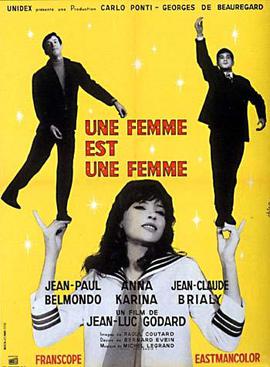
GODARD: Un Femme est une femme (1961)


Having improvised a feature debut with unprecedented artistic freedom and making a hit of it, and having made a follow-up which nearly ruined his filmmaking career in France, Godard moved straight on to Une Femme est une femme (released here as A Woman is a Woman), which may be seen as an uneasy synthesis of his previous two films as well as marking a further innovation in Godard’s cinema.

Une Femme est une femme was sold as an extravagant musical comedy in the Lubitsch mode, but it was a film that arguably challenged its audience much more than À bout de soufflé and Le Petit Soldat. Angela (Anna Karina) works in a strip club and is married to Emile (Jean-Claude Brialy). She decides that she wants a baby, but Emile is not interested, and insists that they get married first. In the ensuing argument, Angela announced that she will find someone else to give her a baby if her husband won’t. This declaration threatens to ruin their marriage, which is further complicated by the appearance of Emile’s best friend, Alfred (Jean-Paul Belmondo), who is more than happy to help Angela out.

A synopsis of the film may sound like the plot of a risqué musical comedy – indeed something that Lubitsch, named during the opening credits, might have made. However, Godard’s intentions seem to be more serious than that, even if the loud Hollywood musical score suggests different. The film begins with a challenging confusion of sound. Angela walks into a café, goes to the jukebox and puts on a record. As she leaves, she winks slyly at the camera. However, when she steps out of the café and onto the busy street, there is near total silence – no score and not even the sound of traffic and pedestrians, only the sound of Angela’s footsteps. The next shot has direct sound – engines, horns, shouting. We cut to a high angle shot and there is silence again and then the shrill opening bars of a sentimental score. These sudden juxtapositions in sound are jarring, bewildering, even irritating, and they will continue throughout the film, but they can be seen to serve a purpose.

Angela states early in the film that she wants to be in a musical – to move from talk and drama suddenly into an exuberant musical number and vice versa – and the film does play as a film that wants to be a musical, but has real life to contend with. The soundtrack then may represent a battle between the drudgery of the real and the emotions of the Hollywood film. Indeed, the first instance, when Angela leaves the music of the café for the silence of the street, feels foreboding and sad – something is lost. However, after this shot and the following shot with raw city sounds, we return to hope (and possibly inside the character’s mind) – the sound elevating the raw footage to something magical. These shots, right at the front of the film, makes it clear that the film is about the opposition between fiction and reality, music and silence, our dreams and our lives.

The seediness of real life and the innocence of the musical is brought out further inside the strip club. When Angela performs, Godard separates her singing from the other noises in the scene. We hear her sing in close-up, her voice as if in a vacuum, sounding young and vulnerable (despite even the sleazy lyrics). Between verses, Godard cuts in Angela’s point of view – seedy characters and the dingy club floor – and removes the sound, creating a distancing effect that further emphasises Angela’s vulnerability and the disparity between her honest performance and the shady setting. Then, of course, the music suddenly kicks in and it blares her out. When she sings again, the background noise again disappears. Godard was to perfect this disassociated POV shot (where we see a disparity between what the character feels and what they and others see) in much more powerful effect in his next film, but it is nonetheless a powerful moment here.

Much of the rest of the film has a looser, sillier tone than these two sadder, darker early moments. While the film is never entirely comic, it is of a lighter tone and one will eventually get the impression that Godard achieved what he was trying to do much more effectively in miniature (the two scenes discussed above) than in the rest of Une Femme est une femme. The film does revel in Karina’s performance, which got her a prize in the Berlin Film Festival, in a way that recalls Bruno trying to capture a beautiful and real image of Veronica through artifice in Le Petit Soldat. The film ends happily, with Angela and Emile reconciled, though it is hard to be convinced, knowing that Hollywood levity rarely wins out when faced with a much darker reality.

Une Femme est une femme was a box office failure, and much of the blame can be placed on Godard’s tinkering with the sound design. While it does offer several fantastic moments, it is overall a challenging and slightly confounding film. It would mark the first time Godard would film a marriage (the long sequence in Angela and Emile’s apartment detailing the ups and downs of a disagreement would be repeated in Le Mepris and La Femme mariée) and it is also possible to read an autobiographical exploration of Godard’s relationship with Karina in this film, given that Emile acts like an intellectual to Karina’s performer. As it is though, it is a slightly dated musical-without-the-musical-numbers but one that is certainly not without interest.


After Godard made Une Femme est une femme, he found himself without an idea, a situation that would be repeated several times in his career. However, what he came up with next would end up being another one of his best films – Vivre sa vie.


Monday, 19 October 2015

GODARD: Le Petit Soldat (1960)


If À bout de soufflé is the work of a young filmmaker, then Le Petit Soldat is as well. In many ways a surprising choice after À bout de soufflé, Le Petit Soldat is a dark and pessimistic film about the ongoing Algerian War of Independence, which ran from 1954 to 1962. The film was made in 1960 - it was banned for three years and ultimately released as Godard’s fourth film – and it can be considered his first political film and a bold attempt to address the crimes of his own country.

Bruno Forestier (Michel Subor) is a twenty-six year old secret agent working for a French paramilitary organisation in Geneva during the Algerian War of Independence. He does not seem to have many serious political convictions and seems to have wandered into his role. When he is ordered to kill Professor Palivoda, whose only crime it seems is to have not chosen a side, he refuses. Either from apathy or from the distraction of falling in love with Veronica (Anna Karina), he is unable to get away in time.

With Le Petit Soldat, Godard addresses politics for the first time, but instead of identifying himself with one side or another as he would later on, here he identifies himself with Bruno, a member of the French secret service who nonetheless has sympathies for the other side and talks about uniting Right and Left. He is horrified by the violence done on both sides, as is Godard. He opens the film in the aftermath of a French terrorist atrocity and will show both sides committing torture. Godard’s awareness that the French were guilty of violence and terrorism is the main reason the film was banned and is a brave and provocative statement for a young filmmaker to make against his own country in wartime.

However, Godard also suffers from Bruno’s confusion and apathy. Admitting that both sides have done evil, Bruno is left with nowhere to go and no one to help. The film has a pervasive sense of a murky world full of secret agents and double agents. Godard heightens this with many of the techniques from À bout de soufflé, using some disorientating jump cuts and a discordant score to increase the sense of Bruno’s, and the viewer’s, confusion – both political and moral. In one early scene on a train, Bruno listens in on a man telling a friend a long-winded joke. Godard cuts seemingly key sections of the joke, leaving the rest as mere gibberish. The two men are laughing away, but it means nothing to us and it leaves an odd alienating and eerie impression, furthered by the sound design throughout which isolates separate sounds and favours voices disembodied and layered over silence. The plotting, though fairly simple, is kept fairly discreet. Throughout the film, we are never quite sure what is happening and what is about to happen, Godard having achieved a wonderful (dis)harmony between form and content.

This film contains one of Godard’s most famous aphorisms – ‘Photography is truth, and cinema is truth 24 times per second’ – though it feels like a statement that has been taken wildly out of context, given the confusing and undecided nature of the rest of the film. Add also the fact that Bruno says this whilst trying to distract Veronica enough to contrive an ‘authentic’ photo of her. Rather than affirming cinema, Godard may instead be trying to interrogate truth. Bruno’s final monologue towards the end of the film is one of the key moments of the film, given that here we see the end result of Bruno’s involvement in this dark world. This diatribe, which moves from a refutation of nationalism to talk of having no convictions to the pointlessness of revolution to the inability to know oneself. After denying anyone’s ability to know what he is thinking, Bruno turns to the camera and tells us what exactly he is thinking, but even he cannot hold onto his thoughts for very long. He has been emptied. His dalliance with this dirty war (compared negatively to the seemingly more virtuous Spanish Civil War – a can of worms there) has left him with nothing, only total apathy and existential confusion. The scene ends with the image of people looking for truth (that word again) by sifting through words, eventually being left with only one – silence.

So key to the film’s sound design, this silence is also what prolongs Bruno’s torture at the hands of the FLN. Captured by the Algerians, they torture Bruno for information and he keeps quiet, without thoroughly understanding why. This torture sequence is the most famous sequence in the film and it is unremittingly bleak and disturbing. Moving from burning to near-drowning to waterboarding to electric shock, it is long, uncomfortable, drawn-out. Godard here had in mind Hannah Arendt’s famous phrase, the ‘banality of evil’ and so this sequence is fairly subdued, near-silent apart from Bruno’s voiceover, almost dull. It is horrible to watch and there is a strong sense that the torture is degrading for both of Bruno and his torturers.

There is one thing that cuts through all of this pessimism and that is love – although, as we have seen already with À bout de soufflé, love is not enough against the pressures of this world. Bruno falls in love with Veronica, despite their political differences and there is a real feeling of optimism in their plans to escape everything and go to Brazil (though even their love is expressed through indirection – Bruno asks her to tell him lies and Veronica replies that she does not love him). However, this love ends up being used by the French as a means to get Bruno to finally kill Palivoda. Here, at the end of the film, Godard may well be at his most pessimistic. Bruno shoots Palivoda in front of a street full of witnesses and runs away. While he flees, we learn in voiceover that Veronica has already been tortured to death and that Bruno is shortly to learn of this. Bruno is left with nothing and will not be able to do anything about it – whether from the range of forces pitted against him or because of his own apathy is left unknown. All he has left to do is learn to not be bitter about it. With these closing lines and a shot of a hunted Bruno disappearing around a corner, the film ends – this sudden, shocking, intentionally dissatisfying ending leaving us with Bruno’s sense of anger and loss. 


Le Petit Soldat is amongst Godard’s best films because it is a challenging, committed, bold and angry work from a young filmmaker who was still finding his voice in cinema and in politics. Ultimately giving way to pessimism and apathy, Godard’s critique may not have the sophistication of hindsight, given that it was made during the Algerian War of Independence, or of his later work but it is nonetheless a brave work. With only his second film, Godard had proven that he would not be a filmmaker who would try endlessly to repeat an earlier success nor one who would remain differential to his country in the face of their crimes at home and abroad, but one who would make films after his own interests and would continue to innovate. Godard would not follow the caprices of the audience, he would ask that the audience follow him. And, next, Godard felt like making a musical comedy.


Friday, 1 May 2015

SHORT REVIEW: Stray Dogs (2015)


This review appeared on The Upcoming website here.

Stray Dogs is the new film from Tsai Ming-liang and another example of ‘Slow Cinema’ that seems to be taking hold of arthouse cinema the world over. Made up almost entirely of long, meditative fixed camera shots, Stray Dogs will be an endurance test for some.

The film follows an alcoholic man, Lee (Lee Kang-Sheng), and his two children as they eke out a meagre existence in modern day Taiwan. Midway through the film, they are befriended by a lonely woman who works in a supermarket.

The synopsis above is quite bare and with good reason. The film defies simple explanations. The relationships between characters are not made clear and three different actors play the role of the woman who works in the supermarket. Not only that but the film seems to either jump backwards and forwards in time or in and out of Lee’s increasingly unstable head.

The film is then a mix of social realism and something more experimental. There is one devastating sequence in which Lee, holding a large billboard for a nearby estate agent’s, in tight close-up and shivering in the freezing wind so much that he looks in danger of falling out of frame, starts to sing. This sequence is long but powerfully sad and it also achieves an easy balance between realism and experimentalism. However, a large amount of the film does not hang together as well. As the film becomes more and more abstract and dreamlike, it loses sight of its characters’ plight. The near fifteen minute penultimate twoshot comes to feel only like a stunt, the film having long before forgotten its supposed subjects - poverty and human beings.


On one viewing, Stray Dogs is then a somewhat confounding film that powerfully conveys humans in terrible situations only to drop that focus in favour of surrealist and experimental aesthetics. Ultimately, one is most likely to wonder, while watching a man smothering, destroying and then tearfully eating a cabbage dressed up to look like a woman in a ten minute fixed shot, what Tsai Ming-liang was trying to say with this film and whether it had more to do with people or ‘slow’ envelope-pushing.


Wednesday, 15 October 2014

LONDON FILM FESTIVAL: Oxi: An Act of Resistance (2014)


This short review appeared on The Upcoming website here as part of their coverage of the BFI London Film Festival.

Oxi: An Act of Resistance is an essay film by Ken McMullen and it takes a unique and experimental view of the economic turmoil in Greece.

The film strives to draw a parallel between Greece’s economic problems and the tragedies of Sophocles and Aristophanes, suggesting that Greece, and the EU in general, have departed from the values of the past and that this is what has lead in the current crisis. The Greek classics espoused democracy and a politics based on love and understanding rather than a politics of economics and party lines, as shown by the democracy of Pericles, which was, among other things, the original welfare state.

The film is interspersed with quotations from Thucydides, which remain remarkably relevant for a text that is two and a half thousand years old. The film opens with one quotation which claims that human nature, being the way that it is, is always going to repeat itself – indicating, first, the historical precedents for the inequalities of today and, second, suggesting that these classics contain important lessons for today. This point is made succinctly as the camera lingers on some ancient Greek landscapes, suggesting a permanence between the past and the present. Several interviewees argue for the return of the values of these ancient writings, often passionately and with inspiration.

The film is at its best, then, as an extended lesson in classical literature and its relevance today. But where it is less successful is in its attempts to restage scenes from these plays, updating them for a new audience. It becomes an exercise in performance, which looks a lot more artificial and cerebral than the impassioned and moving testimonies of real people. Worse still is the fictional element in which a detective, Inspector Pinon (Dominique Pinon), horrified that anyone would dare ‘steal’ the words of Sophocles and Aristophanes and make them relevant for today, castigates writers and actors. The point is that these classics are not set in stone, but live and breath today, but the way the film attempts to demonstrate this is both pretentious and somewhat contradictory.


The film works best as a dialogue between classic Greek literature and the current problems in the world. The people interviewed call for the return of the principles of the past and the film is a moving and fascinating testament to what we have lost. But it often uses too much artifice to tell a plain and simple truth.


Friday, 12 September 2014

SHORT REVIEW: Attila Marcel (2014)


This short review appeared on The Upcoming website here.

Attila Marcel feels like it should be a cartoon, which comes as no surprise since this is Sylvain Chomet’s first live-action feature. Best known for The Triplets of Belleville and The Illusionist, Chomet’s style is one of freewheeling invention and madness barely contained within a slim storyline.

Beginning with a quote from Marcel Proust’s “The Captive”, himself hardly a plot-driven writer, about the dual ability of our memories to delight and poison, the film follows Paul (Guillaume Gouix), a mute pianist, as he tries to reclaim a clear picture of a traumatic past. With the help of Madame Proust (Anne Le Ny) and her seemingly drugged-up madeleines, Paul reignites his childhood memories of his deceased parents, mother Anita (Fanny Touron) and his sinister father Attila Marcel (also played by Guillaume Gouix).

The film has many cinematic forbears, from Tati to Jean-Pierre Jeunet, and it is full of nice little observations and comic moments. A piano-tuning blind man (Luis Rego) stops to mend a staircase railing that doesn’t make the same noise as the others when he strikes it with his cane and some raindrops inadvertently play some sweet music on a ukulele. Paul’s journeys into his own memories are Chomet’s chief interest, shot in vibrant colours and seen entirely from a baby’s perspective and populated with seaside musical numbers and huge dancing frogs.

Back in the real world, the film is tellingly slight, with a number of minor characters (including a doctor whose true ambition is to be a taxidermist) and incidents that never quite add up to anything. The true story of the film is Paul’s emotional journey through his memories via a drug-fuelled fever dream, which means that whenever he is not under the effect of the madeleines, the film has nothing to do. It speedily tries to add interest through pathos by offering more insight into Madame Proust’s life and health, but it is clearly just killing time until Paul can take another madeleine. Though Paul’s story is ultimately emotionally satisfying at the end of the film, one may be left wondering what happened in the middle.


Though slight, the film is likeable and often surprising. Chomet has an eye for an interesting or odd image and the film does feel pleasantly homemade. It is just a pity that its best moments – the moment with the rain playing the ukulele in particular – feel like non-sequiturs.


Wednesday, 6 August 2014

SHORT REVIEW: Smart Ass (2014)

fid14195

This review appeared on The Upcoming website here.

Smart Ass is a French comedy-drama about a group of students who start a school prostitution ring. It sounds unpleasant and the film is not smart or funny or likable enough to get away with it.

Two outsiders in an elitist school of business, Dan and Kelly (Thomas Blumenthal and Alice Isaaz) decide to adapt business models and economic theories to the art of social climbing. Their idea is simple: pay an attractive woman to go out with you, and immediately your market appeal goes up and you become popular amongst the school’s elite. Their prostitution ring is initially successful, though through the influence of posh boy Louis (Jean-Baptiste Lafarge), their idea becomes too big for the three of them to handle.

The idea is, of course, unpleasant, deeply so, but it is unclear whether or not the film itself knows it. This prostitution ring as business model idea is introduced fairly quickly into the storyline and none of the characters seem to be particularly bothered by it. Equally the women that Kelly approaches all dumbly go along with the idea even though it is very clearly just prostitution and the benefits for them are totally unclear. No one seems to think that the idea is sexist and reprehensible, which leads one to wonder if writer-director Kim Chapiron does either.

Of course, only women become prostitutes and only men become customers – women have beauty on their side, while men have brains and money, as Louis explains to no one’s distaste. The whole thing could be a satire about how cold and inhuman market forces are (the idea of students applying economic theory to their everyday lives is not a bad idea in itself – Alain Resnais applied behaviourist theory to everyday lives to brilliant effect in My American Uncle), but you have to see past a lot of leering camerawork and nude but undeveloped female characters to think that.

There is an interesting idea somewhere in the film, but the script is badly thought out, wholly unbelievable and misogynistic. The actors are fine but no one could breathe life into such utterly unlikeable characters so badly written. The film has been billed as a comedy, but that, like the title change – the original French title La crème de la crème is much more fitting – sounds like desperation.


Friday, 18 July 2014

REVIEW: Camille Claudel 1915 (2014)

Camille-Claudel-1915

Bruno Dumont is an auteur in a rather extreme sense of the word. While his films are imbued with a developing style that is all his own and with consistent themes, unfamiliarity with his early work may make it harder to fully appreciate his later work. Having seen only last year’s Hors Satan (apparently the endpoint of what was then his stylistic concerns) before seeing Camille Claudel 1915, it is hard not to imagine that one is missing something which will only make sense when one has seen how this filmmaker’s ideas have developed from his debut – La vie de Jésus ­– onwards. One consistent thing between the two I have seen, however, is the Pasolini-like concern with how religion and reality coincide.

Camille Claudel 1915 is a very specific title for a rather specific film. The film largely follows a typical section in the life of sculptress Camille Claudel (Juliette Binoche), who has been placed in Montdevergues Asylum. In her second year at the asylum, Claudel is clearly unhappy, suspicious of the motives of the nuns who care for her and feeling abandoned and imprisoned. Her existence is severely limited and depressing. Her one hope is her brother Paul (Jean-Luc Vincent) who is coming to visit her shortly.

The film is very minimalist – even more so than Hors Satan – focussing almost exclusively on Juliette Binoche’s face in close-up. As a showcase of Binoche’s talents, it is possibly unparalleled since the film spends a lot of time on Binoche’s face as she silently conveys Claudel’s inner turmoil with limited dialogue. The first hour of the film starkly represents Claudel’s life in the asylum, living amongst mentally disabled adults, all of whom were played by genuinely disabled non-professional actors (the nuns were also non-professional actors and professional nurses), cooking her own food, writing letters to people she thinks may help her, praying and just simply sitting and looking around her. The film offers a long hard look at one woman’s imprisonment.

Where the film most clearly represented Dumont’s concerns about the meeting of the sacred and the profane is in the scenes towards the end of the film involving Camille’s brother Paul, a deeply religious and incredibly self-righteous man whose strong beliefs are effectively imprisoning Camille since his refusal to release her is based on his beliefs. Their long-awaited confrontation at the end of the film only represented her entrapment of the more since their conversation is stilted and uncommunicative. Camille complains of her imprisonment and vents furiously about the men she thinks put her there (her former lover Rodin whom she hasn’t seen in twenty years) while Paul can only look on and shake his head.

Another instance in which the spiritual is checked or forced into contrast with reality is in the faces of the other asylum inmates. Dumont trains his camera on their faces – which may or may not feel exploitative depending on one’s point of view – representing either the religious clichés of the holy fool or an instance in which religion is not present and cannot help. In one scene, a nun helped a patient into the church despite the fact that his feet hurt and he has no idea what God or heaven is. The contrast is presumably intended to be similar to that in Pasolini’s Accattone in which a street fight is famously and rather movingly scored with sacred music by Bach.

If the film feels then like a rather slight work, it is because the film intends to be an accurate representation of what Camille Claudel’s life must have been like in 1915, hence the specific title. Two years into an imprisonment that would last almost thirty years until her death – as one incredibly stark note states at the end of the film – we see a Camille that hasn’t yet given up hope, one that still expected to be allowed out of her asylum.

That said, and after only one viewing, it seems that the film may have more to it than simply a representation of imprisonment and a vague interest in the clash between religion and reality. Like Hors Satan, which imagines what a modern day, country-based Jesus or Satan would be like, Camille Claudel 1915 feels like a film that will reveal more with further viewing and a deeper familiarity with the filmmaker’s work. No bad thing, but it means that some further study is required.

A shorter review is available here.


Wednesday, 4 June 2014

SHORT REVIEW: Camille Claudel 1915 (2014)

Camille-Claudel-1915


This short review appears on The Upcoming website here.

It may be advantageous to be familiar with Bruno Dumont’s cinema before one goes to see Camille Claudel 1915 since his work seems to be extremely personal and his style seems to have developed into one that novices may not fully appreciate.

The film starkly represents a limited though typical period of time in Camille Claudel’s (Juliette Binoche) near 30 years imprisonment in an asylum attended to by nuns. For the first hour of the film, we watch Claudel sit, eat, pray and cry, waiting for the promised visit from her brother Paul (Jean-Luc Vincent), who may get her out of there. Binoche’s believable and restrained performance – she is given very few lines and has to convey a lot with only her face, filmed in long close-ups – powerfully tells of her feelings of entrapment and abandonment.

Meanwhile, Dumont mixes the sacred and the profane by focussing on the faces of the inmates of the asylum (played by disabled, non-professional actors) in a way that is meant to convey the clash between an all-too human reality and a somewhat irrelevant religion. Indeed, when the strongly devout Paul does arrive, Camille and he speak at cross-purposes and it becomes all too clear that Paul has religious reasons for keeping her locked away.

The film is a moving and esoteric depiction of a woman’s long imprisonment held together by a strong central performance from Binoche. Its stark treatment is presumably intended to convey God’s silence and the incongruity of religion and the reality depicted. It is slow, minimalist cinema similar to Bresson in style and Pasolini in theme. Though powerful and artistic, it may appear extremely slight and will probably mean much more to those familiar with Dumont’s previous films and those willing to give it more than one viewing.


A longer review will appear on the website closer to the film's release.

And for a short review of Dumont's previous film, Hors Satan, see the 2013 Round-Up.


Friday, 30 May 2014

SHORT REVIEW: Miss and the Doctors (2014)


Miss-and-the-Doctors-ENG-POSTER

This short review appears on The Upcoming website here.

Miss and the Doctors (Tirez la langue, Mademoiselle) is a comedy-drama from French writer-director Axelle Ropert. A love triangle story, it is about two brothers, Boris and Dimitri (Cédric Kahn and Laurent Stocker) who are both doctors and who share a practise in Paris. Independently of each other, they both fall in love with a young woman Judith (Louise Bourgoin) who has a diabetic daughter (Paula Denis). Ropert traces these developing relationships and the complications that ensue.

Axelle Ropert adopts a very muted, elliptical and somewhat distant tone. The plot plays out through a series of coincidences, which seem to be intended to stretch our disbelief, and moments that could have been fruitfully played for either comedy or drama occur off-screen. We are shown very little detail and when Boris and Dimitri both fall for Judith, we are never sure why. There is a suggestion that Boris and Dimitri may be so in need of a romantic relationship that they don’t care who they fall for, but this comes to nothing. And while it does initially seem that the film does have some kind of a strategy, that all will make sense as the film goes on, a totally flubbed ending ultimately suggests that the confusion is simply down to bad filmmaking.


The film is passable, but it is rather vague and more than a little stiff. The three lead actors suffer with under-developed characters and the script offers ample backstory but no real development. The direction is fine though some scenes seem badly thought-out, such as one key scene’s odd focus on a goofy organ grinder, who seems important but turns out not to be. Ultimately, the film has little going on, beyond a very traditional story told lethargically.


Friday, 16 May 2014

REVIEW: In Bloom (2014)


In Bloom is a Georgian film directed by Nana Ekvtimishvili and Simon Groß. It won Best Film at the 2013 Hong Kong International Film Festival and was Georgia’s entry for the 2013 Academy Award for Best Foreign Language Film – which bizarrely allows only one submission per country.

Set in Tbilisi, Georgia’s capital, as the effects are still being felt of the collapse of the USSR and there is war in Abkhazia – a disputed region then considered part of Georgia until the 2008 Russo-Georgian War. Two young friends Eka and Natia (Lika Babluani and Mariam Bokeria, both only 14 during the production) live in an area torn apart by criminality and economic stagnation. We see them first in vicious breadlines fighting with other people for loaves of bread. Their home life is difficult as well, with deeply unhappy parents on both sides. However, Eka and Natia do not allow their situation to keep them down and the film charts how they manage to survive in their surroundings.

The film offers a thoroughly bleak view of life in Georgia in 1992 – though the references to fighting in Abkhazia may remind viewers as much of 2008. It is a world is which violence has been almost entirely naturalised. Early on, one uncomfortable scene around in dinner table escalates very quickly. When Natia’s apparent boyfriend Lado (Zurab Gogaladze) gives her a gun in order to protect herself, she is barely surprised – in fact, it is almost a romantic moment, representing how much he cares for her. Later, Natia shows it to Eka and her friend does not flinch. Eka is also being bullied for no apparent reason by a local kid Kopla (Giorgi Aladashvili) – though a scene in which a sudden revelation offers a possible reason for Kopla’s bullying is one of the more unexpected and heartrending moments in a film that refuses to reveal details until they can be put to most effective use.

Though bleak and unsparing in its depiction of a society under extreme pressure, In Bloom is far from depressing. The film is a work of social realism, not unlike the work of Ken Loach, but with one refreshing difference, which may just make it unique. The film is full of violent and angry young men and Eka and Natia have fathers that are either absent or abusive. And though there can never be enough films that reveal the effects of poverty and economic collapse on the poorer regions of urban environments, they too often take an exclusively masculine view. In Bloom is about women and how they have to deal with poverty, patriarchal violence and oppression.

In Bloom
, then, is a film about defiance. Eka and Natia would seem to have a deeply unhappy existence – Tbilisi was wracked by violence and recession as well as a fiercely patriarchal society – but they never give up and they always fight back. But, the film is not so simplistic as to simply praise defiance – it offers a much more optimistic version of the same old story. Crucially, Eka and Natia are able to retain their independence from the men around them. In one great scene, Eka skilfully dances during an unpleasant marriage though the film is never clear whether she is defying the conventions of the wedding to show her distaste or simply dancing because she wants to. In the end, Eka and Natia may either succeed or fail – but they succeed or fail entirely on their own merits and flaws. A fairly traditional narrative plays out but thanks to its female focus and the filmmaker’s genuine feminist agenda, In Bloom feels fresh.


The film also features some remarkably good performances from its young cast. Ekvtimishvili and Groß direct in long takes, allowing these young men and women the opportunity to thoroughly convince. The performances are remarkably good when one considers both the age of most of the cast and their lack of experience in front of a camera. Lika Babluani and Mariam Bokeria, non-professionals both, in the lead roles are particularly good and demand and maintain one’s attention. Ekvtimishvili and Groß’s direction is equally noteworthy; their handheld camera lingering on certain images, discovering moments of beauty that may have simply gone unnoticed amid the breadlines and urban decay. In Bloom is, in some ways, a difficult film to pull off but Ekvtimishvili and Groß succeed with originality, ambition and integrity.

In Bloom is a work of social realism, a film that has something important to say about deprivation and violence, but it is also a surprising, rich and moving drama about two young women trying to be themselves in a cruel world. It is a film of empathy and understanding, but also one that is refreshingly female in its focus, if not genuinely feminist, and a significant contribution to world cinema.

See also:

A shorter review of In Bloom from The Upcoming website is available here.


REVIEW: All Good Children (2010)


The opening scenes of Sam Peckinpah’s The Wild Bunch and Straw Dogs show cruel children torturing animals, Peckinpah’s point being that the ability to carry out violent actions is something innate in humanity and present even in children. A range of paedophobic horror films, particularly The Innocents, represent the loss of a child’s innocence as a frightening and psychotic experience. Puberty and a burgeoning attraction to the opposite sex is often represented in cinema as a challenging and sometimes murderous time – Heavenly Creatures, The Scouting Book For Boys, this year’s The Sea. All Good Children is pretty much a heterosexual version of Heavenly Creatures – aside from some slight differences – and it adds very little.

Dara and Eoin (Jack Gleeson and David Brazil) move to France following the apparent suicide of their mother to live with their aunt Valerie (Laura Persain). Dara soon comes across an English family who live not far away and almost immediately falls under the spell of Bella (Imogen Jones), the young daughter of Julian and Lynne (David Wilmot and Kate Duchêne). They have a brief and idyllic summer romance. When their relationship becomes too aggressive, they are forced apart and Dara is not able to adjust to life without Bella.

Writer-director Alicia Duffy has a fondness for moody arthouse aesthetics and the entire film has been made with that slightly distanced, elliptical tone that has become so familiar now in art films about love and sex. There is probably a bit of a Haneke influence, though without the thematic and intellectual rigour of, say, Benny’s Video – Haneke’s own killer kid film. The early scenes of Dara and Bella’s flourishing relationship are all bright sunshine and Malickian sequences of running through grass and dancing barefoot in forests, though played less for romance since it is unmistakably telegraphed that things will soon turn sinister. By the time a heartbroken Dara begins his transition from innocent kid to nut job, the colour scheme has become muted. Though the distanced camerawork remains throughout, we now see dark cave-like dwellings and rotting animals instead of big, open spaces and sunlight.

The film is both dated and redundant – with a very Freudian view of the romance (and a scene involving blood that recalls Andrea Arnold’s films, particularly both Fish Tank and Wuthering Heights) and a storyline that recalls too many other ‘love is confusing for children and might even be dangerous’ films as well as her own short film The Most Beautiful Man in the World.

The performances from the children are quite good, though Imogen Jones suffers from a necessarily underwritten part as the unknowable object of Dara’s attraction. Jack Gleeson (soon to become infamous for playing King Joffrey in the overrated Game of Thrones series) is very good and holds the film together better than the script or the direction. The parents are all practically silent – see also, again, The Most Beautiful Man in the World. Presumably, Duffy is making the point that parents are becoming more detached from their children and that the unfortunate events in All Good Children are due as much to neglect as puberty. As a result, David Wilmot, as well as Persain and Duchêne, is left with little else to do but offer a restrained, quiet performance and is rather forgettable as a result. Apart from Dara, no one in the film seems to be particularly human.

Just like Duffy’s 2002 short The Most Beautiful Man in the World, All Good Children is a film about the difficulties of growing up, particularly in terms of experiencing emotions that one cannot understand, but it is so distanced and humourless and so self-consciously minimalist and arty that it never really makes you want to care. And by the time Dara goes on his violent rampage towards the end of the film, it feels merely unbelievable. As a feature film debut, it is well put together but it doesn’t seem, on this evidence, that Alicia Duffy has a particularly original voice.