Showing posts with label brendan gleeson. Show all posts

Tuesday, 15 April 2014

REVIEW: Calvary (2014)


Calvary is the second feature film from John Michael McDonagh, following on from the very successful The Guard. Unlike his brother Martin’s second feature, the messy, dated Seven Psychopaths, John Michael has followed his funny (though somewhat flimsy) first film with a darker, much more bold tale of the clash between faith and doubt in modern-day Ireland. Calvary is interesting for its contemporary significance but disappointing for its lack of originality.

Father James (Brendan Gleeson) is threatened by an unknown man in his confession box – the man claims that he will kill James in one week, not because he is a bad priest, but because he is a good priest and that would make it more noteworthy. Over the next week, James continues with his job, offering his services in a town full of doubt and anger. Practically everyone in the town (including Chris O’Dowd, Dylan Moran, Orla O’Rourke, Killian Scott, Aidan Gillen, Pat Shortt, M. Emmet Walsh and Isaach de Bankolé) has lost their faith, actively hates the Catholic Church for their crimes and resents Father James for his confidence and integrity. Father James’ daughter Fiona (Kelly Reilly) also returns from London with her own problems.

The first thing to know about Calvary is that, despite its marketing, its casting and the McDonagh brand, it is not a comedy. This is not to say that it is unfunny, since there are a few laughs scattered throughout, but that it is a dark morality tale with some jokes thrown in to, as McDonagh calls it, sugar the pill – more on this later. Calvary is instead a film about a post-Church Ireland, a country of, as the film suggests, lost people who still need their Church but who can no longer trust it. The figure of the priest is no longer a trusted figure, more an anachronistic and slightly suspicious one. Father James is one of the good ones – a compassionate and committed man who feels that he has a valuable role to play even if no one else seems to agree. There is a great scene towards the end of the film in which Father James, about to flee for Dublin, spots two airline baggage carriers leaning casually on a coffin unaware that the dead man’s wife is in view. Father James’ decision is conveyed without words, only Gleeson’s facial expression (in what is overall a fantastic performance) reveals what Father James is thinking – that there is still a place in Ireland for someone willing to preach about compassion and about caring for one another. This being a McDonagh film, however, things are not quite so schematic – Father James is a man of integrity but he is not entirely pure and the other people in the town often do have genuine criticisms. Lynch (Shortt) wonders why he never criticised the actions of the bankers from his pulpit, while Jack (O’Dowd) criticises his emotional remove from stories of Catholic abuse. One great scene late in the film in which Father James comes across a young girl on holiday on a lonely road may even force you to question how much you trust him. Calvary then is an interesting film about the state of the Church in Ireland today, a rare film that reveals the value of such an institution while also starkly revealing many of its inadequacies.

That said, the film is powerfully redundant, wearing its influences much too clearly on its sleeve. The films of Robert Bresson are clearly evoked, with many of the elements, ideas and characters lifted from Diary of a Country Priest and a final scene taken entirely from Pickpocket – albeit via American Gigolo in its use of a modern prison visiting room. The film’s own gigolo character, Leo (Owen Sharpe), endlessly impersonates James Cagney for no apparent reason and the set-up recalls High Noon. Meanwhile, the drama escalates exactly like Vinterberg’s The Hunt and John Michael McDonagh lifts several identical shots, sequences and lines of dialogue, actors and characters from his own unenlightening 2000 short The Second Death. As in The Guard, the only two characters who seem to understand Gleeson’s character is a young boy played by Michael Og Lane and a recently bereaved widow (this time played by Marie-Josée Croze). The film is also way too self-aware, with talk of ‘startling opening lines’, ‘third act revelations’ and Gillen’s atheist doctor all too aware that he is the ‘clichéd character’ with not many ‘good lines.’ For all the seriousness of its themes and the honesty in their treatment – the film does after all have the courage of its convictions and it does not cheat – it ends up feeling much too indebted to other films.

The other problem with Calvary, particularly if it reminds one of the films of Bresson, is that it lacks the rigour of those films. McDonagh casts actors known for comedy and allows them to play eccentric characters and awkwardly included jokes to sweeten the pill. In a way, then, the film is slightly restrained, as if McDonagh is afraid of making it too dark, too disturbing. It would suggest that McDonagh likes the ideas of other filmmakers but is afraid of their conclusions, their unabashed intellectualism and their often strictly spare aesthetics. McDonagh photographs Gleeson dressed as a priest standing head bowed in front of a cross on a bare white wall, but it seems to be only a gesture, a stylistic nod to another filmmaker rather than anything particularly significant to the film at hand. And for all of McDonagh’s talk of Bresson’s transcendental style, he seems to feel the need to puncture similarly redemptive and spiritual moments with emotive score and floating camerawork. You are left wondering how sincere a film is Calvary. Did McDonagh start with his themes or did he self-consciously set out to make a ‘masterpiece’? Is Calvary then inspired by the questions and themes of Pickpocket or is it just inspired by its acclaim?

Calvary is, at heart, a modern, and more specifically Irish, retelling of Bresson’s Diary of a Country Priest but told via Quentin Tarantino’s somewhat vacuous style of surface imitation. Calvary is a bold and interesting film but it is often hard to tell how many of his own ideas McDonagh is really using – and of those how many were lifted from The Second Death and The Guard. Calvary is an interesting mood piece and a fascinating examination of the state of the Church and of faith in Ireland today, but it really needs some of its own ideas.


Tuesday, 21 January 2014

DVD REVIEW: Michael Collins (1996)


By an odd coincidence, I watched Braveheart on the same day as Michael Collins, which offered, by way of contrast, a useful insight into why Neil Jordan’s influential biopic of one of the heroes of Ireland’s fight for independence just doesn’t work.

Michael Collins begins with the Easter Rising of 1916 and the subsequent shootings in Kilmainham Gaol, which caused public favour to fall behind the revolutionary nationalists. The film then jumps forward to 1918 and the beginnings of the War of Independence and then into the Treaty, which caused the partition of Ireland as well as the end of the war. Shortly after came the Irish Civil War between the pro-Treaty government of the Irish Republic, led provisionally by military chief Michael Collins, and the anti-Treaty rebels, incensed by the partition and Ireland’s status as a dominium of Britain, led by Éamon de Valera, Collins’ old commander and previously the President of the Irish Republic. Collins was killed at the age of 31 in Béal na mBláth, near where he was born, during a tour of West Cork.

The above is more of a potted history of Michael Collins than a description of the plot of the film, though it offers about as much insight into the history of the time as the film does. The film is primarily about the events and the circumstances and it will introduce novices to such things as the Black and Tans, the Twelve Apostles, the Cairo Gang, and the Bloody Sunday of 1920. But it does not go much further than that, readdressing each event from the perspective of an international audience and the rules of the three-act structure. As a result, it rushes through the events and loses sight of, as the title would suggest, its main subject. Michael Collins (Liam Neeson) is a bit of a cipher in the film, as is Éamon de Valera (Alan Rickman), played, for the sake of simplicity, as egotistical and unrepentantly evil. In Neil Jordan’s carefully timed and paced version of events, both characters move between a variety of registers without much sense of an inner consistency. Every decision that de Valera makes seems ridiculously stupid but it couldn’t be otherwise because the film spends no time whatsoever in trying to create a sense of what he is thinking of. Similarly, Collins is played as a fun-loving joker who will do anything that a man has to do for freedom but will be alternately ruthless and depressed about it. In Jordan’s rigid subservience to historical events, simplicity and pacing, he does both of them, and nearly every other character, a disservice.

Compared, oddly, to Braveheart, which has been named one of the most historically inaccurate films of recent times, but that nonetheless managed to convey the passions and sacrifices of a fight for national independence. Although the real events and the real life Wallace’s character are far from what the film represents, the film succeeds nonetheless as a rousing entertainment of national heroism overcoming foreign subjugation. If the facts are false, at least the emotions are not and the film represents such nationalism, as it must feel to those committed to national struggles. None of this matters as much as the fact that we never lose sight of William Wallace, the character as played by Mel Gibson. We see his inner struggles, his dark almost animalistic side, his wisdom and his refusal to deny his beliefs – and, crucially, we see how the myths that generate about Wallace are comically inaccurate. The film is simplistic, overly macho and full of falsehoods, but it is a fantastic, old-fashioned epic.

Michael Collins, meanwhile, is not. It works neither as a historical record of the events nor as a hagiographic, rousing spectacle. It ends up being a toothless beast, which fails to bring across either the character of the man (neither fictional nor real) or the significance of the events depicted. It refers to the events with an emphasis that excludes all else, but presents them so simplistically in shades of black and white that nothing of interest can be learned from them. It also refigures them to assist the sentimentalised drama and the running time. Neither does it get a sense of its characters, being both hagiographic in its attempts to make a hero out of Michael Collins and also assisting in mystifying the character more through its terribly inconsistent and unfocused characterization. Short, sporadic scenes will show a likable Collins at home and enjoying himself, but these scenes don’t add up and often feel misplaced. Elsewhere, the film shows only a man going through historical motions.

Only rarely does Jordan’s strategy make sense. We briefly get a sense of one of Jordan’s apparent trademarks, the moral complexity in his work. There are scenes that seem intended to present Collins ambiguously – leaving it up to each member of the audience to decide whether certain actions are justified or not. But these scenes are given short shrift and are only noticeable if you look for them and the rest of the film mainly contradicts them by either making it clear that Collins has no choice or guiding the argument with a simplistic representation of what is at stake. It both makes a saint of Collins and loses sight of him. The film is hence neither rousing or moving nor informative or interesting. It succeeds in being only bland.

Forgive Braveheart its falsehoods and it is a great film made in the old style – not to be taken seriously and a little hokey, but something to be swept up in and enjoyed – the kind of underdog story that Hollywood has forgotten to make since America now makes war with the underdogs. Michael Collins, meanwhile, forgiving its falsehoods, is far from emotionally engaging. Neither is it interesting in its complexity or in its storytelling. It is a grey, cold, dull film that is both contrived for the sake of entertainment and wholly lacking in entertainment.

See also:

Sunday, 1 September 2013

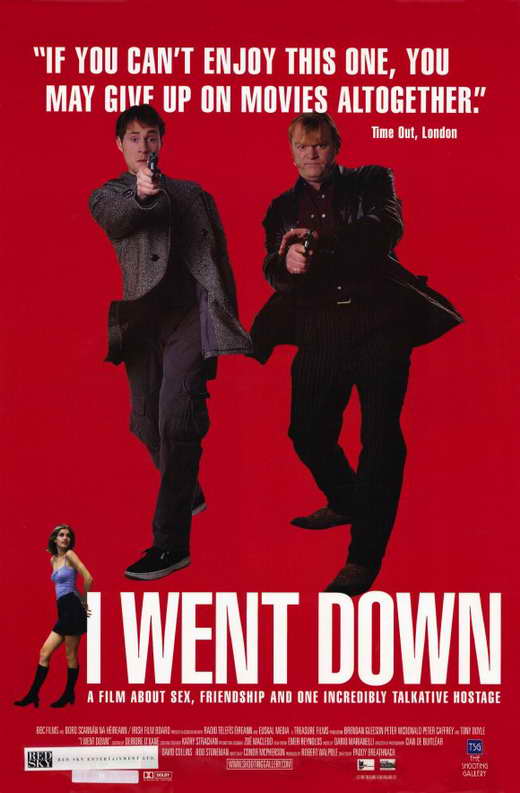
DVD REVIEW: I Went Down (1997)


Made in 1997, I Went Down is probably one of the first of the post-Tarantino Irish gangster comedies of which there are now way too many. Indeed, to watch I Went Down is to notice how similar it is to later films, such as Intermission and Perrier’s Bounty, in terms of tone and in terms of the characters. As the original though, I Went Down is still thoroughly entertaining.

Git Hynes (Peter MacDonald) is just out of prison and has nowhere to go. He meets up with an old friend Anto (David Wilmot) and is almost immediately caught up in an gang punishment. Protecting Anto from a violent gangster Johnner (Michael McElhatton), Git comes to the attention of boss Tom French (Tony Doyle). To make amends, he has to do a job. Teamed with one of French’s men, Bunny Kelly (Brendan Gleeson), Git and Bunny must drive to Cork in search of a man, Frank Grogan (Peter Caffrey), who has unfinished business with French. The job turns out to be much harder than it at first seemed.

In its opening moments, I Went Down feels like a typical Irish gangster comedy, with a luckless lead character, a typical role for Brendan Gleeson, some comically inept villains and an off-kilter tone, which suggests folk songs and westerns. If Perrier’s Bounty and Jump hadn’t felt redundant and out of date before, they certainly do now. Furthermore, it all only goes to show how great In Bruges had been, that, despite all the typical trappings, it had succeeded in being thoroughly unique and subtly serious. Having said that, while Perrier’s Bounty, Jump and ultimately, despite it being a hit, The Guard are cinematic dead-ends, I Went Down deserves a bit of praise for being the first, for being funny and for not being hopelessly dated – after all, in 1997, I Went Down was only the Irish equivalent of a raft of American indie crime comedies all inspired by Tarantino. So while it isn’t groundbreaking in the same way that Rocky Road To Dublin and Poitín were/are, it was a welcome break from troubled history stories like the previous year’s Michael Collins, Some Mother’s Son and The Boxer. I Went Down shows Irish cinema trying to get away from The Troubles and become a part of the film movements of the time. Finally, Irish cinema was allowing itself to have fun.

Ultimately, the main appeal of I Went Down is that it is fun. The plot unravels well and the pace is quick, it doesn’t waste any time and it is consistently funny. Brendan Gleeson is always a joy to watch and though Peter MacDonald’s brand of doe-eyed naïveté never really caught on (see also When Brendan Met Trudy), it is endearing here. There is also a slightly serious undertone to the film in that Git is frequently worried that he is involved in something that might lead to murder. There is a certain morality at play here, which is too often missing in American or British gangster films that often mistake cruelty for cool. In keeping with this, nearly every character is given some sort of distinguishing characteristic or even a degree of likeability. This unwillingness to be cold-hearted adds to the fun, but it also ensures that you can watch I Went Down without getting a bad taste in your mouth. This lightness of touch feels distinctly Irish, as if the film is a bit of craic and anything too dark or violent will only ruin the fun. This is hardly a flawless framework for future films (witness I Went Down director Paddy Breathnach’s subsequent Man About Dog) but done well, it can work simple wonders.

As far as flaws go, there are few that matter – only the dull pair of female characters that the film itself can barely be bothered with (what else is new?) and an out of place conversation at the fade-out. This review will be shorter than usual because, simply, there isn’t much else to say about I Went Down other than to repeat that it is good, undemanding light entertainment.


Friday, 15 July 2011

REVIEW: The Guard (2011)

  The Guard is directed by John Michael McDonagh, the brother of respected playwright and filmmaker Martin McDonagh (Six Shooter and In Bruges). Similarities in tone between the McDonagh’s two features make comparing them almost impossible. While Martin's earlier Belgian-set hit man comedy is the superior film, John Michael's buddy movie is far from disappointing.
  Brendan Gleeson is Sergeant Gerry Boyle, a Galway police officer, who takes his job lightly, preferring shoot 'em up games, alcohols, drugs and prostitutes. When reports come in that a half billion-dollar drug shipment is going to arrive on his patch, Boyle is teamed up with strait-laced FBI officer Wendell Everett, played by Don Cheadle. Alongside their mutual dislike pay-offs, blackmails, psychopaths and a bag of guns complicate things. On top of this, Boyle has to cope with his dying mother Eileen (Fionnula Flanagan).
  Any plot synopsis of this film can't help but make the film sound hopelessly clichéd. However, one of the film’s most successful features is the fact that it breathes new life into the formula. Its hard to think of it has a film in the vein of the Lethal Weapon franchise, especially because McDonagh makes the film his own. Sequences familiar to the genre are followed by more strange and outlandish scenes, such as when the film’s villains (Ian Cunningham, Mark Strong and David Wilmot) philosophise about their profession while watching fish in an aquarium. There are enough scenes like these to make the film feel fresh, often funny and somewhat experimental.
  However, none of this would matter if a less convincing actor had played Gerry Boyle. It is hard to think of a recent film that has been so geared towards one actor. Brendan Gleeson may not be stretching his ability very much, but he is almost note-perfect in the lead role. He’s played this kind of role several times, but rarely in the lead role and arguably never with so fine a script. Don Cheadle does not get much to do, playing what is mainly the straight man, the foil to Gleeson’s cop. Though he does have a few good lines. Undoubtedly, however, this is Gleeson’s film and he walks away with it.
  The film is cynical and offensive (no one comes out of it well) but it has a heart. Like his brother before him – Martin made a hit man comedy with characters with morals, regrets, hopes and dreams – John Michael McDonagh gives the buddy cop movie a shade of melancholy. He is not afraid to deal with loss in the scenes with Boyle’s dying mother. As with In Bruges, some scenes are quite moving, though many of them end too quickly. As well as this, Martin McDonagh could work on your emotions covertly, whereas with his brother, you always know when the sad bit is coming. That said, it is a welcome addition to the genre.
  Ending with the knowing flamboyance of the final shoot-out, The Guard is a lot of fun and very funny. Though John Michael McDonagh doesn’t quite attain the brilliance of his brother’s film, it remains a film worth seeing. As we wait for Martin McDonagh’s second feature, this is a worthy surrogate.

Friday, 19 November 2010

REVIEW: Perrier's Bounty (2009)

  This film comes with a lot of pedigree. Presumably coming off the back of the success of 2008 masterpiece ‘In Bruges’, with the director of ‘A Film With Me In It’ and the writer of ‘Intermission’ and starring Brendan Gleeson, Jim Broadbent, Cillian Murphy and Liam Cunningham, how could it be bad? Well…it isn’t. OK, it isn’t going to give the Irish film industry the kick up the backside that it needs, but it is a very funny 88 minutes and entertaining to beat the band.
  You are alerted to the film’s tone from the off, with a bouncy and colourful opening credit sequences and an introduction by a fun, cynical and annoyingly recognisable narrator. The story is that of a fairly conventional comedy thriller with a heavy dose of seedy locations and even seedier characters. Cillian Murphy’s Michael owes local gangster Perrier (the ever dependable Gleeson) money and has no way of getting it. Things get worse and worse until Michael is forced into hiding, taking suicidal neighbour Brenda (Jodie Whittaker of Venus fame) and dying estranged father (Broadbent) along with him. Perrier puts a bounty on their heads and the hunt is on. It may sound like something you’ve seen before, but the film’s humour raises it to a much higher level, allowing for some brilliantly unexpected little scenes, such as when Gleeson consoles a grieving henchman and when two wheel-clampers get in over their heads.
  The fun script is full of seedy characters spouting philosophical nonsense and tracts about non-existent codes of honour and even the Grim Reaper has a part to play. The characters are all very likable in the vein of Intermission’s multiple characters. Not one of them is innocent but fun performances and good scripting allow you to forget that. What’s great about the film is that it never gets too serious in an effort to be more than just a punchy comedy chase movie. Alongside the laughs, thrills and plentiful spills the film is a pseudo-profound mediation on something or other, which gives it a very enjoyable tongue in cheek feel but isn’t tackled seriously. Art this is not, and the film knows it. As the all-knowing narrator says, “Anyway…bit of craic, no?”