Showing posts with label philippines. Show all posts

Saturday, 16 May 2015

REVIEW: From What Is Before (2015)


Following on closely from Norte, The End of History (or at least if taking account only of UK release dates), Lav Diaz has constructed an even longer 338-minute epic, From What is Before. Apart from a few festival screenings, the film officially premiered on the MUBI subscription website.

From What is Before is set in a remote village in the Philippines. The film begins in 1970 and tracks a series of strange and often unexplained events – a burning house, the slaughter of cattle and the death of a stranger – through to the declaration of martial law in 1972.

A short synopsis may remind viewers of another slow, meditative black-and-white recent arthouse film, Haneke’s The White Ribbon. However, where Haneke’s film is mainly about the cruelty inherent in society and the weight of the intuition of impending crisis, Lav Diaz is interested in investing time in the landscapes he films with the characters he has created. Here, the parallels between the people and the places are frequently drawn – distant humans will suddenly appear in amongst the trees and foliage, giving the impression of hard lives led very close to nature. Alongside this sense of place, Diaz focuses on everyday chores and religious rituals to give a sense of the community, and often these activities will take place in a downpour or in high winds. What the film achieves here then, especially when the viewer invests the time and the attention, is a wholly believable and palpably tough sense of what life is like in these hard, remote places - although sometimes one may be moved to worry about the actors placed so close to some dangerous-looking waves.

Equally, and as with Norte, The End of History again, this means that when the film takes a darker turn – with the arrival of the soldiers and the beginning of martial law – it can be a bit of a shock. The film’s final scenes are convincingly horrible and desolate, and especially so since we have been granted so much time to appreciate the relative peace and normality of what has gone before. The soldier’s invasion of the village feels suitably invasive since we have gotten so used to watching the (relatively speaking) small, individual dramas of the villagers without ever having the impression of a stronger force in the wings. That said, the film’s focus on the tough lives led before the arrival of the soldiers (as well as the crimes carried out by the villagers, which includes a rape) would seem to suggest that the film’s major point is that life in the Philippines is tough, however you go about it.

The question that truly dogs the film, though, and one that will dog all films that are this long, is whether the film really needs to be as long as it is. Films can be slow and immersive without being so long, and as involving as the film is, the length is a drawback, since it will encourage viewers to watch in instalments (as I admittedly had to do) and hence lose the flow of the film’s images, sounds and tone. There are also certain moments were it feels that Daz’s aesthetics are the only reason that a cut is not being made, sometimes to the detriment of the characters or drama in a scene. Daz’s intention could be to show how implacable nature is throughout all of these small human dramas as in one powerful moment in which a suicide occurs off-screen while the camera focuses on the tide battering the coast, but it can equally feel like cruel inattention elsewhere.

The length then is a challenge, and it may require further knowledge of Diaz’s cinema or a better acquaintance with other long films before one can stop thinking of them as stunts or endurance tests. Diaz has a remarkable ability to pull you into his films and they do reward your patience though it may be the case that there is simply too much to take in on one fidgety viewing. There should always be new challenges in the cinema, and Diaz’s films are certainly one of those challenges, and it may be difficult to say anything about his work that doesn’t sound merely facile until more is known about them.


From What is Before is both simpler and more complex than Norte, The End of History in that it shows less and suggests more. I am not going to try to interpret the film’s many apparent meanings since I feel it will require a second and possibly a third viewing before the film’s entirety comes to light but, for my money, it is the superior film.


Wednesday, 6 August 2014

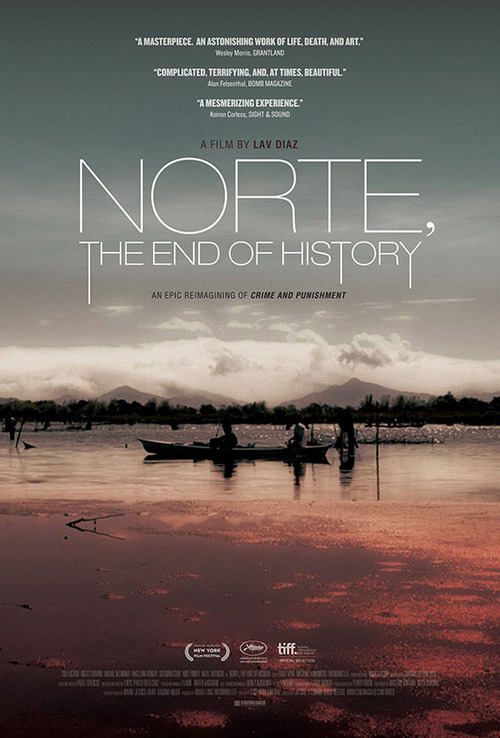
REVIEW: Norte, The End of History (2014)


There is very little than cinema should not do – as an art form, any innovation or experiment ought to be welcomed as an attempt at finding a new means of expression. ‘Slow cinema’ is one such innovation, in which the pace of a film leaves the audience opens to experiencing the quotidian reality of the characters in the film. Put badly, it is cinema with the boring bits left in. Lav Diaz is one of the key exponents of ‘slow cinema’ and his work stretches this idea as far as many of us will comfortably go. Norte, The End of History, at 250 minutes, is one of his shortest films.

A modern re-working of Dostoevsky’s Crime and Punishment, the film, set in the northern Philippines, initially follows Fabian (Sid Lucero), a student who has dropped out of law school, having fallen victim to certain socio-political, historical and philosophical contradictions which the law cannot shed light on. He suggests the answer to the world’s problems is a revolution, a real revolution in which the activists carry out violence rather than simply talk about it. His friends do not agree, so, isolated and confused, Fabian embarks on a murderous spree, wholly misdirected and totally pointless. A poor man, Joaquin (Archie Alemania) is imprisoned for the crime, leaving his wife Eliza (Angeli Bayani) and their two children destitute. The consequences of Fabian’s actions play out over a number of years.

The length and the pace will grab the headlines but there is more to Norte, The End of History than its challenging aesthetics. It is worth mentioning, however, that the film is frequently beautiful to look at and somehow hypnotic – time ceases to matter as the film’s images somehow wash over you and you are immersed in a way that makes the drama all the more moving and the violence all the more shocking. There is a certain reality to the film, which a much shorter film could not capture so easily. The weight of Eliza’s everyday life is seen in stark detail, while Fabian’s wanderings take on a powerfully nihilistic feel. A shorter, pacier film will move from plot point to plot point, but Diaz’ film has its own special appeal in the way that he captures life playing out. It is neither exciting nor boring, it just is.

Norte, The End of History delves into the same themes as Dostoevsky’s Crime and Punishment albeit with a modern and specifically Asian re-reading. The film opens with a discussion of the end of history – capitalism and the West have won – and ends with the question, “What now?” For Fabian, an unfair and Godless world can be changed only by violence. His crime is pathetically misdirected and local and only manages to harm his neighbours. While it only adds to the suffering of Eliza and Joaquin, it devastates Fabian. Eliza and Joaquin have a different view of life, one of work and family and togetherness, a view of life in stark contrast to the laid-back musings of Fabian and his friends. They ultimately survive thanks to their love for each other and their ability to work their way out of their problems. Fabian, however, having got away with murder, is a broken man, wracked by quilt and yet too much of a coward to confess his crime and ensure Joaquin’s freedom. For him, the world is a cruel place and there is no such thing as justice. Equally devastatingly, he has lost any sense of his own self-worth, having become one of the lowest of the low. The film addresses moral, societal, political and philosophical questions – some specific to the Philippines and some of a global nature – and finds answers in a panoramic view of life and time.

However, the film is not without its flaws and these flaws are ultimately down to the film’s aesthetics – it is, after all, difficult to entirely divorce any question of the film’s value from its rigorous and experimental style. Lav Diaz takes 250 minutes to come to his conclusions and yet Norte, The End of History does not extend even as far as Dostoevsky’s novel and Woody Allen’s best and most thoughtful film, Crimes and Misdemeanors. The politics is fairly slight, presumably intended only as the modern-day equivalent of the semi-Nietzschean philosophy in Dostoevsky’s novel whereas the comparisons between Western capitalism with a heartless and exploitative moneylender is obvious. The film is certainly worth seeing and its hypnotic vision of everyday life is interesting and intriguing but it is difficult to feel as if anything more can be gained from this kind of filmmaking. Norte, The End of History has even been accused of being the work of a sell-out, that Diaz’ usual rigour has been watered down for commercial gain (the film is the first of Diaz’ many films to get a UK release). A greater knowledge of Diaz’ cinema may help answer this question, but, taking into account only Norte, The End of History, there seems to be something rewarding and something lazy about Diaz’ aesthetics. It imparts a fascinating and wholly believable vision of everyday life, but it does not do much more than that, paying only surface attention to the ideas it addresses. The pursuit of truth or, at least, a close resemblance to the feel of everyday life is hard to do (and, in a sense, 250 minutes is still far too short a time to properly cover the years that the narrative encompasses) and Norte, The End of History is a little simplistic and one-note.


Norte, The End of History is certainly a film worth seeing. It is a powerful drama, often very moving and thought-provoking. On first viewing, it is interesting, artless, hypnotic, irritating, satisfying and disappointing – far from perfect but a good example of experimental cinema.


Wednesday, 23 July 2014

SHORT REVIEW: Norte, The End of History (2014)


This short review appeared on The Upcoming website here.

There is very little than cinema should not do, any innovation or experiment ought to be welcomed as an attempt at finding a new means of expression. One such innovative filmmaker is Lav Diaz, whose Norte, The End of History, at 250 minutes, is one of his shortest films.

A re-working of Dostoevsky’s Crime and Punishment, the film follows Fabian (Sid Lucero), a student who has dropped out of law school, disillusioned with the law. Isolated and confused, Fabian embarks on a pointless murderous spree. A poor man, Joaquin (Archie Alemania) is imprisoned for the crime, leaving his wife Eliza (Angeli Bayani) and their two children destitute. The consequences of Fabian’s actions play out over a number of years.

The film is long, but it is frequently beautiful to look at and somehow hypnotic – time ceases to matter as the film’s images immerse you in a way that makes the drama all the more moving and the violence all the more shocking. There is a evocative reality to the film, which a much shorter film could not capture so easily. The weight of Eliza’s everyday life is seen in stark detail, while Fabian’s wanderings take on a powerfully nihilistic feel.

Norte, The End of History delves into the same themes as Dostoevsky’s Crime and Punishment albeit with a modern and specifically Asian re-reading. The film opens with a discussion of the end of history – capitalism and the West have won. For Fabian, an unfair and Godless world can be changed only by violence. Eliza and Joaquin have a different view of life, one of poverty, work and family, a view of life in stark contrast to the laid-back musings of Fabian and his friends.

However, Lav Diaz takes 250 minutes to come to his conclusions and yet these do not extend even as far as Dostoevsky’s novel or Woody Allen’s best and most thoughtful film, Crimes and Misdemeanors. The film is certainly worth seeing for its hypnotic vision of everyday life but there is both something rewarding and something lazy about Diaz’ aesthetics. It imparts a fascinating and wholly believable vision of everyday life, but it does not do much more than that, paying only surface attention to the ideas it addresses. On first viewing, it is both satisfying and disappointing – far from perfect but a good example of challenging cinema.