Showing posts with label alec baldwin. Show all posts

Friday, 4 October 2013

REVIEW: Blue Jasmine (2013)


Blue Jasmine is Woody Allen’s 45th feature film and arguably his first to deal with the contemporary world in any real way. It is also his best-reviewed film in quite a while with most of the praise going to Cate Blanchett’s lead performance.

Jasmine (Cate Blanchett) is down on her luck. Once rich and married to successful businessman Hal (Alec Baldwin), she lived a full and vacuous life as one of the 1% in New York’s affluent Park Avenue. Following Hal’s arrest for all sorts of business fraud, Jasmine is left alone and broke. After a nervous breakdown, she moves to San Francisco to live with her sister Ginger (Sally Hawkins), who she has had little to do with since childhood. The film follows her as she tries to get used to working for a meagre living and as she tries get again to snare a rich husband. Meanwhile, she constantly berates her sister for her lack of ambition and choice in men – taking a particular dislike to Ginger’s fiancĂ© Chili (Bobby Cannavale).

As is evident, Allen is in a sombre mood, making a serious film for the first time since the grim but interesting 2010 film You Will Meet A Tall Dark Stranger. The film begins with Jasmine at a very low point in her life and only briefly lightens up along the way, the drama heightened by frequent, well-integrated flashbacks of Jasmine’s time with Hal. These flashbacks are always introduced seamlessly into the narrative and frequently comment on the action, Allen’s movement between these modes displaying again his editorial skills as both a writer and director. The film unfolds well, saving certain backstory revelations until they can have their strongest, or cruellest, effect – particularly when it reveals what happened Hal after his arrest and why Ginger and her ex-husband Augie (Andrew Dice Clay) detest him so much. As is often the case, Allen shows himself to be a fantastic storyteller, very much aware of when to come in and out of a scene and displaying a deft hand at exposition, nuance, character and music. The use of “Blue Moon” as a symbol of Jasmine’s traumatic disconnect from a highly romanticised past is perfect and, in the final scene, simply but powerfully moving. Jasmine is not a nice character but Blanchett’s incisive performance and Allen’s equally insightful script make her human and thoroughly understandable.

The film’s main problem lies in its contemporary relevance. Allen has thus far largely avoided making points on current affairs, making films that, at their best, feel effortlessly timeless. A film like Shadows and Fog is able to reach a large degree of theological and philosophical depth precisely because it has no contemporary relevance whatsoever and oftentimes Allen’s best films work in a similar vacuum. Similarly Blue Jasmine is thwarted slightly by a representation of the working class San Franciscans that is all beer, vests and sports on TV and not much of a stretch from Danny Aiello’s detestable, abusive Monk in The Purple Rose of Cairo. But while Monk was a character from the 1930s, Augie and Chili merely feel anachronistically like characters from the same decade. Allen has made a career of mocking the characteristics and peccadilloes of privileged pseudo-intellectual New Yorkers and it is admirable that he is trying to show the 99% for once. It is just a pity that he does not invest these characters with any depth. Augie and Chili too often feel like caricatures (something Allen often opts for too easily) and when they do not, it is easy to suspect that this is thanks more to Andrew Dice Clay and Bobby Cannavale than to Woody Allen. Here, like Jasmine, Allen might have found himself in a world he does not understand.

Though itself tainted by Jasmine’s snobbery, Blue Jasmine is nonetheless a well-made drama with uniformly good performances and a further example of Allen’s talent for writing quick and believable scripts and directing complex and interesting dramas.


See also:
Midnight in Paris
To Rome With Love


Thursday, 27 September 2012

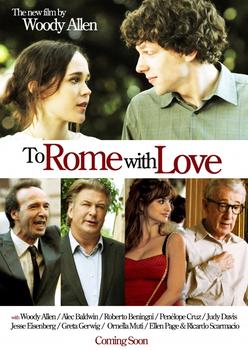
REVIEW: To Rome With Love (2012)


To Rome With Love is this year’s Woody Allen film and his first since the surprise success of Midnight in Paris. Woody Allen has a chequered critical history, though his recent bad reputation is hardly justified. Consistent throughout his films, from the “early funny ones” to the unfairly derided late ones, is a willingness to try new things, though always within a recognisable framework. His late films have ranged from bleak morality fables (Match Point and Cassandra’s Dream) to whimsical and enjoyable entertainments (Whatever Works and Midnight in Paris) or those with elements of both (Anything Else, Melinda and Melinda, Vicky Cristina Barcelona and You Will Meet A Tall Dark Stranger), but all have a slightly experimental edge. To Rome With Love is very much a part of the latter category and it is very enjoyable.

The film is made up of four unrelated stories, all set along different timelines, but all introduced by a traffic warden (Pierluigi Marchionne). What follows is a potted summary, which will do the film no favours, but the less you know going in the better. Hayley (Alison Pill, Zelda Fitzgerald in Midnight In Paris) is an American tourist, who becomes engaged to Michelangelo (Flavio Parenti). When their parents meet, things happen. Newlyweds Antonio (Alessandro Tiberi) and Milly (Alessandra Mastronardi) arrive in Rome for a honeymoon, but Milly gets lost, forcing Antonio to find a substitute for a series of business meetings. Leopoldo (Roberto Benigni) wakes up one morning to find out that he is suddenly and for no apparent reason famous. Jack (Jesse Eisenberg), an architecture student, invites John (Alec Baldwin), a middle-aged architect, back to his house. John observes Jack’s romantic confusion when his girlfriend Sally (Greta Gerwig) invites her friend Monica (Ellen Page) to stay.

To Rome With Love flits through each story at a fast pace, which means that the film does not linger too long on any of them. Admittedly, two of them have their duller stretches and none of them would have withstood a feature length treatment. The stories are reminiscent of Allen’s short prose, collected in “Getting Even”, “Without Feathers” and “Side Effects”, whimsical little pieces that are enjoyable and often funny but, crucially, don’t outstay their welcome. As a compilation of stories, To Rome With Love is quite a success. Each story has enough surprises and enough laughs to keep them interesting and two of them are particularly good – the Alison Pill storyline and the Jesse Eisenberg/Alec Baldwin ones. As a whole, the film is thoroughly enjoyable, but also really rather charming in an old fashioned way.

Ultimately, Woody Allen offers something that Hollywood has not managed to make in quite a while – films whose sole raison d’etre is the audiences’ amusement. It recalls films like The Thin Man series and Top Hat and the films of the Marx Brothers, movies that exist only to entertain and to cheer us up. By comparison, the Hollywood of today has become cynical. Filmmaking is not about enjoyment anymore, but about the money. To Rome With Love is intentionally, even gleefully, out of place. Neither does it have the resonance of Annie Hall or Manhattan or Crimes and Misdemeanours or even You Will Meet A Tall Dark Stranger, but it is remarkably capable of making you leave the cinema with a smile on your face, even despite your own better judgement. It is disposable, but why is that such a bad thing if the film is so entertaining?

To Rome With Love has good ideas - the narrative device involving Alec Baldwin is fun and intriguing in equal measure – some great performances, clever plotting and a good ear for music and scenery. It is too easy to dismiss it as a throwaway travelogue but as a piece of pleasant, good-natured entertainment, it is a satisfying little gem.