Showing posts with label christian bale. Show all posts

Monday, 25 January 2016

REVIEW: The Big Short (2016)


Adam McKay may seem like a strange filmmaker to opt for an awards season biopic of the beginnings of the global economic meltdown of 2008, given his previous form as the director of Anchorman, Step Brothers and The Other Guys. Though it is clearly something close to his heart (remember the serious animated lecture that acted as an appendix to the not-awful The Other Guys), can a filmmaker like McKay pull off something so dense and complicated and, yes, serious.

The Big Short, a title that recalls more The Big Easy or The Big Lebowski than The Big Sleep, is about a few (all-male) groups who saw evidence of a housing bubble and who bet against the seemingly rock-solid housing market, reaping millions as millions lose homes and jobs. We have Michael Burry (a largely restrained Christian Bale), a solo financial wizard, who first sees the inevitable collapse due to the precarious way in which all of the banks had tied their money and capital up in potentially worthless mortgage bonds. His plan inspires others including Jared Vennett (Ryan Gosling) and Mark Baum (a quite good Steve Carell), who all tie up their funds in betting against the housing market.

The film traces the risks that these characters take, the pitfalls and the dark moments in which bankruptcy looms before the ultimate pay-off. Here, particularly in the Burry storyline, the film is closest to that other Michael Lewis adaptation, Moneyball, about the lone innovator who takes a serious risk and ends up triumphant and vindicated in the end. All fine with baseball (though that film was rather dull), but more troubling in the case of The Big Short. The film’s primary focus is on these financial traders who saw the fall coming and bet on it, making a quick buck in the process, which is not the greatest angle from which to address the serious greed and avarice that led to the economic collapse that ruined lives. The film does sort-of address this upside-down morality with Baum having doubts about what he has done, but ultimately the film strives to get an underdog triumph storyline out of something that can only be negative, if not fully misanthropic. Surely that misses the point about what this purely-financial collapse ought to represent.

The film does try to offer a serious critique of what brought about the collapse and the leniency of the response of the world’s governments. There is a running sense of disbelief at the stupidity of the bankers (how did they not know that this was going to happen? Did they really think this kind of policy was going to be sustainable?), that is nicely countered when we hear from Baum about the government’s bailouts, i.e. they knew that there were doing damage, but they were confident that the taxpayer would foot the bill and so simply didn’t care. The film does rouse your indignation, possibly even more effectively than the too-often misunderstood The Wolf of Wall Street. However, the film is not enough of a sustained critique. Though it will inspire a new ire in people who find the news boring, it is just not serious enough, working too hard to be an entertainment with heroes, an underdog storyline and a damaging, slightly desperate comedic strain that does it no favours. So we have Margot Robbie in a hot tub and Selena Gomez playing blackjack to explain CDO’s, stupid jokes that are wholly out of place and stupid pop culture montages. McKay seems to believe that too serious a critique will only confuse and irritate audiences, so he has tried to make the film as entertaining as possible, but it only makes it look foolish, hysterical and jumpy. Sadly, the filmmakers simply do not have enough trust in their material.

And that is it. The Big Short is a story of the outsider vindicated, which severely misses the point; it largely avoids the darker side to this story (the homelessness, the poverty) in favour of out-of-place comedy and easy pokes at villainy and greed; it lacks the intellectual heft to truly tackle its subject. It may be a good primer for the initiated, but with its hot tubs and poker games, it may feel like an insult to one’s intelligence. Though given how the collapse came about and the ease with which a stunning critique like The Wolf of Wall Street can be taken as a celebration and an inspiration, maybe that is what we deserve.


Wednesday, 1 August 2012

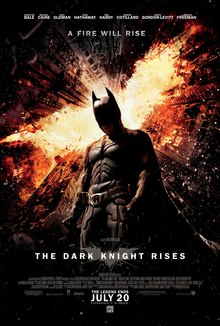
REVIEW: The Dark Knight Rises (2012)


  With The Dark Knight Rises, Christopher Nolan apparently closes his retrospectively named Batman trilogy. Nolan has long been credited with making intelligent blockbusters that engage the mind as well as delivering all the thrills and spectacle that the Hollywood big budget production line demands. With The Dark Knight and Inception, Nolan has managed to create blockbusters that are oftentimes complex and open to many interpretations. Does his fondness for clever action spectacle shine through in The Dark Knight Rises?

  Eight years after the events of The Dark Knight, Bruce Wayne (Christian Bale) has become a Howard Hughes-like recluse. Older and frailer, he has left Gotham City to the care of the police. However, Commissioner Gordon accidentally discovers an underground army, run by Bane (Tom Hardy), which threatens to rise and attack the very fabric of Gotham’s existence.

  Initially, the film is a bit of a mess, hurriedly introducing several new characters, who will all become important later, with several different plot threads which will all tie up in some unlikely ways. The film is slow to find its footing and it is frequently wrong footed as the convoluted plot carries on, making varying degrees of sense as it goes. Rarely does the film manage to find a key scene and stick with it, with several scenes that should be have much more significance being lost in a fast-paced montage of several, much more functional scenes. Even key emotional scenes, like those between Wayne and his butler Alfred (Michael Caine) appear rushed, intended to important context or motivation, disappear from the screen and, often, from memory much too quickly. The film is rarely allowed to breathe and never really recovers from its rushed and often rather hackneyed pacing and storyline, becoming, in the final analysis, a film without a core.

  Much less comprehensible is the film’s final point. Critics, in particular, pride themselves in identifying Nolan as a blockbuster director with smarts, but The Dark Knight Rises is a shallow film. Yes, it references the economic downturn and the culpability of the rich, but they are exactly that – references without any real conclusions being drawn. The same can be said for the film’s politics. One of the more difficult things about The Dark Knight was an ending that advocates lying to the public in order to get the job done, epitomized in this film with the Dent Act. Put simply, Batman and Gordon are lying to the people of Gotham City for their own well-being, a difficult proposition not so long after the WMD controversy. The Dark Knight Rises does ultimately disown the previous film’s conclusion and the Dent Act, but instead it starts talking about the people. Batman frequently talks about the importance of the Batman as a symbol for the downtrodden and about what he must give to the people of Gotham (a typical exchange being – Catwoman: “You don’t owe these people anymore. You’ve given them everything?” Batman: “Not everything. Not yet”; an apparent suggestion that he can still give his life). Similarly, Bane preaches to these same people that Gotham City is theirs for the taking and that they must fulfil their own destiny, one without the lies and falsehoods of Batman and Gordon and the Dent Act. However, where are these people of Gotham and who are they? We never see them (even when Bane’s minions attack innocent people, they are clearly the rich and privileged) and when Bane takes control of Gotham, are we to assume that the people are all collaborators? We never see them rebel against Bane, like the police ultimately do. And if they have joined Bane, then why is it so important for Batman to save them? In fact, the only so-called people of Gotham that we see are two construction workers who are openly colluding with Bane. There is a message somewhere in The Dark Knight Rises, one that is ultimately a humanist one about the importance of looking after each other and helping people in need (this does come across towards the end in a clipped conversation between Batman and Gordon), but it is lost in the flow of (too much) information and by the typically Hollywood need to move along quickly to the next money shot or action sequence. Nolan might be credited with pioneering the clever blockbuster lately, but with The Dark Knight Rises, he has made a rather facile action film that superficially presents real-world problems and fails to cohere around any central point.

  When it wasn’t being silly, The Dark Knight proved surprisingly adept at being exciting. Aside from many well-constructed action sequences, the film was an often stirring and fascinating examination of terrorism, psychosis and widespread hysteria with many scenes that matched the sweep of Michael Mann’s classic Heat with a complexity and intensity that seemed to defy conventional blockbuster rules. The Dark Knight Rises is clearly aware of what made The Dark Knight’s best scenes work so well, but it has given itself too little space to successfully replicate them, with even the film’s action scenes paling in comparison. However, the film is not a total write-off. After all, the performances are still of a high standard, particularly, as with the two previous films, Gary Oldman, the direction is broad and interesting and the cinematography is flawless. But it smacks hopelessly of expectations not met and of the bar having been raised too high.

  The Dark Knight Rises is a messy film that could have used a tighter, tougher script and more consideration as to what the film is supposed to be about. The typical Nolan ambiguous ending really should have worked but feels botched, if only because certain revelations make Batman’s actions seem odd. The film fails ultimately to measure up to The Dark Knight, a film whose flaws were outnumbered by its graces. With too few graces to make it work, The Dark Knight Rises is ultimately beaten down by its flaws, which are often too big to ignore.

Wednesday, 9 February 2011

REVIEW: The Fighter (2011)

  The Fighter is the new film from David O. Russell, something of a comeback for the director, at least in terms of Oscar nominations. His previous films were the fantastic Three Kings and the under-seen I Heart Huckabees. These films mixed barbed social commentary with humour that could sometimes verge on the ridiculous. With The Fighter, however, he seems to be on his best behaviour.
  Based on a true story, the film centres on the relationship between two brothers, Micky (Mark Wahlberg), a small-time pugilist desperate for the chance at a title shot, and Dicky (Christian Bale), the older of the two whose chance has come and gone. After an embarrassing defeat, Micky begins to reconsider the quality of his mother’s (Melissa Leo) and his brother’s management. Into the fray comes Charlene (Amy Adams), Micky’s love interest, who starts to come between Micky and his family.
  This is a film with Oscar written all over it, packed as it is with actors putting on accents and engaging in largely overwrought shouting matches. Bale’s performance is an inch away from a comedy routine, while Adams overdoes her cold and cynical role and Leo plays a cantankerous and irritating woman that, as was possibly intended, becomes incredibly irritating to watch. Only Wahlberg plays his role with subtlety and restraint. A good performance though it is, it can’t help but be drowned out by the much louder, much more broad actors around him. In some scenes in which the focus should be on him, he is barely audible. Otherwise he is absent from the screen as the film pays more attention to Dicky’s character arc (Micky doesn’t really even have an arc), the filmmakers themselves seeming to have forgotten who their film was supposed to be about. When Micky complains that his brother is overshadowing him and that no one listens to him, you really do believe him.
  As drama, it is gratingly authentic, with the scenes of the large family squabbling resembling real life family arguments. It becomes repetitive, hard on the ears and very annoying. In the end, it is rather hard to care about any of them. The same can be said for the directing. Russell drops the experimental and vibrant visuals of Three Kings for a more award-friendly hyper-realism. Without any of his usual trademarks, the attention is forced to remain fixed on the annoying family on the screen while the tripod-less camera merely shakes to and fro in an effort to add a layer of immediacy that is neither needed nor wanted. As well as that, the boxing matches are lazy. The editing speeds up but the heart goes out of it.
  Without the ingenuity, power or the patience of Raging Bull and The Wrestler, The Fighter is a film with few likeable characters, few nice visuals and a lot of shouting. Here we are introduced to a family that no one would want to spend time with as well as a group of actors ruthlessly playing their parts bigger and louder to attract attention. The fact that Bale, Adams and Leo were all nominated, though Wahlberg wasn’t, indicates the state of the Hollywood drama. Yelling, evidently, can cover up any shabby writing, dull directing or mismatched performance.