Showing posts with label donal mccann. Show all posts

Saturday, 25 August 2012

REVIEW: Cal (1984)


  Cal is a 1984 adaptation of a Bernard Mac Laverty novel directed by Pat O’Connor (The Ballroom of Romance, A Month in the Country, Circle of Friends and Dancing at Lughnasa) and starring John Lynch, Helen Mirren and Donal McCann. Not unlike Angel, it is set in Northern Ireland during the Troubles, but unlike Angel, it is a much more conventional near-melodrama, which just might have something to say about the conflict.

  Cal (John Lynch, in his film debut –In The Name of the Father, Words Upon The Window Pane, The Secret of Roan Inish, Nothing Personal, Some Mother’s Son, This Is The Sea, Puckoon, Evelyn, Isolation and Five Day Shelter) is a perennially out-of-luck IRA volunteer, who becomes helplessly besotted with Marcella (Helen Mirren – Some Mother’s Son), the wife of a policeman that he had had a hand in killing. Cal and his father Shamie (Donal McCann - (Poitín, Angel, Budawanny, The Dead, December Bride and The Nephew) are the only Catholics in a Protestant housing development and are constantly under threat. And if that wasn’t enough, the local IRA commander Skeffington (John Kavanagh – Paddy, The Ballroom of Romance, Joyriders, Into The West, Circle of Friends, Some Mother’s Son, The Butcher Boy, Dancing At Lughnasa, Puckoon, The Tiger’s Tail and Closing the Ring) wants him to do a few more jobs and won’t take ‘no’ for an answer.

  Cal is a film that is seemingly obsessed with the suffering of the oppressed. Cal is always troubled and is frequently beaten up by bigoted thugs, the army and the police. Most of the other characters in the film do not come out well either, with one falling into a severe depression and another deep disappointment. O’Connor’s, and Mac Laverty’s, who adapts his own novel, vision of life during the Troubles is a bleak one, with a heavy focus on suffering, guilt and repentance. In one scene, a guilt-ridden Cal burns himself in the hand with a lit cigarette as atonement for the crime that he cannot tell Marcella about. There is also the figure of The Preacher (Tom Hickey – My Left Foot, Circle of Friends, The Butcher Boy, Inside I’m Dancing, Breakfast on Pluto, Garage, Alarm and Stella Days), who is often present to represent the question of faith and repentance. Ultimately, the film seems to suggest that the best response to the Troubles is self-harm and self-sacrifice, with more political or social avenues largely ignored.

  So, Cal does little to lift Northern Ireland out of the quagmire of the Troubles, but it is, nonetheless, a rather effective melodrama, despite an overdone story. Cal’s frequent flashbacks to that night may be overused, but the presentation of the drama (leisurely and muted, almost cold) and the quality of the performances, particularly McCann, whose downfall is the most tugging as he was the chirpiest, manage to make the film more than just a quiet moan. John Lynch plays the unfairly and too-frequently prosecuted man well, and would continue to play that role in In The Name of the Father and Nothing Personal. Helen Mirren does not have a huge amount to do, but when she does, she is convincing. The end of the film, though expected (who would ever have thought that it would all turn out well), is effective, the fade to the credits and their slow climb up the screen accompanied by some melancholic music quietly devastating in their own small way.

  Like Angel, Cal has little to say about the Troubles, a pity as both were, after all, opportunities to reach wide audiences and purvey a better message than that of the violence. However, unlike Angel, Cal has no pretensions to great art and, as a result, does not fall so far. A diverting and sometimes affecting melodrama, it is a much more fruitful starting point.

Monday, 20 August 2012

REVIEW: Angel (1982)

  Angel was Neil Jordan’s (The Company of Wolves, The Crying Game, Michael Collins, The Butcher Boy, Breakfast on Pluto and Ondine) directorial debut, made in 1982, and it stars regular Stephen Rea (all of the above, as well as Trojan Eddie, The Last of the High Kings, A Further Gesture, This Is My Father, I Could Read The Sky, On The Edge, Evelyn, Bloom, The Halo Effect, Tara Road, Kisses, Nothing Personal (2009) and Stella Days). Though Angel is set in Northern Ireland during the Troubles, the film is a much more abstract examination of the evils of violence. The film also has, in slight roles, Donal McCann (Poitín, Cal, Budawanny, The Dead, December Bride and The Nephew) and the ubiquitous Gerard McSorley (Taffin, In The Name of the Father, Words Upon The Window Pane, Widows' Peak, Moondance, Nothing Personal (1995), Michael Collins, Some Mother's Son, The Butcher Boy, The Boxer, Dancing At Lughnasa, Agnes Browne, Angela's Ashes, Ordinary Decent Criminal, On The Edge, Bloody Sunday, Dead Bodies, Veronica Guerin, The Halo Effect, Omagh, Inside I'm Dancing, Middletown, The Front Line, Trapped, Mr Crocodile in the Cupboard, Wide Open Spaces, Swansong: Story of Occi Byrne).

  Stephen Rea plays Danny, a saxophone player in a band that tours around the country. After one performance, three balaclava-wearing gangsters kill his manager and a girl that he was seeing while Danny watches helplessly on. Danny decides to swap the saxophone for a machine gun and goes out in search of vengeance.

  Angel appears to be a straight-forward action thriller/vigilante yarn, albeit one with a limited budget, not unlike Jordan’s more recent, thoroughly ghastly The Brave One, but it soon becomes something much more abstract, and much more pretentious. At one point, a rather pointless conversation turns towards a poster of an Antonioni film, Jordan’s apparent influence. Indeed, the film is very distanced and has at least a vague focus on the surrounding landscape, though it seems more of a style choice than a thematic one. There are quite a few quotations as well, as if the film need only quote the works of famous writers in order to be as artistic or as profound. The film is also horridly vague and wandering, again as if an exercise in Antonioni-like near-plotless rambling is the only way to achieve artistic merit. Angel ultimately ends up being as superficial and meaningless as any similarly themed exploitation fodder. And that’s before one engages with what the film is attempting to talk about.

  Angel is about the evils of violence and the senselessness of violent action and of the damage it wrecks on the mind of the perpetrator, as Danny does ultimately come to appear at the very least unhinged. Pointed as it was presumably meant to be, it is hopelessly lost, not least in the film’s slipshod denouement in which the bad guy is speedily revealed and then disposed off by a cop who does not seem troubled by his own act of violence. The film seems to suggest that some violence is justifiable and will not destroy one’s mind, though it is hopelessly vague about how one determines the difference between good and bad violence. Again, it is the police and the state that seem to have the monopoly on morality and ethics – a conclusion that looks forward to Neil Jordan’s equally superficial and almost fascist The Brave One. The setting then becomes a problem with the film’s conclusion about violence ringing false in terms of the conflict in Northern Ireland, the specifics of which the film makes great efforts to avoid. The violence perpetrated by the state is unequivocally just and any corruption and evil are individual problems that can be easily dealt with, rather than institutional problems that are more complicated than anything this film dares deal with.

  The main problem with Angel, however, is not that it does not work as the art film that it so desperately wants to be, but more that its aspirations to great art thwart any other enjoyment that could be gained from the film. The plot is not exciting and the performance are too withdrawn, the actors merely goes through the motions and allowing the humanity to be staged and choreographed out of them. Ultimately, the film is full of narrative hiccups (the sequence with the woman who cuts his hair) and it is too deliberate and pre-meditated to be surprising in any way. The problem is not that the film has absolutely nothing to say that is worth hearing, it is that it can’t work on any other level beyond aborted art film.

  Angel is ultimately a messy film that trips itself up on its way towards for complexity and artistry. More like the work of Tomas Alfredson than that of Michelangelo Antonioni, it is a film that is too pretentious to be merely sufficient as a guilty genre pleasure and too superficial to be intellectually engaging. It ought to please no one and irritate many.

See also:
The Company of Wolves
Michael Collins

Thursday, 31 May 2012

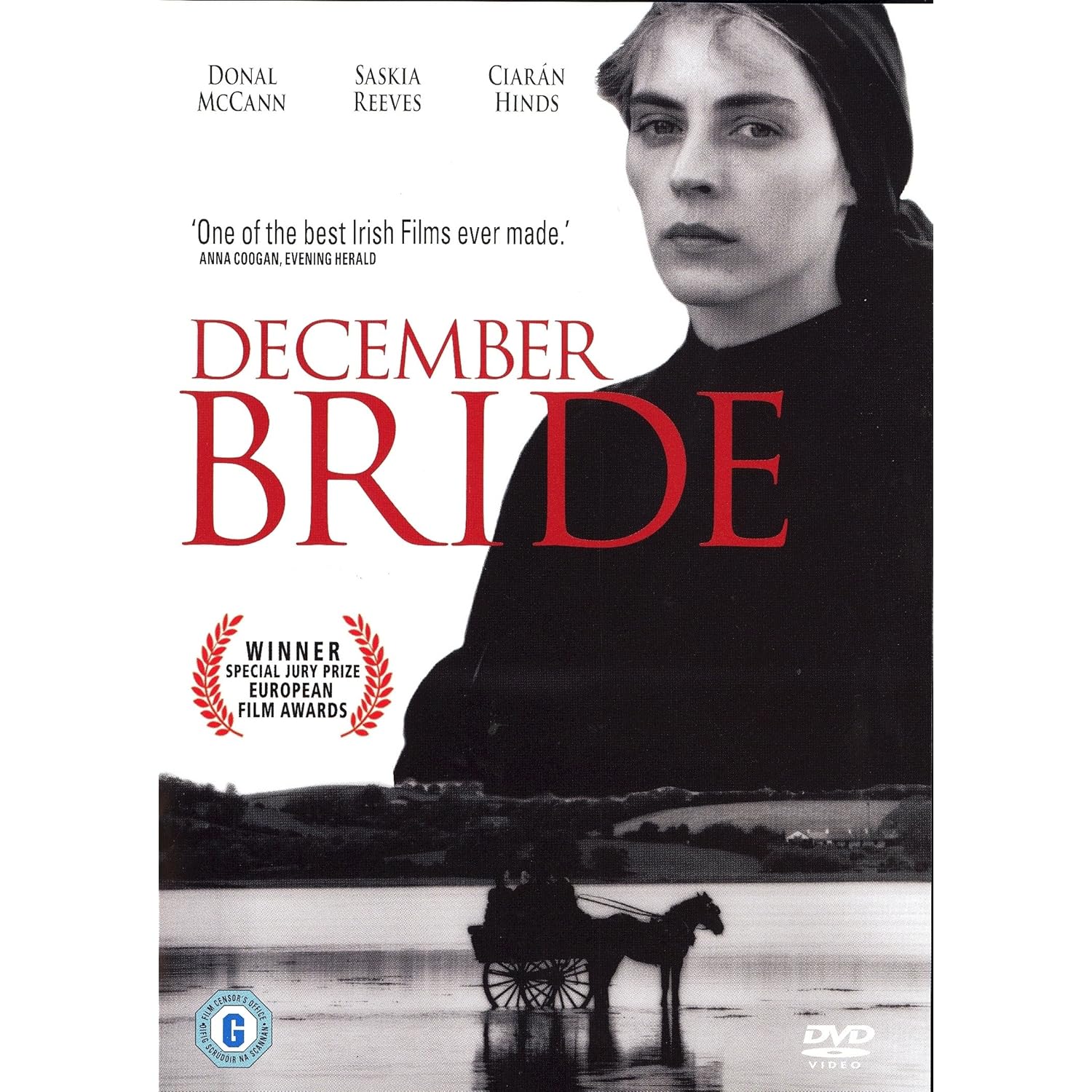
REVIEW: December Bride (1991)


  December Bride is a 1991 Irish-UK film directed by Thaddeus O’Sullivan (Nothing Personal, Ordinary Decent Criminal and the forthcoming Stella Days), starring Saskia Reeves, Donal McCann (Poitín, Angel, Cal, Budawanny, The Dead and The Nephew) and a remarkably young Ciarán Hinds (Circle of Friends, Some Mother’s Son, Titanic Town, Mickybo and Me, The Tiger’s Tail, In Bruges, IFTA-winning The Eclipse and the crowd-pleasing but rather slight Oscar-winning short The Shore). Set in and around Strangford Lough, December Bride fits into the Northern European strain, having much akin stylistically to the work of Dreyer and Bergman.

  Saskia Reeves is Sarah Gilmartin, a maid who works for the Echlin brothers, Hamilton (McCann) and Frank (Hinds). Ignoring the restraints of her devout Presbyterian background, Sarah initiates a ménage a trios with Hamilton and Frank. The three are effectively ostracised by the townsfolk and matters are made worse with the arrival of a child. The identity of the father is unknown to both the town and to the three outsiders.

  O’Sullivan’s aesthetic is extremely stilted and deliberate, a surprise considering his work on the fast-paced and empty-headed Ordinary Decent Criminal. The action is frequently punctuated with images of foreboding and unforgiving scenery. The dialogue is quiet and often monosyllabic and actorly histrionics are largely avoided. However, while Dreyer imbued his films with a fascinating mysticism and pensiveness and Bergman addressed such big issues as life and death, faith and morality within the frame of his often equally quiet and composed work, there is little in December Bride beneath the refined aesthetics. Ultimately, it initially feels less O’Sullivan’s chosen style and more the primitive work of a beginner.

  However, December Bride is a slow burn, which does manage to, in some small and incalculable way, reward the viewer’s patience. Both difficult to get swept up in, or to even believe in, at the beginning, the film does develop a tone and a mood. It is ultimately down to the viewer whether or not they are willing to forgive the struggle that is the film’s first half. After all, the performances from the three leads are all rather good, though McCann has a few silly scenes to struggle through and Reeves has a character that is a little one-note. She doesn’t have very much to do. Hinds is very good when he is allowed to act more than quiet longing.

  Irish cinema is still far from a great cinema, largely because there is so little of it and because there is barely a history yet. December Bride is an interesting example of the variety of Irish cinema – which isn’t all Brendan Gleeson crime-comedies, great as a few of them are. The film’s primary problem is probably that it is a story that is well trod in Irish cinema (albeit usually from a Catholic perspective) and that it is almost entirely devoid of humour – no great crime but one that makes the film seems hopelessly serious and portentous.