Showing posts with label marion cotillard. Show all posts

Monday, 21 December 2015

REVIEW: Macbeth (2015)


‘Macbeth’, the play, is difficult to get right. It isn’t that it’s a bad story – the warning about ‘vaulting ambition’ is, of course, still relevant, the trickery of the witches feels cruel and modern in its existentialism, the endless cycle of suspicion, jealousy and murder. But the play is not flawless. In place of character development, the play favours soliloquys about the tasks to be done – Macbeth too quickly turns to murder where most of us would not. The best film versions of the play are distanced. Orson Welles’ adaptation is Brechtian in how obviously stagey it is, while Kurosawa’s Throne of Blood is heightened beyond all recognition. Justin Kurzel’s new version strikes a balance between modern re-reading and overblown supernatural spectacle and doesn’t come off at all.

Michael Fassbender is a grieving Macbeth, who has just lost his only child (thus robbing the brutal, vengeful ambiguity of Macduff’s line “He has no children” in Act 4, Scene 3). He and his wife, Lady Macbeth (Marion Cotillard) then fall on the plan to assassinate King Duncan (a clueless David Thewlis) and set themselves up as king and queen, taking the idea from some deeply suspicious witches. Once crowned, however, the couple descend into bitterness and madness.

There isn’t much that really works with this new Macbeth. Fassbender plays the character mostly as a raving sociopath – the line ‘full of scorpions is my mind’ has never before sounded so sinister – but it doesn’t hold the film together, getting instead repetitive. We understand that the witches’ prophecy gives hope to a man who has lost an heir, but it isn’t convincing – especially when we see Macbeth putting Macduff’s family, including some youngsters, to the stake. Cotillard has one good scene, where she performs the ‘out damned spot’ soliloquy more as an act of sheer despair than of anything else. This works, but the film doesn’t have the material to make a believable transition from her earlier talk of smashing a baby off a wall (how this line works with a grieving parent is anyone’s guess) to this depression. Equally, Malcolm (Jack Reynor) and Macduff (Sean Harris) are left with little to do.

The battle scenes are admirably grotty and unheroic, but there is a feeling of dullness about them. They resemble too many other films (Braveheart, Gladiator, The Lord of the Rings and Game of Thrones and on and on) and they are not peopled with enough characters that we care about. The orange-tinting of some sequences and the sudden slo-mo don’t help, giving more a feeling of stylistic desperation.

Finally, the film emphasises the play’s secondary subtext about violence begetting violence (a cheap theme that has been used to praise such tawdry films as The Last House on the Left) over the warning about ambition, but it doesn’t do much with it beyond suggesting that all this violence and murder is a bit extreme and offering a silly ending with Fleance. This new adaptation then offers little that we haven’t seen before and many of its chief innovations don’t really work. Fassbender and Cotillard do fine work, but it is hard to credit them, given that they are playing characters that fundamentally do not make sense. By the end of the film, the characters are exhausted and fed up and it is not hard to feel their pain.


Tuesday, 27 November 2012

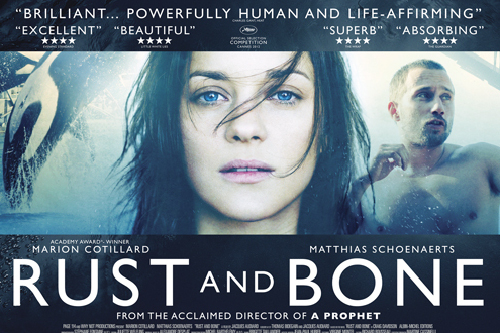
REVIEW: Rust and Bone (2012)


Rust and Bone is the sixth feature from writer-director Jacques Audiard, best known for his previous, the tough A Prophet. Rust and Bone feels like a return to the odd couple motif that gave his otherwise gritty 2001 crime film Read My Lips a heart. Whereas these previous two enlivened the tropes of the crime film through their extreme intensity and earthy realism, Rust and Bone is a bit of a departure, being mainly a romance between a disabled woman (Marion Cotillard) and a bare-knuckle boxer (Matthias Schoenaerts).

Unexpectedly put in charge of his young son Sam (Armand Verdure) after his mother disappears, the practically destitute Alain (Schoenaerts) moves to Antibes and begins to look for work. As a bouncer in a nightclub, he meets Stéphanie (Cotillard), a killer whale trainer. Following a horrible accident at her work, Stéphanie is disabled and a friendship develops between her and Alain. Meanwhile, Alain gets involved in bare-knuckle boxing for some quick cash.

Like Read My Lips and A Prophet, there is nothing especially new here in terms of the film’s plot, which is instead somewhat derivative. However, where the film excels is in Audiard’s ability to give potentially tired material a breath of fresh air. With a handheld camera and natural lighting, his films approach the material with an eye for realism and an honesty of focus. Though it can be manipulative, Rust and Bone is refreshingly uncritical and its emphasis on the emotions of the characters rather than on the developing plot mechanisms makes it surprisingly warm and heartfelt. Technically, the film rarely displays any meaningless stylistics, with Audiard typically preferring to shoot his characters in tight close-ups even when mobile. The film is not without its technical flourishes but, for the most part, the film stays with its characters and happily down to earth. As a result, the film’s contrivances become believable and Rust and Bone becomes a film that it is very easy to be taken away by.

Audiard is ably assisted here by some fantastic cinematography. Stéphane Fontaine, in his third collaboration with Audiard, proves equally adept at shooting intimate indoor scenes with a minimum of intrusive lighting set-ups and the large crowds scenes set in the sea park. Similarly, the film has many impressive lyrical sequences usually to do with the killer whales or with the bare-knuckle boxing, which are off-putting in terms of the film’s otherwise realist aesthetic but do manage to convey a certain beauty. The scenes early in the film set in the sea park are almost sickeningly tense as we are left waiting for something horrible to happen without being quite sure how or when. When the accident does occur, it is shocking precisely because it is unexpected, unseen and subtly presented. Similarly, the bare-knuckle boxing sequences are all horribly realistic, despite a few passages during which the film seems to poetise the violence.

However, the film is best during its slower and quieter moments between Cotillard and Schoenaerts and it is here that the performances get the chance to shine. They approach their characters with a large amount of understanding, often conveying a lot without saying very much. Similarly, they are far from one-note and both display moments of real cruelty, which the film bravely does not make apologies for, instead accepting that, in real life, there are never simply just heroes, villains and victims. Cotillard makes Stéphanie’s devastation queasily real but is also powerfully convincing as a woman tries to get herself back up after a life-shattering accident. One sequence in which Stéphanie begins to do her whale-training exercises for the first time since the accident is a moving and triumphant moment, only slightly sullied by Audiard’s bizarre decision to drown it out with Katy Perry song on the soundtrack. Schoenaerts is equally good in an intensely physical performance although, again, he is best when things are quiet. We are not always supposed to like him, but Schoenaerts is adept at portraying a hint of vulnerability even when he is at his most thuggish. His developing attraction to Stéphanie is well handled and his refusal to let her sit inside and mourn her legs could have been annoying and contrived but is instead surprisingly convincing. It is a tribute to the two lead actors that when the film is focused on them it is at its best.

The film is not without its flaws, often the result of a certain over-egging of the cake. Audiard sometimes moves into an oddly lyrical approach during the bare-knuckle boxing scenes, which feels like a bit of a misstep. The same is true for the use of Katy Perry during an emotionally significant moment that would have worked better without brash American pop. Similarly, the film’s final third does become less convincing and towards the end the film rushes to throw a variety of dramatic devices into the mix, none of which really come off. Cotillard is robbed of a real ending and Schoenaerts is given too many. One involving a frozen lake, while admittedly effective as it plays out, feels in retrospective to be a little too artificial and cheap. The ending also feels a little too optimistic, as everything seems to work out so well that it undercuts the film’s realism somewhat. However, the film is full of enough nice touches and enough honesty that these inconsistencies feel like quibbles.

Rust and Bone is a very good drama, marked by Audiard’s typical intensity and his ability to make recognisable material refreshingly new. Cotillard and Schoenaerts compliment Audiard’s directness with great performances, most likely a career best for both of them. The film is hardly perfect but is not an easy one to dismiss. 

Saturday, 15 October 2011

REVIEW: Midnight In Paris (2011)

  Midnight In Paris is this year’s Woody Allen film in which Owen Wilson takes the role Allen is now too old to play. It is a light comedy full of quietly funny scenes and a fantastical premise that it is best not to know anything about going in.
  Owen Wilson plays Gil Pender, a successful Hollywood hack writer who wants to drop everything and move to Paris and work on his first novel. He is also deeply nostalgic for 1920s Paris. His fiancé Inez (Rachel McAdams) would rather that he grow up and embrace success and modernity. Choosing to forgo the many social engagements that Inez tries to drag him into, Gil prefers to wander the streets of Paris where, on the stroke of midnight, something odd happens.
  The phrase ‘return to form’ has been used with each subsequent Allen film since 2008’s fantastic Vicky Christina Barcelona; but the truth is that it hasn’t been a bad decade for the prolific writer-director. With Small Time Crooks, The Curse of the Jade Scorpion and Scoop to the more recent Whatever Works and You Will Meet A Tall Dark Stranger, Allen has made a collection of pleasantly surprising, and often funny, films, whether light or dark in tone. With Midnight In Paris, it is made abundantly clear that he has cornered the market in cheerfully breezy comedies, held together by good, amusing ideas. He doesn’t waste time delving into the intricacies of his fantasy plot, to the point that Gil very quickly accepts the strange environment in which he finds himself. Allen isn’t interested in whether this could actually happen. What concerns him, like in his much earlier Sleeper, is working with the idea he has and developing it in several unexpected but very pleasing ways. To use any of them as examples would be to ruin the fun but, for the sake of critical analysis, they are, for example, the PI’s unfortunate wrong turning and Luis Buñuel’s inability to understand Gil’s movie idea as well as Michael Sheen’s arrogant Paul, Adrien Brody’s Dali or Corey Stoll’s mad, almost unblinking Hemingway. This list could go on and on.
  This light tone pervades the film, even in the rather long opening montage of Paris, which shows the city from morning until night. It will no doubt have many critics sneering at the tourist’s eye view of Paris, but it fits the mood of the film absolutely. After all, the film is about a tourist celebrating his idea of Paris, as well as the worth of nostalgia and whether or not it is merely a denial of the present.
  Though it does deal with a variety of neuroses, it is a film to enjoy and not to take seriously. Ultimately, light-hearted Woody Allen films fall out of a lot of critical criteria because of their whimsical nature. They are not like other films. They are simple little films which don’t take themselves too seriously and which don’t ask you to either. They have their flaws but, in the end, they are little joys filled with great performances and well-used music.

Friday, 19 November 2010

REVIEW: Inception (2010)

  Inception comes with a lot of hype. With enigmatic trailers, huge posters and the fact that it is the new film by Christopher Nolan, it’s making sure that everyone will notice it. Now, it’s easy to be prejudiced against a film as hyped up as Inception. Avatar and Paranormal Activity were duds, while the great Kick-Ass went by almost unnoticed. However, Inception is one of those rare films that, while not living up to expectations (whatever they were as the trailers were so devoid of clues), it surprises in other, completely unexpected ways.
  Without getting too bogged down in the plot, Inception is presumably set in the near future where corporate espionage has moved on to “extraction”, a means of entering the dreams of your rival and stealing their ideas. Leonardo DiCaprio plays the extractor and he’s the best there is. He becomes embroiled in the seemingly impossible idea of ‘inception’, an attempt to plant the seed of an idea in the mind of a business rival, effectively brainwashing them. Mind, there is much more to the film than this comparatively simple synopsis would suggest.
  The first forty minutes of the film are hard to fully grasp and suspicions are that this is intentional. From the first scene, Nolan is giving you a warning, “Get ready to think”. Eventually it will all become remarkably coherent, as long as you pay attention and keep up. Those seeing the film solely for the visceral action of set pieces (of which there are many) held together by a threadbare story, which seems to be the way of most recent action movies, will suffer. But therein lies the beauty of Inception.
  Having to think during a $160 million action movie is a rarity, and for that simple reason Inception is unique. Who, after ten minutes, didn’t know where Avatar was going? And who really felt moved to discuss it at length afterwards? Inception is full of ideas and is a genuinely creative film. Cherish it. There will not be many films like this in the multiplexes unless, of course, Hollywood takes Nolan’s lead and start making films that are actually about something again.
  However, Inception is not without its flaws. Primarily a visual film and a film about ideas: the question of the difference between the dream state and reality and how to tell them apart is intriguingly tackled. As a result, it is not an actor’s film. As good as the cast may be, they are not characters. As the posters show, they are merely roles (The Extractor, The Architect, The Mark) to which each actor is assigned. People who don’t like it say that they didn’t bother trying to keep up with the intricate plot because they didn’t care about the characters. While these arguments are just, it should be remembered that it’s a film about a concept and, in some ways, post-human. On top of this, the film is 148 minutes long. Adding character development, with a little exploration into the morality of extraction and a bit of humour thrown in, it wouldn’t be a film. It would be a mini-series. Another thing to bear in mind is that while Inception is an original film, it does owe a certain number of its ideas to David Cronenberg’s eXistenZ. In some ways, what Heat is to The Dark Knight, eXistenZ is to Inception.
  Inception is a film you will find yourself thinking about days after seeing it. It’s a work-out and great fun for that. And it deserves every penny.