Showing posts with label tom hardy. Show all posts

Tuesday, 6 October 2015

REVIEW: Legend (2015)


The Krays are already a big part of British cinema, and not just because there is a film about them already. The Krays and the apparent mythology that surrounds them has inspired many a queasy British gangster flick (I am obviously thinking here more of the Guy Ritchie types than either John Mackenzie or Mike Hodges, whose gangster films had a purpose). So here’s one called Legend.

Tom Hardy (tell me if you’ve heard this before) plays both Krays – the suave, Bond-like Reggie and the jittery psycho Ronnie, both over-written and over-performed for the movies. The film’s primary focus (despite a voiceover from Reggie’s wife Frances – played by Emily Browning – which unconvincingly tries to take precedence, but never does) is the relationship between the two brothers and how it lead to the undoing of the Krays’ very possibly unprecedented hold on gangland London.

First, the obvious. The film is called Legend (and, again, despite the wholly unconvincing ‘It’s All True’ narration) and it is a complete work of fiction, written and directed by a relative outsider in American Brian Helgeland. The two points to make about the outsider status of Helgeland are significant if contradictory. First, this is a film that no British filmmaker would be able to make – British cinema being somewhat less false and less at ease with its fondness for gangsters. And yet, secondly, therein lies its unexpected fun, since the film is made by a filmmaker clearly enthralled with this material and totally willing to disrespect the brutal realities behind his version of events and have fun with it. The film is indeed largely played as a comedy. Even a brutal torture scene is played for laughs.

Helgeland has clearly seen a fair share of Scorsese. His film is full of pop tunes, violence, swearing, posturing and long tracking shots roaming through the gangsters’ dens. However, what he hasn’t lifted is the seriousness of Scorsese’s cinema. The challenges to the audiences’ willingness to emphasise with whatever scumbag is projected in front of them and the truthful examinations of the damage that this violence, cruelty and largesse causes that are all consistent in his films all the way from Who’s That Knocking At My Door? through to The Wolf of Wall Street is totally missing from Legend, which prefers its Hollywood myths free of such real-world complications.

As a result, there is something utterly misjudged and unsavoury about Legend underneath the undeniable fun and frivolousness. Because it is based on real people and real murders, such a sugar-coating of Reggie Kray may make one uneasy. Worse is the fact that we never see the legendary Krays’ muscling in on and threatening some hardworking small business owner – surely their trade – only evil members of other gangs. Worse still is the scene in which Reggie rapes Frances. It is hard here not to imagine Helgeland making some kind of mental calculation – that the film will be pilloried if the scene is left out and yet will be too damaging to the film’s glossy, carefree feel if allowed to be presented honestly and truthfully. The latter would never have bothered his hero Scorsese, but Helgeland’s troubling solution to this dilemma is the only time that the camera decides to back away from the violence.


Legend then seeks to have fun with these characters and these events without having to show too much of the real pain and suffering and as such it is a classic Hollywood story, but where it could have had a challenging edge, instead it has a rotten core.


Wednesday, 1 August 2012

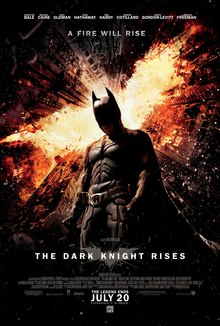
REVIEW: The Dark Knight Rises (2012)


  With The Dark Knight Rises, Christopher Nolan apparently closes his retrospectively named Batman trilogy. Nolan has long been credited with making intelligent blockbusters that engage the mind as well as delivering all the thrills and spectacle that the Hollywood big budget production line demands. With The Dark Knight and Inception, Nolan has managed to create blockbusters that are oftentimes complex and open to many interpretations. Does his fondness for clever action spectacle shine through in The Dark Knight Rises?

  Eight years after the events of The Dark Knight, Bruce Wayne (Christian Bale) has become a Howard Hughes-like recluse. Older and frailer, he has left Gotham City to the care of the police. However, Commissioner Gordon accidentally discovers an underground army, run by Bane (Tom Hardy), which threatens to rise and attack the very fabric of Gotham’s existence.

  Initially, the film is a bit of a mess, hurriedly introducing several new characters, who will all become important later, with several different plot threads which will all tie up in some unlikely ways. The film is slow to find its footing and it is frequently wrong footed as the convoluted plot carries on, making varying degrees of sense as it goes. Rarely does the film manage to find a key scene and stick with it, with several scenes that should be have much more significance being lost in a fast-paced montage of several, much more functional scenes. Even key emotional scenes, like those between Wayne and his butler Alfred (Michael Caine) appear rushed, intended to important context or motivation, disappear from the screen and, often, from memory much too quickly. The film is rarely allowed to breathe and never really recovers from its rushed and often rather hackneyed pacing and storyline, becoming, in the final analysis, a film without a core.

  Much less comprehensible is the film’s final point. Critics, in particular, pride themselves in identifying Nolan as a blockbuster director with smarts, but The Dark Knight Rises is a shallow film. Yes, it references the economic downturn and the culpability of the rich, but they are exactly that – references without any real conclusions being drawn. The same can be said for the film’s politics. One of the more difficult things about The Dark Knight was an ending that advocates lying to the public in order to get the job done, epitomized in this film with the Dent Act. Put simply, Batman and Gordon are lying to the people of Gotham City for their own well-being, a difficult proposition not so long after the WMD controversy. The Dark Knight Rises does ultimately disown the previous film’s conclusion and the Dent Act, but instead it starts talking about the people. Batman frequently talks about the importance of the Batman as a symbol for the downtrodden and about what he must give to the people of Gotham (a typical exchange being – Catwoman: “You don’t owe these people anymore. You’ve given them everything?” Batman: “Not everything. Not yet”; an apparent suggestion that he can still give his life). Similarly, Bane preaches to these same people that Gotham City is theirs for the taking and that they must fulfil their own destiny, one without the lies and falsehoods of Batman and Gordon and the Dent Act. However, where are these people of Gotham and who are they? We never see them (even when Bane’s minions attack innocent people, they are clearly the rich and privileged) and when Bane takes control of Gotham, are we to assume that the people are all collaborators? We never see them rebel against Bane, like the police ultimately do. And if they have joined Bane, then why is it so important for Batman to save them? In fact, the only so-called people of Gotham that we see are two construction workers who are openly colluding with Bane. There is a message somewhere in The Dark Knight Rises, one that is ultimately a humanist one about the importance of looking after each other and helping people in need (this does come across towards the end in a clipped conversation between Batman and Gordon), but it is lost in the flow of (too much) information and by the typically Hollywood need to move along quickly to the next money shot or action sequence. Nolan might be credited with pioneering the clever blockbuster lately, but with The Dark Knight Rises, he has made a rather facile action film that superficially presents real-world problems and fails to cohere around any central point.

  When it wasn’t being silly, The Dark Knight proved surprisingly adept at being exciting. Aside from many well-constructed action sequences, the film was an often stirring and fascinating examination of terrorism, psychosis and widespread hysteria with many scenes that matched the sweep of Michael Mann’s classic Heat with a complexity and intensity that seemed to defy conventional blockbuster rules. The Dark Knight Rises is clearly aware of what made The Dark Knight’s best scenes work so well, but it has given itself too little space to successfully replicate them, with even the film’s action scenes paling in comparison. However, the film is not a total write-off. After all, the performances are still of a high standard, particularly, as with the two previous films, Gary Oldman, the direction is broad and interesting and the cinematography is flawless. But it smacks hopelessly of expectations not met and of the bar having been raised too high.

  The Dark Knight Rises is a messy film that could have used a tighter, tougher script and more consideration as to what the film is supposed to be about. The typical Nolan ambiguous ending really should have worked but feels botched, if only because certain revelations make Batman’s actions seem odd. The film fails ultimately to measure up to The Dark Knight, a film whose flaws were outnumbered by its graces. With too few graces to make it work, The Dark Knight Rises is ultimately beaten down by its flaws, which are often too big to ignore.

Sunday, 25 September 2011

REVIEW: Tinker Tailor Soldier Spy (2011)

  Tinker Tailor Soldier Spy is both the tirelessly faithful adaptation of the John le CarrĂ© novel and the next film by Tomas Alfredson, who had critic’s falling over themselves to come up with new superlatives to describe the admittedly somewhat messy Let The Right One In. Boasting a fantastic cast and much critical kudos, does Tinker Tailor Soldier Spy see the mainstream arrival of a new talent?
  The plot of Tinker Tailor Soldier Spy is as convoluted as you would expect of any faithful adaptation of such a book. Put simply, George Smiley (Gary Oldman) plays an espionage agent who is brought back from a forced retirement in order to find a mole in the British Intelligence network. His suspects are represented by the four figures of the title and are played by Colin Firth, Toby Jones, CiarĂ¡n Hinds and David Dencik. Helping him is Benedict Cumberbatch, Tom Hardy and Trigger from “Only Fools and Horses” Roger Lloyd-Pack.
  The film is entirely plot-driven and convoluted in the style of modern-day serious thrillers, which basically means withholding key pieces of information. For example, towards the end, one character is to be traded for someone that the Soviets have imprisoned. This is never said, but the fact that it has been mentioned before in a different context is deemed enough of a clue. Ultimately, it is a film that makes you think it is more intelligent than it actually is. However, it is a fairly straightforward film that is only confusing when it tries very hard to be. A case in point, the introduction of Tom Hardy’s character, which is not referred to before and not explained until long after it occurs.
  Another hallmark of the ‘serious modern thriller’ is a period detail. The film is set in 1973 and a lot of the running time is spent on showing the production design. The convincing costumes and the carefully placed period props get more of a focus than the characters. This is the film’s major stumbling block. Being a faithful adaptation, it deals with too much information, becoming almost pedantic in the amount of detail it tries to bring across, and being a period film, it focuses too much on creating a realistic 1970s England. So much so that the characters becomes ciphers, merely plot points and catalysts to move things forward. We never see their motivations, their weaknesses or their strengths. They are all just very serious people doing very serious things, but with no soul. Few of the actors get a chance to shine, raising the question of why they bothered signing up for such a small role. Like Tom Hollander’s character in In The Loop, they are merely ‘meat in the room’ for much of the running time.
  Tomas Alfredson’s directorial preoccupation seems to be based on bringing arthouse techniques to genre filmmaking. His Tinker Tailor Soldier Spy, like his Let The Right One In, is awash with formalist framings and very deliberate pacing. The final confrontation between Smiley and the culprit is left largely unseen and characters are constantly framed alongside symmetrical objects. While this style is commendable, especially now with cinemas crowded with over-edited and special effects laden bores such as Transformers, it doesn’t work in films that should be a bit more fun and a bit more exciting. Alfredson clearly thinks that Tinker Tailor Soldier Spy is a serious meditation on the mores of the 1970s and the paranoia and cruelty of the Cold War, but the film is rarely successful from this perspective. Indeed, the film’s final shot suggests a film that is more ironic and cynical than its stony seriousness and pretentious trappings would suggest. Mostly it is a rather trashy story that is too slow and too stretched to be much good.
  Tinker Tailor Soldier Spy is intended to be serious and profound, but it merely achieves the level of rainy Sunday afternoon entertainment. It is a misfire, but it is a reasonably diverting and somewhat pretty misfire.