Showing posts with label article. Show all posts

Monday, 5 January 2015

ARTICLE: 2014 Round-Up


Here is a quick round-up of short reviews of 2014 films I have seen but didn’t have the time to write up properly. All are either films seen recently for awards consideration (through my membership with the OFCS) and the rest are films I missed and saw later on TV or DVD or VOD.

The Skeleton Twins is an indie American drama taking inspiration from Ingmar Bergman in its dark themes and from Judd Apatow with its sense of humour and the casting of Kristen Wiig and Bill Hader. Both are quite good – particularly Hader – but the film does not seem sure about whether it wants to follow the typical beats of the Apatow formula or challenge and interrogate as Bergman would have done. It veers too far towards Apatow, as well as towards mawkish sentimentality, to be properly successful, but it is reasonably diverting.

A Most Wanted Man is another John le Carre adaptation to follow the success of the recent Tinker Tailor Soldier Spy. Anton Corbijn will probably always be worth watching, even if he continues picking less than brilliant adaptations (see The American). Here, he is straitjacketed by the plot-heavy story, but he nonetheless gives the film a nice feel and a forward momentum it would otherwise certainly lack. The film ends up feeling more successful than it probably should.

More successful, though slightly barmy, is Tommy Lee Jones’ new film The Homesman, which takes a funny but powerfully bleak, existential view of the Western and never lets up. It is a strange, flawed, risk-taking, endlessly intriguing film full of suffering and madness – and it is probably one of the most successful psychological Westerns yet made.
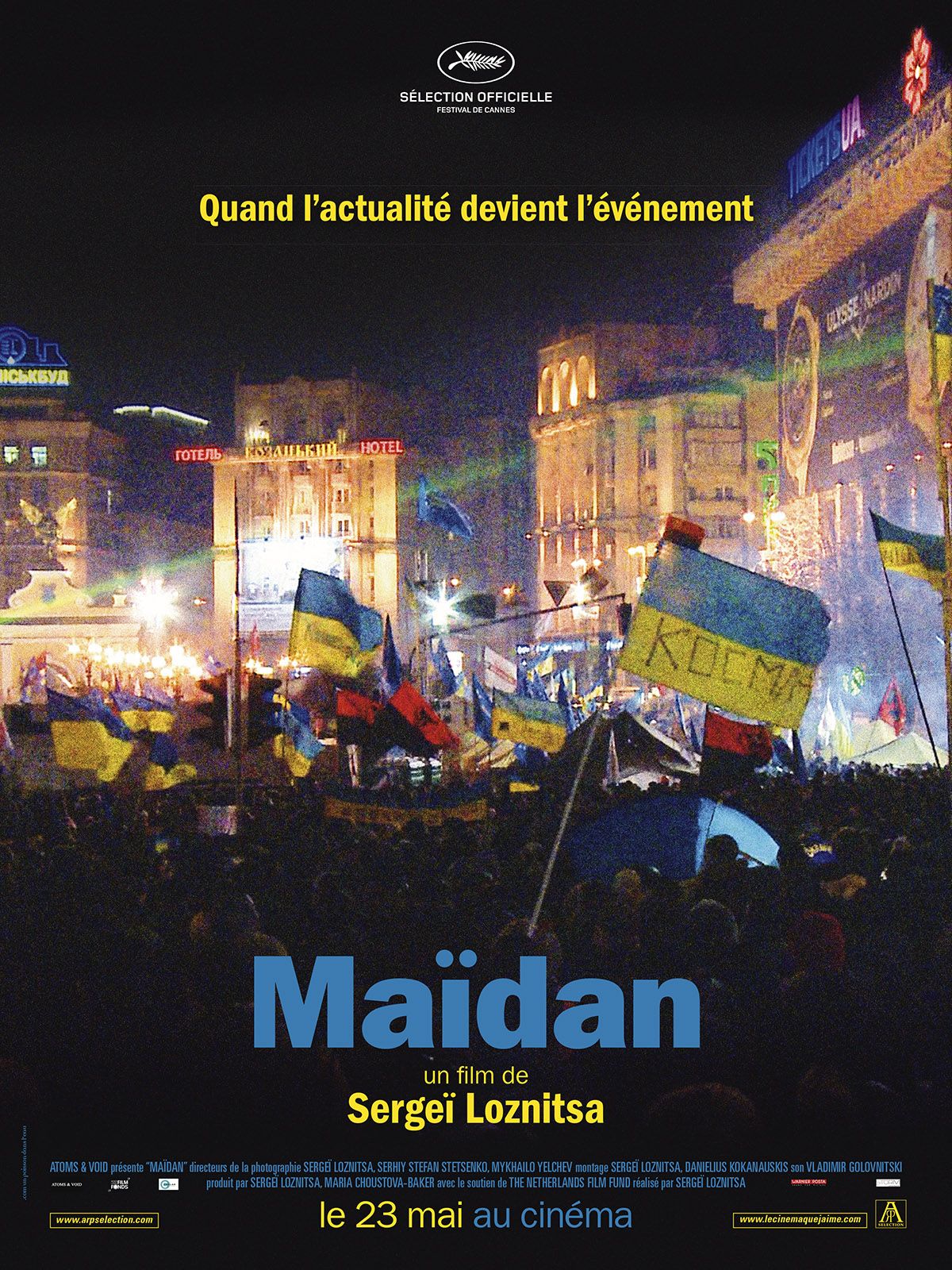
There is something of the art installation about Maidan, a documentary record of the protests in the central square in Kiev during 2013 and 2014, which makes it a moving, bold and oddly inhuman spectacle. The camera is largely kept steady and at a distance, capturing an almost anthropological view of a revolution in progress. Moments of raw humanity do manage to sneak in, but they are just as likely to be overwhelmed – many of the images in the film require a lot of searching. Whether Loznitsa was aiming for balance or a cold purely observational style, he doesn’t really succeed in either case, since the cameras are entirely focussed on the plight of the protestors and not the cops and the camera, editing and sound are often engineered to provide an emotional effect. None of this is particularly problematic, though it leaves the film feeling somewhat slight. The film’s most damaging flaw is its near total lack of context – there are only a few paragraphs of text – which robs this protest of its arguments, its debates, its flaws and its strengths. By the time the film closes with vigils and tributes for the hundreds dead, it is difficult to know why any of it had to happen.

The Boxtrolls is an odd film – less successful than ParaNorman, but more challenging. It has a wandering plot and pays too much attention to Boxtrolls messing around Minions-like, which is never particularly funny. It takes a while to get going, but by the end of it, you may have warmed to it enough for it not to matter. Or maybe not.

Night Moves is a film about environmental terrorists from an arthouse director and, hence, should have been more challenging and interesting than last year’s disappointingly mainstream The East. A pity then that after a fairly solid first half, the film reveals itself to be a context-less wallow in the old themes of guilt and paranoia. Instead of political and/or moral complexity, we get the same old ambiguity – a didactic form of non-didacticism in which the impression is given that the audience is left to think whatever it likes and is yet carefully guided towards a shrugging apathy. Kelly Reichardt avoids making a point about anything and Night Moves, somewhat shamefully, offers no opinion but attacks those who do.

As for films I’ve missed, but caught up with:

I have a fondness for Mark Cousins’ style of unembarrassed and honest pretension and I have enjoyed the infectious fun and joy of experimentation in the films What Is This Film Called Love? and Here Be Dragons. However, when Cousins is on firmer ground, he is less able to make it all up as he goes along. That problem effected parts of his massive The Story of Film series and it remains present in The Story of Children and Film. It has its moments and its insights, but it is less risky and less innovative and, therefore, less fun. On TV.
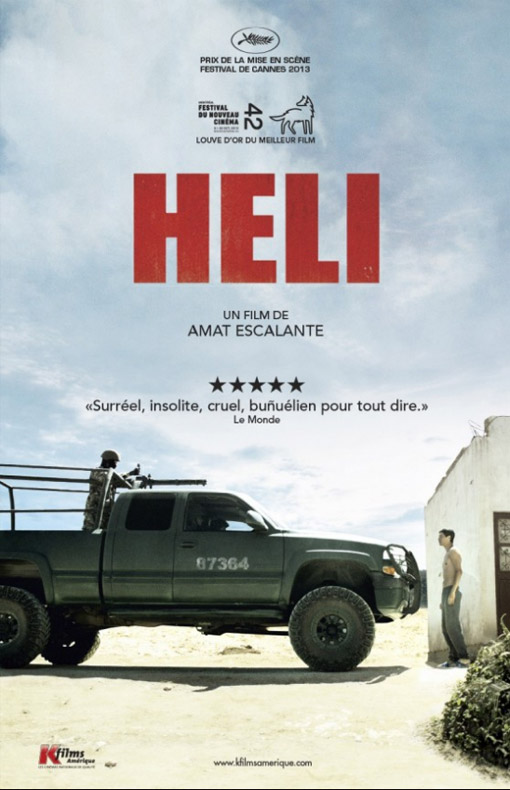
Heli is a tough Mexican crime film about drugs, torture and corruption in a remote part of Mexico. If there is a point to this film, and the long and lingering arthouse style suggests there is at least a surface point, it is lost in a parade of suffering and nastiness. Most people will come away from the film thinking about the scene where the bollocks are set alight rather than anything of value. In short, it is tough to figure out why this film exists. On TV.

Belle was better. A British costume drama that is (to a point) aware of the flaws within its own conventions, Belle attempts to address race and feminism from within the confines of the Austen-Merchant Ivory style. There are some nice scenes, particularly one in which Belle is disturbed when her servant for the day turns out to be black, suggesting that Belle is more comfortable amongst people of her own class rather than people of her own race. Ultimately, the film descends into silliness but it was a nice attempt to do something new and a welcome new perspective in an industry that is too often both white and male. Rental.

The Monuments Men should have been great fun with a nice little tribute to art underneath the comedy and drama, but it fails to strike a good balance between fun and ‘the message.’ Clooney over-sentimentalises the subject and his characters, and the ‘funny’ scenes, considering the cast, aren’t as funny as they should be. On TV.

Ida was another film that should have worked. Its story about a woman looking into her community’s past actions during the turmoil of WWII and their collaboration with the Nazis recalls the excellent The Nasty Girl. However, the film is made with a self-conscious arthouse style that recalls a degree of Carl Dreyer, but which mainly mirrors a lot of other modern arthouse films. The style adds little beyond a melancholic, leaden tone and the film’s real ideas about the past and suffering and knowledge are lost underneath such consciously austere stylistics. VOD.


The best films that I missed this year were Two Days, One Night and Starred Up, both excellent depictions of people left behind, either in the workplace or in prison. Both films are remarkably powerful and dramatic and stand as important works calling for more understanding and more communication. I’ll be writing about both tomorrow. Rental.


Friday, 29 August 2014

ARTICLE: Party Girl (1958), Or A Rumination On Auteurs and Mediocre Films


Party Girl sits somewhat nicely in between Nicholas Ray’s classic middle period and his late religious epics – capturing, one could say (and don’t the auteurists love to fit a narrative to a filmography) the style of the former and the languorousness of the latter. Or so the auteur theory, or the politiques des auteurs if you prefer, would have you believe. Watching Party Girl, it is difficult not to think of Cahiers’ critics’ influential treatise, especially since you are probably watching Party Girl because of the cachet they bestowed on Ray’s cinema, amongst others.

Despite the title, the film is primarily focussed on the morality of a gangster lawyer Thomas Farrell (Robert Taylor). He meets and develops a relationship with nightclub dancer Vicki Gaye (Cyd Charisse), who castigates him for his moral prostitution, mirroring his criticisms of her own lifestyle, after seeing him lie in court to save the skin of gangster Louis Canetto (John Ireland). They all work for the violent and unhinged Rico Angelo (Lee J. Cobb) and the law is closing in.

Party Girl begins well – excepting the dance number, which, like all the numbers in the film, feels too lazily integrated – with a bawdy, gaudy dressing room scene that seems like something out of Kenneth Anger for some reason. Farrell looks a little Anger-esque in a few scenes in which he seems to have been heavily made up. After that, there are a few nice touches that would remind fans of the seething tensions and explosive emotions of In A Lonely Place, Johnny Guitar and Bigger Than Life and Rebel Without A Cause (though, and it tears me apart to say this, it is becoming increasingly challenging to be emotionally invested in a film that has one scene much too similar to Tommy Wiseau’s The Room for comfort). A depressed Rico emptying a gun into a picture of his beloved Jean Harlow after finding out that she has just got married, and then immediately feeling chipper is one such moment. Another is a weird moment in which Farrell stares at a sleeping Vicki for a little too long and a little too hungrily before shaking his head and going away.

So, Party Girl begins looking like Kenneth Anger, morphs into a murky morality play that Douglas Sirk would have made a good melodrama out of, with occasional moments of violence that seem to point forward to Scorsese or Tarantino – a long speech about a metal pool cue preceding a battering seems particularly like the latter, so boring there and yet so shockingly unexpected here. But the film soon grows dull – the morals become simplistic, the plotting routine and the climax disappointing. Several pointless scenes follow Farrell and Vicki discussing and re-discussing the stakes, interspersed with gangster killings, which recall the endings of The Godfather films. There is a long stretch of the film in which Farrell and Vicki are waiting for Rico to make his next move, while Rico seems happy to wait and see what they are up too. So, everyone discusses the stakes again instead. Farrell eventually comes up with a plan that should get him killed immediately, but somehow doesn’t. And, in the end, Ray, or his writers (those hardworking creatures that the politiques liked to forget about unless they needed someone to blame) dispatch Cobb in the most ridiculous and lazy fashion, giving the gangster his comeuppance without trampling all over the newly – and so easily – found morality of our heroes. And then you remember that the film was called Party Girl, an odd title since the film only rarely pays attention to Vicki – and never in preference to Farrell.

In the end, Party Girl has some nice moments, but not nearly enough to sustain its running time. Nicholas Ray deserves his reputation, especially for the four films mentioned above (plus They Live By Night), but it does not shine through all of his films (see also Knock On Any Door). But where does that leave that old politiques des auteurs? There are better, or should that be worse, examples of films that have unjustly received attention, if not acclaim, thanks to a director’s previous track record. But it is difficult to sit through something like Party Girl, especially if you have a sense of expectation, and not feel that the politiques des auteurs hasn’t in some way negatively effected how we watch, or choose to watch, films. Indeed, giving Howard Hawks or John Ford or, indeed, Nicholas Ray more attention over a filmmaker like, say, Michael Bay (for whom cinema is a business enterprise and the viewer is the sucker) is an argument for this necessary evil, and a good one. But it leaves you with a list of films – in the case of John Ford, there is well over a hundred – that have the prestige but not the quality to struggle through. Meanwhile a film like, and here I’m being embarrassingly honest, Twilight or Die Hard With A Vengeance or Hostel or non-canonical works from canonical directors like Donovan’s Reef, How To Steal A Million or Man’s Favourite Sport? for me, hold more interest (in terms of gender, politics, economics or just plain entertainment). Better, anyway, than Hitchcock’s Number 17 or Ford’s The Rising of the Moon or Sirk’s Lured or Ray’s Party Girl, with significantly less good feelings and over examination. Equally, The Gunfighter is as powerful a revisionist Western as any of those by Robert Altman, but without imparting a reputation of revisionism on its director Henry King.

So is there an alternative to the politiques des auteurs or are we stuck with it? Or does it even matter anymore? These are probably not questions that anyone is still debating these days, beyond specialist circles where the latest Malick is either formal perfection or self-parody. But to sit through a film like Party Girl is a stark reminder of its still-present effect.


Tuesday, 31 December 2013

ARTICLE: 2013 Round-Up


There’s been a lot of films I have missed, ones that I didn’t bother reviewing (usually for lack of anything particularly interesting to say about them) and a ton I have been sent recently for awards consideration which I couldn’t possibly keep up with. So here’s a quick round up of short reviews.

First, ones I saw but didn’t review:

Hors Satan – A strange art film that moves between moments of extreme beauty and philosophical depth (if the idea that Nature’s cold, uncaring gaze would be embodied more accurately in the figure of a serial killer than a saint is particularly deep) and shock tactic that reach the level of Monty Pythonesque silliness. Odd, slow but somehow fascinating.

Hitchcock – Dull, tame film about the making of Psycho. Surprisingly lacking in anything interesting to say whatsoever about Hitchcock or filmmaking, with the central role taken by a pile of bad makeup. BBC’s The Girl wasn’t much better, both films failing to realize that Hitchcock – sex pest or genius – is only a portly British man who made films. It is the films that are interesting – especially Shadow of a Doubt and Rear Window.

I Give It A Year – The rom-com is now considered so bland and formulaic that the only way to breathe new life into it is to make the two central characters as unlikeable as possible. I Give It A Year thinks it is rewriting the rules, but it’s the same stuff done worse.

This Is 40 – After the long, unfunny Knocked Up and, even worse, Funny People comes an even longer, even less funny film in which Judd Apatow attempts to make an adult film about life, love and aging. Having mistaken adult themes for adult jokes, he has made possibly his most childish film yet and also his most narcissistic. Paul Rudd (Judd’s replacement) and Leslie Mann are not playing human beings, and the story about their financial woes is hard to believe since they seem to be doing so well. Elsewhere, there is a raft of bad cameos, which only make it longer and longer and longer.

Promised Land ­– Disappointingly traditional in terms of the storyline, this film is a simplistic treatment of the fracking controversy, being a film more about one man’s shifting morality, hence dodging the political for the much less controversial personal. Nonetheless, it is well made, well performed (Damon is very good in it) and it moves along at a good pace. A very good drama, but it isn’t stepping on anyone’s toes when it should be.

Stoker – Park Chan Wook’s first English language film is so stylised that it is utterly devoid of meaning. Even trying to think about it is a waste of time. It evaporated from my memory pretty quickly, though the frequent comparisons to Hitchcock’s Shadow of a Doubt (it again) can still make me roll my eyes.

Robot & Frank – A pleasant, amusing little yarn that rushes an inevitable ending a little too fast. It also runs out of steam, but it is light fun and Langella is great in it.

Frances Ha – I didn’t review it for the same reason as Stoker. It is another film that it is difficult to say anything constructive about. Frances is deeply unlikeable as are all of her friends. The fact that she is out of university and coasting, trying to find the thing that she’ll have to do for the rest of her life (something quite close to home at the moment), should have made her sympathetic but it really doesn’t. Dull, pretentious and really rather infuriating.

The World’s End – The latest Pegg/Wright/Frost film is a lot less irritatingly self-referential than Shaun of the Dead but it is probably their most pointless film yet – some good character comedy all to swiftly dropped for a derivative, unimaginative sci-fi storyline and some misplaced, contradictory morals. It is hard to imagine that the filmmakers were even enthusiastic about any of this.

Cloudy With A Chance of Meatballs 2 – The original was bizarre but very funny. The sequel is more bizarre and less funny, and it feels – sadly - a lot more tightly structured and commercial. However, it is still a lot of fun.

Awards films:

Gimme the Loot – I have been wanting to see this since I first read about it all the way back in May but it never came out in Belfast. A pity, because it is a fresh, vibrant comedy that is charming and thoroughly likable. The premise doesn’t initially sound very promising, but it is barely referred to and is merely an excuse for a wander around New York and a chance to meet some of its inhabitants. It is also a nice antidote to the entitled characters of Girls and Frances Ha. Its major influence seems to be Cassavetes’ Shadows – and Gimme the Loot is fantastic proof that a film made quickly and cheaply on the streets can be just as good as anything made by committee, indeed better.

The Last Time I Saw Macao was another one I’ve wanted to see for a while, but it was much more disappointing – especially since it is oddly similar to a lot of films that did make it to Belfast. The movement between fiction, documentary and essay recalled Museum Hours and the playful use of the East that the West sees reminded me of Mister John. It is an interesting watch, designed as an allusive puzzle in which half the fun is trying to put all of the film’s disparate elements together into one thematic whole. But, ultimately, the film is blandly inhuman – probably by intention since humans are largely absent from, if not bisected by, the frame. The real mystery is not the nourish storyline but how the past affects the present and how it can give a city a presence. Ultimately, Jem Cohen found that a museum was a much more fruitful location to address these themes, giving The Last Time I Saw Macao a rather redundant quality – one it doesn’t necessarily deserve but one it’s stuck with.

The Place Beyond The Pines Ambitious, moving and well made. When the focus shifts away from Ryan Gosling, the film does flag a little, but a little wandering is fine, since the film has a cumulative emotional weight. The film powerfully conveys how small actions can effect the future much more effectively than nostalgia and memory. In its surprisingly simple way, it is very moving.

Despicable Me 2 – I never saw the first one, but it doesn’t seem to bare too much on this dull sequel, which relies too heavily on its pointless storyline, overblown action sequences and the charmless Minions in place of decent jokes. The voice actors are all as irritating as their characters.

Upstream Colour – The best thing about Upstream Colour is that, in its own, highly original way, it makes sense. It challenges the viewer to make connections (plot and emotional) through a near unique cinematic language. It is also very nice to look at. It’s one big flaw is that it is hard, after about an hour, to maintain an interest in a plot about pigs having psychic connections to humans thanks to some maggots.

Ain’t Them Bodies Saints – Decided against seeing this at the time it was released since I thought it won’t be much more than a mixture of Badlands and The Assassination of Jesse James By The Coward Robert Ford. It isn’t, but it is nonetheless beautiful to look at, well told and nicely performed.

A Teacher – Too distancing to allow you to care particularly about the characters, but it is a decent effort, hampered a little by a too obvious Haneke influence. The final shot is surprisingly powerful, though.

These Birds Walk – Unfocused, but nonetheless important, its humanitarian message coming through despite the bumps along the way. The most uncomfortable moments may unintentionally be the filmmakers refusal to intervene during a fight, which they gleefully film regardless. Nicely shot, though, and a powerful statement about what effects the wars and aggressive foreign policies of the adults have on children.

Call Me Kuchu – The story of the Ugandan anti-gay legislation needs to be told, but this documentary’s personal focus is rather unhelpful. Though it is a moving, personal statement about the new laws, it fails to represent the society at large and it is too non-confrontational – letting one particularly venal newspaperman off the hook. It is also rather overlong, possibly the result of the production occurring while events were still on-going - it lacks a structure.

Viola – Passages from Shakespeare are repeated ad nauseam by a small group of actors while life imitates art imitating life. Fairly uninspiring.

Blue Caprice – The story of a real life case, the film tries hard not to be exploitative, and largely manages it, but fails to find an alternative approach. Isaiah Washington is very good as is Tequan Richmond, but their characters are too unknowable to sustain a drama about dependence and loss. Nonetheless, this lacking is brilliantly turned into an advantage with a subversive Psycho-style ending that cleverly mocks the cheap, lazy cod-psychology that films about psychopaths usually dish out.