Showing posts with label 2014. Show all posts

Monday, 5 January 2015

ARTICLE: 2014 Round-Up


Here is a quick round-up of short reviews of 2014 films I have seen but didn’t have the time to write up properly. All are either films seen recently for awards consideration (through my membership with the OFCS) and the rest are films I missed and saw later on TV or DVD or VOD.

The Skeleton Twins is an indie American drama taking inspiration from Ingmar Bergman in its dark themes and from Judd Apatow with its sense of humour and the casting of Kristen Wiig and Bill Hader. Both are quite good – particularly Hader – but the film does not seem sure about whether it wants to follow the typical beats of the Apatow formula or challenge and interrogate as Bergman would have done. It veers too far towards Apatow, as well as towards mawkish sentimentality, to be properly successful, but it is reasonably diverting.

A Most Wanted Man is another John le Carre adaptation to follow the success of the recent Tinker Tailor Soldier Spy. Anton Corbijn will probably always be worth watching, even if he continues picking less than brilliant adaptations (see The American). Here, he is straitjacketed by the plot-heavy story, but he nonetheless gives the film a nice feel and a forward momentum it would otherwise certainly lack. The film ends up feeling more successful than it probably should.

More successful, though slightly barmy, is Tommy Lee Jones’ new film The Homesman, which takes a funny but powerfully bleak, existential view of the Western and never lets up. It is a strange, flawed, risk-taking, endlessly intriguing film full of suffering and madness – and it is probably one of the most successful psychological Westerns yet made.
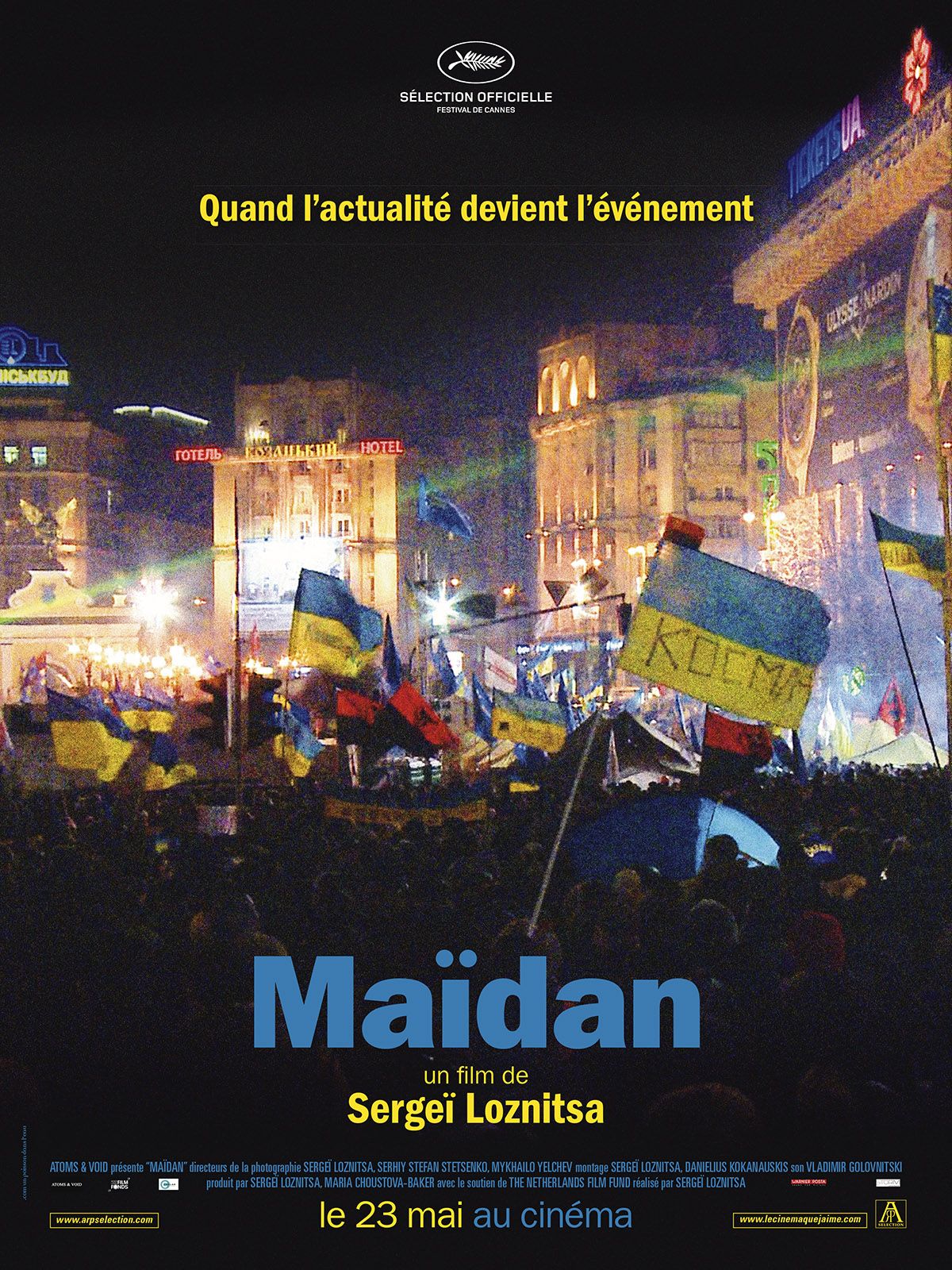
There is something of the art installation about Maidan, a documentary record of the protests in the central square in Kiev during 2013 and 2014, which makes it a moving, bold and oddly inhuman spectacle. The camera is largely kept steady and at a distance, capturing an almost anthropological view of a revolution in progress. Moments of raw humanity do manage to sneak in, but they are just as likely to be overwhelmed – many of the images in the film require a lot of searching. Whether Loznitsa was aiming for balance or a cold purely observational style, he doesn’t really succeed in either case, since the cameras are entirely focussed on the plight of the protestors and not the cops and the camera, editing and sound are often engineered to provide an emotional effect. None of this is particularly problematic, though it leaves the film feeling somewhat slight. The film’s most damaging flaw is its near total lack of context – there are only a few paragraphs of text – which robs this protest of its arguments, its debates, its flaws and its strengths. By the time the film closes with vigils and tributes for the hundreds dead, it is difficult to know why any of it had to happen.

The Boxtrolls is an odd film – less successful than ParaNorman, but more challenging. It has a wandering plot and pays too much attention to Boxtrolls messing around Minions-like, which is never particularly funny. It takes a while to get going, but by the end of it, you may have warmed to it enough for it not to matter. Or maybe not.

Night Moves is a film about environmental terrorists from an arthouse director and, hence, should have been more challenging and interesting than last year’s disappointingly mainstream The East. A pity then that after a fairly solid first half, the film reveals itself to be a context-less wallow in the old themes of guilt and paranoia. Instead of political and/or moral complexity, we get the same old ambiguity – a didactic form of non-didacticism in which the impression is given that the audience is left to think whatever it likes and is yet carefully guided towards a shrugging apathy. Kelly Reichardt avoids making a point about anything and Night Moves, somewhat shamefully, offers no opinion but attacks those who do.

As for films I’ve missed, but caught up with:

I have a fondness for Mark Cousins’ style of unembarrassed and honest pretension and I have enjoyed the infectious fun and joy of experimentation in the films What Is This Film Called Love? and Here Be Dragons. However, when Cousins is on firmer ground, he is less able to make it all up as he goes along. That problem effected parts of his massive The Story of Film series and it remains present in The Story of Children and Film. It has its moments and its insights, but it is less risky and less innovative and, therefore, less fun. On TV.
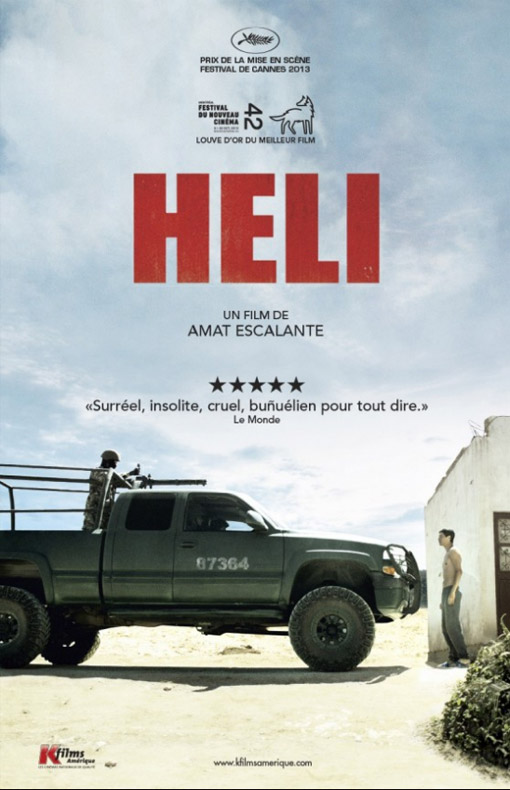
Heli is a tough Mexican crime film about drugs, torture and corruption in a remote part of Mexico. If there is a point to this film, and the long and lingering arthouse style suggests there is at least a surface point, it is lost in a parade of suffering and nastiness. Most people will come away from the film thinking about the scene where the bollocks are set alight rather than anything of value. In short, it is tough to figure out why this film exists. On TV.

Belle was better. A British costume drama that is (to a point) aware of the flaws within its own conventions, Belle attempts to address race and feminism from within the confines of the Austen-Merchant Ivory style. There are some nice scenes, particularly one in which Belle is disturbed when her servant for the day turns out to be black, suggesting that Belle is more comfortable amongst people of her own class rather than people of her own race. Ultimately, the film descends into silliness but it was a nice attempt to do something new and a welcome new perspective in an industry that is too often both white and male. Rental.

The Monuments Men should have been great fun with a nice little tribute to art underneath the comedy and drama, but it fails to strike a good balance between fun and ‘the message.’ Clooney over-sentimentalises the subject and his characters, and the ‘funny’ scenes, considering the cast, aren’t as funny as they should be. On TV.

Ida was another film that should have worked. Its story about a woman looking into her community’s past actions during the turmoil of WWII and their collaboration with the Nazis recalls the excellent The Nasty Girl. However, the film is made with a self-conscious arthouse style that recalls a degree of Carl Dreyer, but which mainly mirrors a lot of other modern arthouse films. The style adds little beyond a melancholic, leaden tone and the film’s real ideas about the past and suffering and knowledge are lost underneath such consciously austere stylistics. VOD.


The best films that I missed this year were Two Days, One Night and Starred Up, both excellent depictions of people left behind, either in the workplace or in prison. Both films are remarkably powerful and dramatic and stand as important works calling for more understanding and more communication. I’ll be writing about both tomorrow. Rental.


Saturday, 29 November 2014

REVIEW: Omar (2014)


Omar is a thriller from Palestine and like the recent ’71, it moulds difficult politics into the plot line of a thriller rather well. There isn’t anything here to guide people who know nothing about Palestine through these complex issues – a much better recent film for that would be the documentary Five Broken Cameras – but the film’s simplicity and on-the-ground realism is revealing enough, even if the mechanics of the thriller take the film closer to the ridiculous.

Omar (Adam Bakri) is a Palestinian, living in the West Bank, who regularly hops over a large Israeli wall to visit his sweetheart Nadia (Leem Lubany). Her brother Tarek (Iyad Hoorani) is in charge of the local rebels and is bringing Omar and his friend Amjad (Samer Bisharat) under his wing. After they kill an Israeli soldier, Omar is captured and brutally interrogated. The only way out is to become an informer, but will Omar be a double or a triple agent?

The film keeps a lot of its character’s motivations a secret. We are never offered anything that we can fully trust, and this sense of unease and confusion (itself not dissimilar to ‘71) is well conveyed in the first half of the film. Writer-director Hany Abu-Assad handles the action and story with a simple and direct approach without giving away any more than he has to to make the film comprehensible. Omar may either betray his friends or the Israelis or be betrayed by his friends or by the Israelis. The first half of the film is well made and often tense and surprising, though its greatest achievement is that it is entirely believable. It is valuable, even, as a snapshot of life in occupied Palestine where you have to brave walls and the bullets of unseen sentries in order to have a simple chat with your girlfriend.

Where the film is less successful is in its second half, in which believability is forsaken for the more recognisable dynamics of the thriller. The film ties itself in knots trying to come up with an ever-expanding series of twists, becoming silly and melodramatic. Though it is obviously ridiculous to expect one Palestinian film to speak accurately and eloquently of the whole Palestinian conflict, this turn seems slightly unhelpful nevertheless. Whereas the film had been a decent mix of politics and thriller, Abu-Assad allows the thriller elements to take over and the film loses believability. And where before the film unravelled with ingenuity and unexpectedness, it becomes somewhat repetitive and predictable. The ending, although a nice closer, seems to reflect the reactions of Westerners when faced with the Israeli-Palestinian conflict – the film seems to throw up its hands and laments the impossibility of any proper solutions beyond existentialist death by cop.

Though not a film about the Palestinian conflict, it is difficult to watch Omar as anything other than a political film. It avoids moral arguments and leaves the audience free to judge the film’s characters whatever way they might want, but by ditching the political (so integral to the conflict anyway) halfway through, the film becomes less believable and less relatable. The ending seems to allow the uninitiated off the hook by suggesting that the conflict is an unintelligible mess and better left alone. Decent and well-made but it sacrifices too much in its attempts to wrong foot the audience.


Wednesday, 5 November 2014

REVIEW: '71 (2014)


Since ’71 is a film set in Northern Ireland during the Troubles from the perspective of a British soldier and filmed entirely in England, one could be forgiven for feeling suspicious. Either the film is going to be grossly inaccurate or it is going to be like those American Vietnam war films that focus entirely on naïve American soldiers and ignore both the destruction and carnage they wrought and the suffering of the Vietnamese people. It is a credit to the quality of Gregory Burke and Yann Demange’s work, as well as that of the cast, that ’71 avoids these pitfalls.

Gary Hook (Jack O’Connell) is in boot camp, having only just joined the army, when he and his unit are sent off to Belfast. After a brief lesson in the history of the conflict, Hook is brought to the Falls Road to assist the RUC during a house search. Thanks to the tactics of the RUC, a riot soon breaks out. Hook is left behind during the panicked evacuation and is soon chased by two IRA gunmen (Martin McCann and Barry Keoghan). Lost and wounded, Hook tries to stay alive in a hostile environment.

The film works primarily as a thriller, giving only a short, potted introduction to the history of the Troubles. The film’s title, referring to the year 1971, seems to be a plea for a well-read audience to take the film as a thriller only and seems consciously set prior to internment and Bloody Sunday in an effort not to annoy anyone potentially offended by the sympathetic portrait of the British army in Northern Ireland. The soldiers here are seen as decent but lost, and there is a nice moment in which they are attacked by children throwing balloons of urine at them. The greener soldiers react with laughter, clearly finding the image of such furious children outlandish. The film does offer some criticisms of the British Army, though it is the commanders and the MRF, as well as the RUC, who are shown to be the most criminal. There is a rivalry between the Provisional IRA and the Official IRA and there is a band of unidentified Loyalist terrorists, too busy with their own schemes to help Hook out.

This is all that the film offers by way of historical context and, as simplistic as it may be, it is well integrated into the film, which is essentially a nighttime thriller in the vein of Walter Hill’s The Warriors or Carpenter’s Assault on Precinct 13 or certain moments from The Wanderers. Some of the film’s best moments are the surrealist visions of Belfast at night in the middle of a riot. Hook walks along a dark and empty street only for petrol bombs to suddenly explode and a crowd of faceless people to appear, running right for him. Essentially it is a film about a young man trapped in a hostile environment trying to stay alive, and the film’s use of the Troubles as a backdrop is respectful but also mere scenery. The film is not a ‘Troubles film’ particularly because its focus is on the human drama and on the suffering of all of those involved. By the end of the film, the ludicrousness of violence and war is the most strongly felt message, not one about the innocence of the British Army. The film does not take sides on who was right and who was wrong and is more about the hysteria and the fear and the paranoia. In this sense, the film also doubles as a good ‘Troubles film’ because, like In the Name of the Father, Bloody Sunday and Omagh, it replaces context and didacticism with a focus on the humanity and pain underneath.


Suggesting that ’71 is a humanist vision of the Troubles may be overstretching the point, but the film is remarkable, first, for being very well made, very well written and very well performed and, second, for taking a divisive issue and moulding it into a thriller that doesn’t feel exploitative and insensitive. The issue of the legacy of the Troubles has not yet been resolved in Northern Ireland, and a film like ’71 is hardly going to help much, but when the film depicts the last in its series of pointless, defeatist murders, there is little politics and little justification. Instead, there is only pain and exasperation. And that sure beats the hell out of our own attempts to deal with the Troubles (see A Belfast Story).


SHORT REVIEW: The November Man (2014)


This short review appears on The Upcoming here.

The November Man is a spy thriller with Pierce Brosnan, who obviously wants to try out his own darker version of Bond without getting sued. The film is based on the seventh instalment of a novel series by Bill Granger and there is apparently a sequel already on the way.

Brosnan is Peter Devereaux, an aging secret agent who is called back into action by his old boss Hanley (Bill Smitrovich) to ensure the safe extraction of Natalia Ulanova (Mediha Musliovic), a secretary of the future Russian president Federov (Lazar Ristovski), who knows something that Federov does not want revealed. Olga Kurylenko, playing committed social worker Alice, gets shoehorned into the film too.

The film disappoints almost immediately. There have been few decent action films this millennium (the first three Bourne films are all that spring to mind) and The November Man seemed to be offering a dopey but fun throwback ‘90s film. But, unfortunately, the film is humourless and painfully clichéd from the start. It is po-faced throughout, leaving the actors desperately trying to make it all seem worth caring about, and when the plot kicks in, it is either incompressible or ridiculous or both. When you finally find out the significance of the title, it is so stupid that you wonder why no one stopped it.

Roger Donaldson directs in an uninterested, slapdash fashion. The final scene is a great example of a filmmaker not in control of his medium – it just does not work. He injects a few splashes of bloody violence in an effort to liven things up, but it is clear he couldn’t care less.

There is one half-decent idea about there being so many spies running around that no one knows who is a friend and who is an enemy, but the film does absolutely nothing with it. The only other thing that is decent about the film is that it suggests that the CIA are actively involved in war crimes and is, in very general terms, evil. It is nice to see mainstream films in which the CIA are the villains but the film just does not care enough to be truly committed to this point, or any other.


Bill Granger wrote the November Man novels during the Cold War, but that is not the reason that this film feels so dated and so tired. It is simply down to sheer laziness. Dull, dull, dull.


SHORT REVIEW: Extraterrestrial (2014)


This short review appeared on The Upcoming website here.

Extraterrestrial is a horror film with a mission. Filmmakers The Vicious Brothers (actually named Colin Minihan and Stuart Ortiz) have a checklist of alien invasion and slasher film clichés and they want to tick off every single one.

The characters are not developed beyond The Final Girl (Brittany Allen), The Bland Semi-Capable Boyfriend (Freddie Stroma), The Dumb Blonde (Anja Savcic), The Promiscuous One (Melanie Papalia) and The Obnoxious Sex-Crazed One (Jesse Moss). They visit a Cabin In The Woods, have no signal on their phones and when a tree collapses across The Only Road Into Town, there is no way out. And when the aliens crash land nearby, the film runs through the same deadeningly familiar slasher film routine. A ridiculous extended cameo from Michael Ironside stinks of desperation rather than inspiration.

The one surprise that this film has to offer is that, for a low-budget horror quickie, it looks rather good. The lighting and camerawork are decent and the CGI is used sparingly, though the filmmakers repeatedly lurch into found-footage during the big special effects scenes for reasons presumably financial.

The actors try to do more than the poor and uninterested script will allow, but it is a lost cause. The script makes you hate The Obnoxious One after only one line and leaves it at that, but worst off is Anja Savcic, who is given fewer lines than an alien hand has fingers before being relegated entirely to the background. The sole bit of drama in the film is a rushed scene in which The Final Girl illogically tries to get out of a marriage proposal by claiming that we are alone in the universe. The aliens quickly show up to belie that notion and any pretence at making the characters seem like actual people ends there. The Vicious Brothers are more interested in being, well, vicious but then the film is restrained by a box office friendly 15 certificate. The only scene that could be considered vicious is one with an anal probe, which tries to make that peculiar alien obsession appear frightening rather than just wholly stupid.


The film ends with an extended tracking shot that is nasty, cynical and pranky, an amusing close scored to Elton John’s version of ‘Spirit in the Sky’ that cries out for a better film to precede it. The rest of the film is insistently unoriginal, tonally erratic and just not much fun.


SHORT REVIEW: Nas: Time Is Illmatic (2014)


This short review appeared on The Upcoming website here.

Nas: Time Is Illmatic is a documentary about Nasir Jones, better known as Nas, taking us through his early years growing up in the Queensbridge Projects in New York City leading up to 1994 and the conception, recording and release of his debut album ‘Illmatic’, one of the most acclaimed hip-hop albums ever released.

The film is a fairly standard documentary, preferring to offer quick biographies of Nas and his family intercut with talking heads and footage of Nas performing the album live in 2013. The film analyses some key tracks from the album, detailing the genesis of the lyrics and music and the truths between the lines. The film is bookended with Nas’ journey to Harvard to announce the beginning of the Nasir Jones Hip-Hop Fellowship.

Nas: Time Is Illmatic is not particularly groundbreaking in terms of form. At its worst, it resembles any cheap and quick biography with degraded footage cobbled together from publicly owned sources and released on some remote satellite channel. But for a potted history of the effects of the creation of the Projects and the GI Bill provided by Cornel West, the film often prefers to avoid context. Though it is true that writer Erik Parker and director One9 may legitimately feel that Nas’ furious but eloquent lyrics speak for themselves, it leaves tracks like ‘The World Is Yours’ and ‘One Love’ doing most of the emotional heavy lifting.

The key thing that differentiates watching the film from listening to the album are the interviews with Nas and his brother Jabari, or Jungle, which reveal the roots of the anger and disaffection that inspired Nas’ lyrics. Often filmed in the Projects themselves, the brothers eloquently and poignantly recount their troubles, the deaths and incarceration of friends and the toll that drugs took in their neighbourhood. These interviews bring across the value and truth of a record like ‘Illmatic’ with more melancholy and heart than the series of talking heads raving about the album seen earlier in the film.


Nas: Time Is Illmatic too often assumes that the viewer is aware of the socio-political causes and effects behind hip-hop and the urban African-American experience in general. It may not feel that it has to (and it probably shouldn’t have to), but the film does little of its own work. None the less, its portrait of the Projects in 2013 is as effecting as ‘Illmatic’s was in 1994.


Monday, 20 October 2014

LONDON FILM FESTIVAL: Beti and Amare (2014)


This short review appeared on The Upcoming website here as part of their coverage of the BFI London Film Festival.

Beti and Amare is a difficult film to categorize – a war romance set in 1936 with science-fiction elements made for only $7,000 in Ethiopia – and most likely one the likes of which you probably haven’t seen before.

Set during Mussolini’s Abyssinian war, a young woman, Beti (Hiwot Asres), escapes to her grandfather’s (Atrsaw Wisenbet) remote hut. They lead a meagre existence. Beti is threatened with rape by the local militia, a band of three young men in search of Italians to kill. When their goat dies, Beti’s grandfather leaves her alone in the hut, where she encounters a stranger, Amare (Pascal Dawson), who may be from outer space.

The film begins with an old-fashioned newsreel, which, despite being oddly upbeat in the face of some very real suffering, does make one pertinent observation – in times of war, it is the most vulnerable who suffer the most. The film then is an attempt to address Mussolini’s war from the perspective of those who suffered the most. Beti is a refugee, forced into a meagre life in a remote hut, living alone and under threat from men riled up by war. Beti dreams about a spaceship crash-landing on Earth, a dream that seems to come true when Beti is most in danger. Beti and Amare strike up a strong wordless friendship, one that helps Beti through her suffering and her loneliness.

The film is about suffering rather than battles and war, and it is a valuable film in this regard. Asres gives a strong performance, conveying both Beti’s vulnerability and strength without the use of a lot of dialogue. The film is well directed, particularly when one considers that it was made on a shoestring. However, the film seems to be more interested in being a festival oddity, rather than an honest and emotional story about how a young woman copes with the horrible world she finds herself in. Instead of making Beti’s retreat into fantasy the focus of the story, the film uses it as an excuse for extended flights of fancy, which ultimately overwhelm the drama at the film’s heart.

The film sacrifices coherence for strangeness, leaving one wondering what exactly was writer-director Andy Siege trying to say with the film. The film purports to be about the suffering of the most vulnerable (a fact that sets it apart already), but it loses a certain truth by focusing on oddity.


Wednesday, 15 October 2014

LONDON FILM FESTIVAL: Still The Water (2014)


This short review appeared on The Upcoming website here as part of their coverage of the London Film Festival.

A film of love, life and death on the island of Amami, south of the Japanese mainland, Still the Water attempts to represent the traditions of a small island community as two children come to terms with death.

The film follows Kyoko (Jun Yoshinaga) and Kaito (Nijiro Murakami) as they both come face-to-face with death. Kyoko falls in love with the moody Kaito, who is significantly less mature than she is. Kaito’s parents have divorced and neither seems to spend much time with Kaito, who suffers in silence. Meanwhile, Kyoko is trying to come to terms with her dying mother. Then Kaito finds a corpse floating in the sea.

The film has a real human warmth to it, and there are many scenes that manage to convey some universal truths about life and death and our inability to fully grasp these big questions. The main problem with the film is that its success or failure may depend on the degree of one’s sympathy for films that juxtapose the permanence of nature with the human struggles playing out in its midst. In this respect, the film is much too long and somewhat conventional for its own good. A more experimental or vibrant film might have better represented these themes more successfully than a lot of sober looks into the middle distance followed by shots of wind blowing through foliage. Oftentimes it feels cold and intellectual when it should be emotional and the graphic goat slaughtering scenes seem to paradoxically suggest that the kind of natural grace the film represents is only open to humans. Similarly, the film’s triumphant ending, thanks to a judicious use of blur, seems to unintentionally suggest that an embrace of nature should only go so far.


The film ends with a typhoon, which both threatens to engulf the humans or bring some sort of clarity, but the film remains somewhat vague. The character’s emotional journeys are clearly mapped out (almost too precisely) but we are left with a feeling that we have not learnt anything we didn’t know before. One death scene is presented lyrically and rather movingly, but only because it totally ignores the pain and the discomfort of the act of dying. It is a warm film, but it feels only surface deep – a film betraying the influence of Malick, Herzog, Kurosawa and Mizoguchi but few ideas of its own.


LONDON FILM FESTIVAL: Oxi: An Act of Resistance (2014)


This short review appeared on The Upcoming website here as part of their coverage of the BFI London Film Festival.

Oxi: An Act of Resistance is an essay film by Ken McMullen and it takes a unique and experimental view of the economic turmoil in Greece.

The film strives to draw a parallel between Greece’s economic problems and the tragedies of Sophocles and Aristophanes, suggesting that Greece, and the EU in general, have departed from the values of the past and that this is what has lead in the current crisis. The Greek classics espoused democracy and a politics based on love and understanding rather than a politics of economics and party lines, as shown by the democracy of Pericles, which was, among other things, the original welfare state.

The film is interspersed with quotations from Thucydides, which remain remarkably relevant for a text that is two and a half thousand years old. The film opens with one quotation which claims that human nature, being the way that it is, is always going to repeat itself – indicating, first, the historical precedents for the inequalities of today and, second, suggesting that these classics contain important lessons for today. This point is made succinctly as the camera lingers on some ancient Greek landscapes, suggesting a permanence between the past and the present. Several interviewees argue for the return of the values of these ancient writings, often passionately and with inspiration.

The film is at its best, then, as an extended lesson in classical literature and its relevance today. But where it is less successful is in its attempts to restage scenes from these plays, updating them for a new audience. It becomes an exercise in performance, which looks a lot more artificial and cerebral than the impassioned and moving testimonies of real people. Worse still is the fictional element in which a detective, Inspector Pinon (Dominique Pinon), horrified that anyone would dare ‘steal’ the words of Sophocles and Aristophanes and make them relevant for today, castigates writers and actors. The point is that these classics are not set in stone, but live and breath today, but the way the film attempts to demonstrate this is both pretentious and somewhat contradictory.


The film works best as a dialogue between classic Greek literature and the current problems in the world. The people interviewed call for the return of the principles of the past and the film is a moving and fascinating testament to what we have lost. But it often uses too much artifice to tell a plain and simple truth.


LONDON FILM FESTIVAL: Kelly and Cal (2014)


Kelly & Cal Movie Poster

This short review appeared on The Upcoming website here as part of their coverage of the BFI London Film Festival.

Kelly (Juliette Lewis) has just had a baby with her husband Josh (Josh Hopkins), and is now wandering around her house, trying to get used to the idea of motherhood and domesticity. She meets Cal (Jonny Weston), a teenager in a wheelchair, whose rambunctious past and trapped present mirrors her own. They strike up a relationship that will threaten everything Kelly has.

Kelly and Cal is yet another American indie film about a lost middle-class woman torn between her materialistic friends and a more anarchic past. Kelly used to be in a band – a Riot Grrrl band called Wetnap – though her mellowing is typified by an embarrassed nostalgic fondness for Bryan Adams. As it goes with films like this, she finds release in an outspoken younger man whose hatred of all compromise and tradition represents first what she has lost and then, when the film begins to re-establish the status quo for its safe ending, his dangerous immaturity. Jen McGowan and Amy Lowe Starbin, the director and writer respectively, ensure that their film about repressed non-conformity hits all of the typical beats, smugly mocking Kelly’s in-law (including Cybill Shepherd) and friends for their wholly blinkered and materialistic view of life and yet re-establish these very things for the ending in which Kelly finally embraces motherhood and domesticity. Kelly’s fears and her attempts to escape from her big house and tightly knit family are revealed as something rather selfish, rather than something truly self-fulfilling, and the film ends triumphantly (to the upbeat twangs of an indie song) with her having learnt her lesson.

The actors are all rather good, but they are never given anything to do. McGowan and Starbin prefer dramatic scenes to end with one character storming out while the other looks on, agape, shaking their head in sadness and confusion. The viewer can be forgiven for wishing that they would simply yell and scream at each other until all of those not so subtle nuances were laid clearly out in the open, instead of this series of barbed, pointed statements followed closely by a slammed door. When Cal drowns out Kelly’s complaints by playing the drums, one wants her to toss the drums out the window. Instead, she leaves.


Films such as this, presumably about repressed emotions, are much too often repressed themselves. It is a half-decent film well acted, but there doesn’t seem to be any real heart in it.