Showing posts with label germany. Show all posts

Wednesday, 2 December 2015

REVIEW: West (2015)


West is an interesting film. A modern German film set in the 1970’s about a woman and her son emigrating from East Germany to West Germany, which examines the similarities between the two halves of the state, rather than merely considering the former as a site of cold bureaucratic menace and the latter as one of freedom and opportunity.

Three years after the death of her lover, Nelly Senff (Jӧrdis Triebel) smuggles herself and her young son Alexei (Tristan Gӧbel) into West Germany. Housed in a refugee camp, she goes through the process of collecting enough stamps to be legally allowed to make a life for herself in the West. One stamp involves getting the all clear from a tough intelligence agent, John Bird (Jacky Ido). The longer it takes Nelly to get the stamps she needs, the more she begins to realize how little the West is different from the East.

Our films, as well as our histories, are fond of showing a dark, unpleasant Orwellian East (Soviet bloc) in opposition to a free, colourful and open West. We have enough films like The Lives of Others about East Germany and the Stasi, but few enough about the equally cold and bureaucratic West. West revolves around the same Kafkaesque set-up as these other films, but its main difference is in showing that this kind of dehumanising processing was not unique to the Soviet bloc. Indeed, in one scene, it is an arch picture of Carter hanging on the wall, rather than a tough, uncompromising picture of Stalin. Later, we see Alexei playing with a friend, both of them sitting by a tall chain-link fence with West Germany and normality beyond. The parallels with the current plight of refugees in Calais is obviously unintentional (the film was made in 2013), but nonetheless telling.

However, where the film works best is in the quality of its cast. Triebel gives a fantastic performance as a woman trying to comply whilst also keeping some sense of personal liberty and dignity. Her strong performance ensures that the film is as much if not more about her character’s struggles than any overarching political message. The film’s examination of her attempts to make a life for herself and her son indeed recalls the feminist but fairly non-political Alice Doesn’t Live Here Anymore.

Anchored by a strong central performance and intriguing for its rare view of Soviet-US bloc parallels, the film makes a slight misstep with the shady past and indeed possible present by Nelly’s former lover, who may just be a Stasi informer and who may be attempting to contact her. Where the film had previously worked as the story of one woman’s struggles, this development moves the film into spy movie territory, a convoluted storyline that distracts from the real drama of the film.


West then is a moving drama that has the ring of lived-in authenticity and strong performances. Questioning what it is that we call freedom, it feels as much a film about today as one about the 1970’s, which is really what all films set in the past should feel like. Worth seeking out.


Thursday, 19 February 2015

BERLIN FILM FESTIVAL: The Money Complex/ Der Geldkomplex (2015)


This short review appeared on The Upcoming here.

It is hard to know what to think about a film like Der Geldkomplex (I am assuming the English translation – The Money Complex – isn’t a particularly good one), largely because it isn’t very clear.

The film begins with a man being coached in how to ask for money in German. The household needs money, but they don’t seem that bothered about getting any. They lounge around in what is presumably a holiday home and avoid doing anything too laborious. It becomes increasingly clear that they may be bankrupt.

Der Geldkomplex is intriguingly odd to start with, but halfway through it becomes clear that it hasn’t explained anything. The film offers no explanations and the viewer will have no way to understand what is going on in the film – if, indeed, anything is. This isn’t helped by the film’s absurdist streak, which finds room for a woman’s extended (and rather good) impression of a chicken.

At first, it seemed that the film was about the decadent rich – the world is collapsing around their ears and they are still too idle and removed to notice. But that doesn’t quite fit with the films opening quotation from Lenin about the fact that the banks helped foster socialism. There doesn’t seem to be much socialism going on in the film – though maybe the characters here are avoiding society because they think it has a corrupting influence. Hence, the lack of action is in fact meant to be suggesting that there isn’t a lot one can do in a world that one finds shameful.

Maybe. At one point, it does set up a dichotomy between love and money, suggesting again that living properly in this capitalist world is difficult and unfulfilling. Fair enough, but couldn’t this point have been made with a little more humanism. The point isn’t helped by the fact that the film’s characters, or political outsiders if that is what they are, are clearly more privileged than most. Surely a film from the perspective of the working poor would be more valuable, though that is assuming that this film intended to address these debates about capitalism and recession and our way of life in any real way.


Juan Rodrigáñez, whose directorial debut this is, has crafted an intermittently amusing but wholly vague film. It seems to have a political message, but it isn’t particularly clear what it is.


Tuesday, 9 September 2014

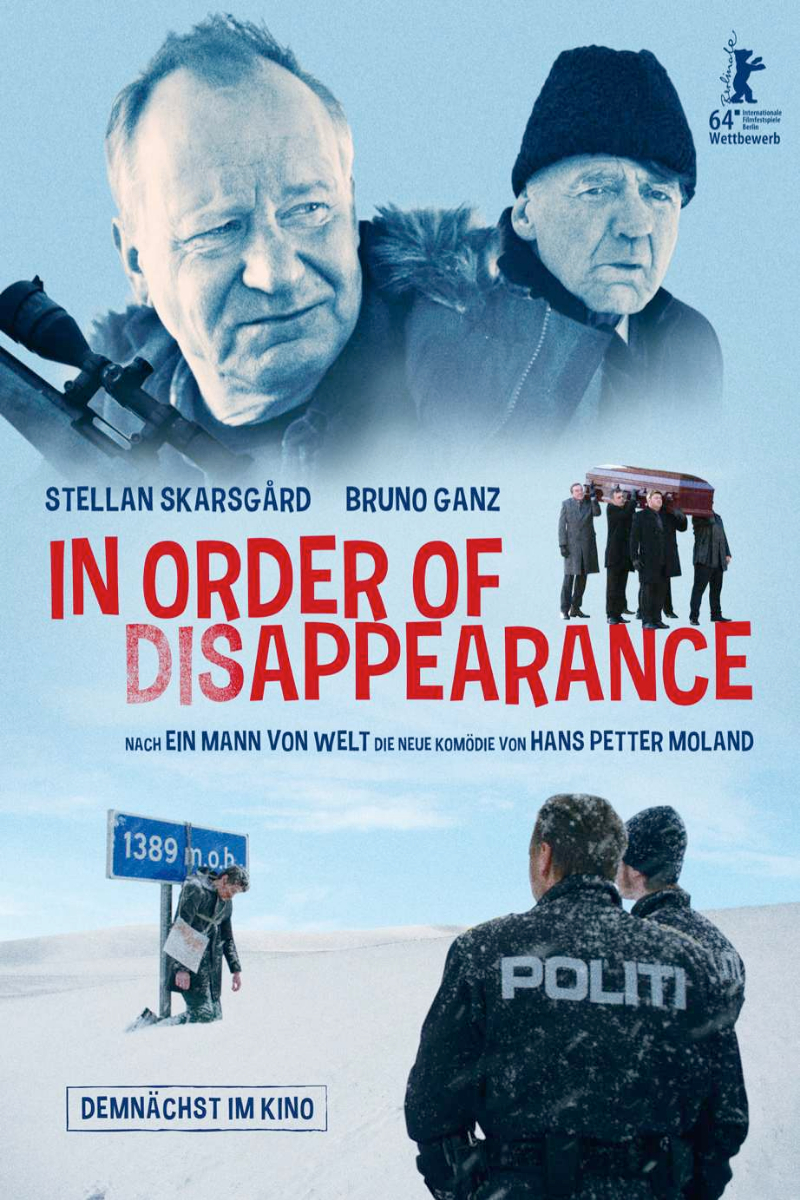
SHORT REVIEW: In Order of Disappearance (2014)


This review appeared on The Upcoming website here.

‘A Scandinavian crime film’ and a ‘Crime-comedy in the vein of Quentin Tarantino and the Coen Brothers’ are two of the least appealing descriptions in modern cinema. Such things are now ten a penny and rarely worth sitting through. However, In Order of Disappearance (Kraftidioten) manages to transcend these simplistic descriptions by being, well, good.

After his son is murdered by gangsters for something that he did not do, his father Nils (Stellan Skarsgård) decides almost immediately to take revenge. Despite there being nothing in his past to suggest that he should be any good at this kind of thing, he proves remarkably able. It is not long before kingpin Greven (Pål Sverre Hagen) takes notice. However, his inability to figure out who it is that is killing his men leads to a series of further misunderstandings and more bloodshed.

The last high body count gangster comedy with arthouse cachet was the late Aleksey Balabanov’s tiresome The Stoker, so there does seem to be little precedent for the success of a film like In Order of Disappearance. Yet it does. Aakeson and Moland seem to have decided to shove in all of the tropes of crime cinema. The story goes along at a very fast pace – writer Kim Fupz Aakeson and director Hans Petter Moland are either much too eager to get to the shootouts or they are mocking the too familiar plot points of this kind of film. The film is slightly mocking throughout, with lots of stupid laughs. Characters appear only to very quickly be dispatched and the intertitles displaying the names of those just killed along with the symbol of their respective religions are a constant presence. The film largely maintains an off-kilter and unpredictable feel, and it plays out with great verve.

Sadly, it has no characterization whatsoever. Skarsgård is given very little to do throughout and most of the other characters are barely discernible beyond slight details speedily presented and tangential conversations about the joys of Norwegian prisons and how no country has both sunshine and welfare.


Though the film is amusing throughout and quite a good parody of its genre, which is too often used as a simple framework for gruesome violence and bad writing, it is difficult to work out why it exists. It is a good deal of fun, but the film really could have used a point.


Friday, 16 May 2014

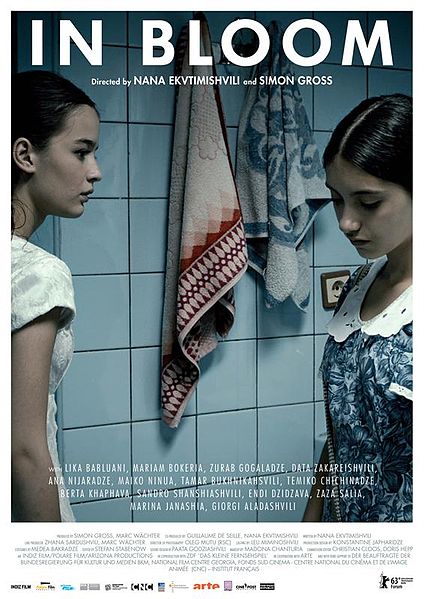
REVIEW: In Bloom (2014)


In Bloom is a Georgian film directed by Nana Ekvtimishvili and Simon Groß. It won Best Film at the 2013 Hong Kong International Film Festival and was Georgia’s entry for the 2013 Academy Award for Best Foreign Language Film – which bizarrely allows only one submission per country.

Set in Tbilisi, Georgia’s capital, as the effects are still being felt of the collapse of the USSR and there is war in Abkhazia – a disputed region then considered part of Georgia until the 2008 Russo-Georgian War. Two young friends Eka and Natia (Lika Babluani and Mariam Bokeria, both only 14 during the production) live in an area torn apart by criminality and economic stagnation. We see them first in vicious breadlines fighting with other people for loaves of bread. Their home life is difficult as well, with deeply unhappy parents on both sides. However, Eka and Natia do not allow their situation to keep them down and the film charts how they manage to survive in their surroundings.

The film offers a thoroughly bleak view of life in Georgia in 1992 – though the references to fighting in Abkhazia may remind viewers as much of 2008. It is a world is which violence has been almost entirely naturalised. Early on, one uncomfortable scene around in dinner table escalates very quickly. When Natia’s apparent boyfriend Lado (Zurab Gogaladze) gives her a gun in order to protect herself, she is barely surprised – in fact, it is almost a romantic moment, representing how much he cares for her. Later, Natia shows it to Eka and her friend does not flinch. Eka is also being bullied for no apparent reason by a local kid Kopla (Giorgi Aladashvili) – though a scene in which a sudden revelation offers a possible reason for Kopla’s bullying is one of the more unexpected and heartrending moments in a film that refuses to reveal details until they can be put to most effective use.

Though bleak and unsparing in its depiction of a society under extreme pressure, In Bloom is far from depressing. The film is a work of social realism, not unlike the work of Ken Loach, but with one refreshing difference, which may just make it unique. The film is full of violent and angry young men and Eka and Natia have fathers that are either absent or abusive. And though there can never be enough films that reveal the effects of poverty and economic collapse on the poorer regions of urban environments, they too often take an exclusively masculine view. In Bloom is about women and how they have to deal with poverty, patriarchal violence and oppression.

In Bloom
, then, is a film about defiance. Eka and Natia would seem to have a deeply unhappy existence – Tbilisi was wracked by violence and recession as well as a fiercely patriarchal society – but they never give up and they always fight back. But, the film is not so simplistic as to simply praise defiance – it offers a much more optimistic version of the same old story. Crucially, Eka and Natia are able to retain their independence from the men around them. In one great scene, Eka skilfully dances during an unpleasant marriage though the film is never clear whether she is defying the conventions of the wedding to show her distaste or simply dancing because she wants to. In the end, Eka and Natia may either succeed or fail – but they succeed or fail entirely on their own merits and flaws. A fairly traditional narrative plays out but thanks to its female focus and the filmmaker’s genuine feminist agenda, In Bloom feels fresh.


The film also features some remarkably good performances from its young cast. Ekvtimishvili and Groß direct in long takes, allowing these young men and women the opportunity to thoroughly convince. The performances are remarkably good when one considers both the age of most of the cast and their lack of experience in front of a camera. Lika Babluani and Mariam Bokeria, non-professionals both, in the lead roles are particularly good and demand and maintain one’s attention. Ekvtimishvili and Groß’s direction is equally noteworthy; their handheld camera lingering on certain images, discovering moments of beauty that may have simply gone unnoticed amid the breadlines and urban decay. In Bloom is, in some ways, a difficult film to pull off but Ekvtimishvili and Groß succeed with originality, ambition and integrity.

In Bloom is a work of social realism, a film that has something important to say about deprivation and violence, but it is also a surprising, rich and moving drama about two young women trying to be themselves in a cruel world. It is a film of empathy and understanding, but also one that is refreshingly female in its focus, if not genuinely feminist, and a significant contribution to world cinema.

See also:

A shorter review of In Bloom from The Upcoming website is available here.


Wednesday, 14 May 2014

SHORT REVIEW: In Bloom (2014)


This short review appeared on The Upcoming website here.

In Bloom, directed by Nana Ekvtimishvili and Simon Gross was Georgia’s official entry for the 2013 Academy Award for Best Foreign Language Film and won Best Film at the 2013 Hong Kong International Film Festival.

It is a dark, realist tale set in 1992 about two friends, Eka (Lika Babluani) and Natia (Mariam Bokeria), trying to survive adolescence and marriage in a fiercely patriarchal society of Tbilisi, Georgia. The film is a bleak view of life in Georgia with a clear focus on the violence seething just underneath the surface of everyday life – the sudden appearance of a gun seems to shock no one. Eka and Natia do suffer, but they are completely defiant and, crucially, independent of the cruel masculine world around them. That the film’s traditional narrative ultimately plays out in an unexpected direction is both a statement of the originality of the filmmakers and the honesty of their feminist agenda.

As far as the mechanics of the plot go, it is not overly unique, but it works on the intensity of its performances and the toughness and integrity of its approach. It is beautifully shot, the handheld camera discovering and lingering on moments of aesthetic beauty as it goes, finding beauty in images of breadlines and urban decay. It is passionate, socially aware filmmaking with complex long takes capturing raw humanity more evocatively than most documentaries. It is also pleasantly optimistic where it could have been depressing.

The performances are very good, particularly non-professional young actors Babluani and Bokeria, who bring more experience, emotion and honesty in their roles than their ages (14 during filming) would suggest possible. They demand and maintain one’s attention and empathy throughout.


In the end, the film is a rich, realistic and moving story about friendship and defiance.

A longer review is available here.


Friday, 21 March 2014

REVIEW: The Grand Budapest Hotel (2014)


Mixing Lubitsch, Hitchcock, the writings of Stefan Zweig and possibly such ensemble works as Grand Hotel, Wes Anderson has made a genre pastiche that retains his own insular preoccupations despite the apparently free wheeling wit and whimsy.

The plot is gleefully convoluted. A young writer (Jude Law) encounters Mr Moustafa (F. Murray Abraham) in an empty Grand Budapest Hotel in 1968 and they strike up a conversation during which Moustafa is called upon to reminisce about the glory days of the Grand Budapest and his own beginnings in the hotel as a lobby boy. Zero Moustafa enters the hotel in 1932 and is put under the strict tutelage of M. Gustave (Ralph Fiennes), a foppish old charmer who sleeps with a lot of the older ladies who visit the hotel. The death of one of his conquests, Madame D. (a much made-up Tilda Swinton), leads to a complex plot involving murder, dangerous relatives, the theft of a priceless artwork and a chase across Eastern Europe.

The majority of the film is taken up with a fast-paced chase storyline, designed and played like a 1930s-1940s screwball comedy, coupling the fast talking of His Girl Friday with the antics of To Be Or Not To Be, with a slight measure of the melancholy of something like The Shop Around The Corner thrown in. Ralph Fiennes is great in a comic role designed perfectly to showcase his comic timing and ability to talk quickly but clearly. Indeed, few other characters make an impression alongside him – and few are even given the screen time to make an attempt – allowing Fiennes to dominate the film.

That said, it remains Wes Anderson’s film, and ultimately The Grand Budapest Hotel will stand or fall based on one’s own ability to enjoy Anderson’s typical trademarks. The lateral camerawork (mainly moving only either forward and backwards or side to side at ninety degrees to the action) works well here where it felt only like an affectation in Moonrise Kingdom. The quirky humour is often in keeping with the tone of the film as is Anderson’s fondness for extreme artifice, which remains somewhat irritating. The world of the film is again one of strict rules and hierarchies. All of the above made Moonrise Kingdom feels like such a soulless work even despite its obvious emotional honesty, but in The Grand Budapest Hotel it feels that Anderson has finally found the right story on which to hang his preoccupations.

And yet it isn’t as successful as it might at first appear. The film noticeably flags in the middle and there are many unsuccessful attempts to spark it up. Sudden bursts of violence, though never realistic, create tonal shifts that are too off-putting in a film that has no real reason to be engaging in them. Similarly, the profanity, initially so funny because it is initially so surprising in a film so apparently prim and proper, becomes an old joke. The artifice of many scenes and the attention to detail in many of the sets and props only distract from the characters that Anderson seems to want us to empathize with. In the end, it gives The Grand Budapest Hotel a somewhat unpleasant feel, a dishonesty or coldness that may impair your enjoyment of the film. This proves particularly harmful when the film becomes properly melancholic in its closing moments. Here the film should be moving and heartbreaking – and there are plenty of ideas here that suggest that it could have been – but it only feels like a final flourish from a trendy filmmaker who doesn’t really care either way.

The film ends nicely as it begins. In what is apparently the modern day, a young woman finds a statue of an author in a seemingly deserted Eastern Europe city. She opens one of his books and is transported back to the time when the author (Tom Wilkinson) wrote the book. In writing the book, the author is in turn transported back to his younger self (Jude Law) who meets the older Zero Moustafa (F. Murray Abraham), whose tragic story will form the plot of the book that the older author is writing. Moustafa’s story transports us to 1932 and the bulk of the film. This is mirrored at the end of the film by a few short shots bringing us from 1932 to 1968 to 1985 to the final shot of the young woman reading by the statue of the author – a sequence that is delicately realized and acts as a moving and melancholy portrait of the loss engendered by the march of time and man’s foolish cruelties. However, it is difficult to believe that this sequence is truly heartfelt and not more a mere gesture, one more vacuous tonal shift to keep the audience on their toes. There is heart here surely – and this is clearly borne out by the tribute to Zweig, who tragically committed suicide along with his wife in Brazil in 1942, left hopeless by the tragic and horrendous events in Europe at the time – but it is packaged in a film that is too cool, too stylised, too dead inside to be truly emotionally engaging.

All of Anderson’s films (I haven’t seen The Darjeeling Limited and Fantastic Mr. Fox) are fairly cold and a little mechanized, inhuman. Though with Moonrise Kingdom and The Grand Budapest Hotel there is a vague sense that he is softening up, it is not yet nearly enough. As fun a romp as The Grand Budapest Hotel may be for the majority of its running time, it remains just too eager to shock, surprise and poke fun to be truly emotionally involving when it suddenly decides to shift into a darker register. It merely feels like a dishonest film that wants to pluck at the heartstrings but is too cool to risk looking soft. And though it has been organised and timed like a precise and complex grandfather clock, it is still just as inanimate.


Wednesday, 12 March 2014

REVIEW: Only Lovers Left Alive (2014)


The Twilight films, in their depiction of untroubled romanticism, finished with a large question mark hanging over them, one that the first film’s poster referred to without addressing – “When you can live forever, what do you live for?” Jim Jarmusch, despite giving assurances in the March issue of “Sight and Sound” that he has not seen the Twilight films (or any vampire film and TV series more recent than Tomas Alfredson’s turgid Let The Right One In), sets out to look at this question in more detail.

Adam and Eve (played by Tom Hiddleston and Tilda Swinton) – named more in reference to the length of time that they have been on the planet rather than for any religious significance – are two vampires stuck in the modern world. Adam is a Romantic and a moody rocker, disillusioned with life and with the humans he is surrounded by (he calls them ‘zombies’), and considering suicide. Eve is older, much older, and has a more Classical bent, still boundlessly curious and excited by the world and content with the awareness of the circularity of life, having an apocalyptic relish for the coming fall of the West. Both are fairly reclusive and, despite Adam living in Detroit and Eve living in Tangiers, are very much in love.

The film is primarily about the wealth of knowledge and interest that the world has for people and, in this way, it is disarmingly optimistic. Eve believes that the humans, particularly the West, will soon lose their battle against the Earth and that some kind of apocalyptic reversal is coming, though having seen all sorts of plagues and floods (as well as the Inquisition) she doesn’t seem particularly bothered. However, she is boundless excited about being alive. When she packs for a trip abroad, she fills her suitcase with her favourite books – two books that are easily discernible are Cervantes’ “Don Quixote” and David Foster Wallace’s “Infinite Jest”, showing her ability to still be inspired. Adam, meanwhile, is depressive and contradictory and allows himself to get bored. He pretends that he has no heroes, although he has a wall covered with framed photographs of people who could only be heroes – Kafka, Proust, William Burroughs, Neil Young and Buster Keaton among them. Adam’s centuries-old ennui is made the butt of a few jokes, the kind that may bring only a murmur of appreciation from some of the audience but are welcome nonetheless. However, when Eve discovers his plans for suicide via a specially designed wooden bullet, she is outraged. In one great scene, she tells Adam about what makes her want to keep living, before putting on a record to which they both dance, and not at all like amateurs. The heart of the film is in this scene, creating a sense that curiosity and the joy of discovery is where the value and meaning of life lies – ultimately the film is about being glad to be alive.

The film has an infectious love of culture and science and, particularly, music and many of the film’s best scenes are simply moments revelling in these simple pleasures. Adam and Eve’s breadth of reference is not the product of snobbery, as Eve’s sister Ava (Mia Wasikowska) mistakenly claims, but the entirely enviable product of time well spent. The appearance of Ava midway through the film gives a sense of urgency and heightens the plot in a way that was not entirely necessary, since the film was enough fun when Adam and Eve were merely hanging out.

In a timely fashion, the film is able to create a sense of the destruction and desolation of the earth by the zombies. The film shows Detroit as an empty wasteland, full of cavernous abandoned buildings, the real world equivalent to the Gothic castles of tradition but equally a sign of the zombies’ destruction and waste. Despite their obvious political resonance, these sequences do not feel as heavy-handed as they may seem since any ancient vampire with an ounce of nostalgia would be angered by a huge music hall's relatively immediate transformation into a car park. Adam frequently derides the zombies’ ability to ignore or undo their own great achievements such as Detroit’s auto industry or the works of Nikola Tesla, thanks to whose work Adam has found the means to develop a machine that creates clean energy and which he is too bitter to share with the rest of humanity. However, Only Lovers Left Alive is an optimistic film, and where Detroit may represent the decline of American industry – though the music still seems to be pretty vibrant – and of the West in general, Tangiers represents a kind of hope. Though similarly crumbling and full of vice but nonetheless multicultural and very much alive, Tangiers seems to suggest that the zombies can still surprise – especially towards the end when Adam is moved by a performance by Lebanese singer Yasmin Hamdan.

Jim Jarmusch has not always been the easiest filmmaker to like – the inclusion of Neil Young on Adam’s wall of heroes can only bring back memories of the awful Year of the Horse. With Only Lovers Left Alive, he has made a film that is unexpectedly romantic, funny and excited by life. It has an infectious love of music – the music choices feel slightly dated but totally assured – and for writing. Optimistically, it suggests that love and culture can make life worth living and that time should be spent wisely lest any of it be missed. Only Lovers Left Alive does not have a highly original message, but it is one worth transmitting and if the method of transmission is as pleasing and imaginative as this, why complain?


Tuesday, 4 March 2014

REVIEW: Nymph()maniac Parts 1 & 2 (2014)


Divided into two parts for commercial reasons, but worth seeing in one sitting – most art house cinemas are allowing the option of seeing them together with a short interval – Nymph()maniac has been declared as Lars von Trier’s magnum opus and it certainly feels like a summation of his career, of both the films and the public controversies.

nymphomaniacIt is difficult to write about what Nymph()maniac is about since it is a highly deceptive film, seemingly about nothing in particular and about everything at once. Seligman (Stellan Skarsgård) is walking home when he spots a woman lying in an alley, brutally beaten. She calls herself Joe (Charlotte Gainsbourg) and, refusing medical help, agrees to go to Seligman’s flat for a cup of tea and some rest. Once there, she starts to talk about her life from her first sexual experiences to her adulthood coping with, as she insists on calling it, nymphomania. Insisting also that she is a bad person, her stories are intercut, and frequently punctured, by Seligman’s digressions into all kinds of subjects that seek to naturalise her seemingly extreme behaviour. This digressions move from the art of fly fishing to Bach’s music, to differences between Eastern and Western theology, to mathematics and art.

Nymph()maniac is, in many ways, a highly satisfying art film in the best sense of the term, since it is a fascinating and multifaceted discussion of a series of themes all presented to an audience positioned to watch critically and engage with the subject matter. The film’s Brechtian devices allow the audience some distance from the often intense drama, allowing them to question the events onscreen and come up with their own conclusions concerning what the film is about and what the film is doing. These Brechtian devices are present in many different forms and are often fascinating to detect. The film begins with Joe lying in the alley, snow gently gliding down onto the scene while the camera focuses on the sets, creating a sense of the construction of the scene as opposed to it’s drama. This is also the site of the film’s first major disruption – the sudden explosion of Rammstein’s “Führe Mich” – that immediately throws the audience out of whatever impression they were forming of the film. Taken as a distanciation device, it is a powerful moment of upset that would probably make Brecht, or Godard, proud. It also represents a certain bravery in Lars von Trier’s film, which gleefully subverts the conventions of ‘good’ art, since the sudden inclusion of this song is so disruptive and, ultimately, hard to take. It also reveals how, even from the opening minutes, Nymph()maniac is not afraid to risk losing you.

The film is a discursive, dialectical work that offers a multitude of perspectives and arguments over one significant, unifying theme. As a result, it may appear to be about nothing – a meaningless exercise in brutality – though it is the arguments and the digressions and the film’s refusal to simplify its themes into easily digested titbits that makes Nymph()maniac worthwhile. While Joe recounts her life story – unreliably since her stories (told in eight chapters) seem to be based on objects littered about Seligman’s room – she could be seen to be confessing her crimes in a final act of masochistic penitence. Either this or she is gleefully asserting her nymphomania, wanting to shock the intellectual Seligman. Seligman, however, insists on drawing parallels between her behaviour and a variety of subjects, including art, architecture and mathematics. Gainsbourg subtly conveys a degree of annoyance, flustered that the frequent shock tactics in her storytelling only seem to invigorate Seligman’s intellectual curiosity. Only towards the end of the film is Seligman properly appalled (on the subject of Joe’s pity for paedophiles) and Joe gleefully argues her position, seemingly changing his mind on the subject.

This seems, to me, to be key to the understanding of the film. The film is loaded with references to Lars von Trier’s previous work and to his public appearances. Seligman’s comment that anti-Zionism and anti-Semitism are too frequently confused would seem to be a gesture towards the controversy surrounding von Trier’s Nazi comments which had him declared persona non grata at the Cannes Film Festival in 2011. He also recreates the controversial scene of child death from Antichrist as well as that film’s themes of female sexuality as monstrous. The film has Joe’s husband Jerôme (Shia LaBeouf) suggest she see other men in order to help their sexual relationship as well as having Joe have a spontaneous orgasm played as a religious experience, both suggesting Breaking The Waves. Joe’s shock tactics, if that is what they are, may represent what are perceived as von Trier’s own shock tactics. As a result, the figures of Joe and Seligman can almost be seen to be two strains of von Trier’s own personality – just as, in Melancholia, Justine’s (Kirsten Dunst) depression seemed to represent von Trier’s own. But what of that? Lars von Trier is a filmmaker who airs out his own issues and thoughts via fictional means. In Nymph()maniac, Joe also tells stories, the veracity of which are often in doubt. Seligman’s frequent parallels with art suggest that Joe’s problems are far from unique and that art – be it music, writing, architecture, fly fishing – offers, to a degree, comfort for one’s problems. In other words, Seligman’s interpretations naturalise Joe’s issues, the shocking and the mundane alike, and helps her to come to terms with them and Nymph()maniac is primarily about the regenerative power of art. This would seem to certainly be the case towards the end of the film in which Joe is left feeling, though not entirely convinced, assured and positive about the future. However, in a shock ending, so frustrating since the film had suddenly seemed to find a heart and something positive to say, von Trier gives a lie to such simplistic notions about life and art, suggesting that there is ultimately no answer. It is, however, a great moment, reminding us of the use of Rammstein in the beginning of the film, puncturing our need for art to say something affirmative and our need for an empathetic figure that we can all get behind – a ‘good’ man in ‘good’ art.

As it is, Nymph()maniac remains a difficult but fascinating film that can either mean nothing at all or is brimming with ideas and themes. This review constitutes only the first impressions, since I have only seen the film once, and barely scratches the surface – especially since it hasn’t even mentioned the film’s representation of nymphomania or female sexuality in general, the use of brackets in the title in place of the ‘o’, the performances (Shia LaBeouf’s dodgy British accent as another Brechtian device (?), the awkward actor changes between young and old versions of Joe and Jerome another (?)) or the scene in which Joe tries to have sex with two African men that she is unable to understand, which feels horribly racist and probably requires a whole other review. It does, however, suggest that Nymph()maniac is a complex work, a fascinating if uncomfortable watch and quite possibly von Trier’s most challenging film.


Tuesday, 29 October 2013

REVIEW: Nosferatu: A Symphony of Horror (1922)


Along with The Cabinet of Dr. Caligari, F.W. Murnau’s Nosferatu: A Symphony of Horror is probably the most famous silent horror film ever made. Many of its images are recognisable – Count Orlok’s (Max Schreck – an iconic performance if a little stiff) hunched shadow against a wall, or the shadow of his hand clutching Ellen’s (Greta Schröder – very good, turning in a powerfully subtle performance in a film full of theatrical actors) heart or his rigidly straight rise from a coffin. These are key images of German Expressionist cinema, a form of cinema in love with shadows and strange sets and make-up. They create a fantasy world that bleeds into the reality of our own world, just as the film’s references to a plague would have recalled the mass deaths during the Spanish flu epidemic of 1918-20. Nosferatu is, hence, in many ways a film of moments, but does it hold up as a whole?

Freely adapted (or in other words, ripped-off) by Henrik Galeen, who also scripted Paul Wegener’s 1915 version of Der Golem (now considered lost and to which the much better known 1920 version was, apparently, a prequel – originally called The Golem: How He Came into the World) and Waxworks, from the Bram Stoker novel ‘Dracula’, Nosferatu has become one of the most famous versions of the vampire story. Hutter (Gustav von Wangenheim) is tasked by his villainous boss Knock (an overeager Alexander Granach) to travel to Count Orlok’s castle deep in the Carpathians in order to assist in the purchase of a house in the village. Ellen, Hutter’s wife, is wary of the journey and is proven right – Count Orlok’s arrival brings a plague upon the village.

As part of the BFI Gothic season, Nosferatu has been released through the Eureka ‘Masters of Cinema’ series and, thanks to a restoration, the film is looking better than I have ever seen it look before. Crisp and clear, it is now a lot easier to appreciate Murnau’s visuals. However, this version is also the most complete version of the film and, sadly, makes some of the pacing flaws all the more evident. The action is frequently interspersed with the post-facto writings of Hutter’s friend Harding (Georg H. Schnell), which are initially fascinating. The film is forebodingly framed as the story of the mass death in Wisbourg, which makes more explicit the references to the Spanish flu – as Werner Herzog would do in his remake. However, the film’s pace is frequently disrupted by long passages of text from Harding’s journal, which are rarely necessary from a storytelling perspective and merely assist in holding things up. It is difficult to imagine that Nosferatu is the work of the same Murnau who tried so often to make films entirely without intertitles – their use in The Last Laugh and Sunrise: A Song of Two Humans is very limited. As a result, there is little momentum to the film and it is easy to see it as simply a series of brilliantly done moments – all camera effects – than as an effective whole.

There seems to be a sexual subtext to the film, which is there if you want it to be. Ellen seems to be sexually frustrated – wandering around their house in a deep funk. After Hutter gets her some flowers, possibly as a sexual substitute, she can only moan, “Why did you kill those beautiful things?” Hutter is only too eager to leave her and go away on a long journey, as if he has been waiting for any excuse to escape from the house. Early in the film, he is stopped from running on the street and told that “no-one can escape their destiny” – possibly suggesting that he has yet to consummate his marriage. In the Hutter household, the bedroom seems very central. Scenes are often set either inside the bedroom or in the next room with the bed visible through a door. Hutter is played by von Wangenheim as a child, hiding under his covers when Nosferatu first attacks and showing his disdain for a superstitious book by throwing it on the floor rather than just putting it away. Everything he does is a performance – he can’t even get up in the morning without a big theatrical stretch. As if compensating for some unease, he is pretending to be happy and carefree. Count Orlok may represent to Hutter a kind of maturity or sexuality that he is deeply afraid of. An attack on Hutter, which Ellen, through some kind of clairvoyance, is able to see, plays out with both Hutter and Ellen in bed. Later, Count Orlok is seen at a window, staring into the Hutters’ bedroom. Ellen forces Hutter to look out of the window, to face his fears but instead he collapses on the bed in tears, the performance breaking down. With her ineffectual man asleep on a chair (not in bed with her), Ellen decides to fight the monster herself – she finds an excuse to make Hutter leave and then invites Orlok into her bedroom. Hutter leaves to get the doctor and, for no apparent reason, is away all night, allowing Orlok to spend the entire night with his wife. Ellen, hence, dies as a direct result of Hutter’s inability to grow up. Though not entirely convincing, the above certainly does make sense of some of Nosferatu’s odder moments – especially Gustav von Wangenheim’s performance, Ellen’s melancholy and the fact that no-one else seems to be aware of Count Orlok’s presence in Wisbourg – apart from Knock, a raving lunatic.

Nosferatu is hardly flawless, but it remains a seminal moment in cinema history. Though the restoration reveals some bad pacing (and a bombastic horror movie score that destroys a lot of the film’s more subtle, eerie moments) and misjudged interruptions, it is nevertheless a great way to watch the film. Somewhat primitive, even by the standards of other silents, Nosferatu is essential viewing for anyone interested in cinema. 


Monday, 29 July 2013

REVIEW: Death of a Superhero (2012)


Death of a Superhero is a 2011-made Irish-German co-production, which never saw a cinematic release in Northern Ireland other than as part of the 12th Belfast Film Festival – the same fate suffered by the much more dull Stella Days. Directed by Ian Fitzgibbon (Spin The Bottle, A Film With Me In It, Perrier’s Bounty) and a bit of a departure from crime comedies, Death of a Superhero is a sombre drama about a young man coming to terms with terminal illness, ineffective chemotherapy, terrified parents and girls.

Donald (Thomas Brodie-Sangster) is dying and though he tries to put up a front for his parents (Sharon Horgan – Run and Jump - and Michael McElhatton – November Afternoon, All Soul’s Day, I Went Down, Saltwater, Intermission, Adam and Paul, Mickybo and Me, Spin The Bottle, The Tiger’s Tail, Fifty Dead Men Walking, Perrier’s Bounty, Parked, Albert Nobbs, Shadow Dancer), inside he is wracked by thoughts of nihilism and suicide. A thanatologist cum therapist Dr. Adrian King (Andy Serkis) breaks through his defensiveness and they form a bond, which will ultimately give Donald a new outlook on life. At the same time, Dom falls for the rebellious Shelly (Aisling Loftus).

Donald is a talented animator and he has created a private, highly personal comic book world for himself, inhabited by a doomed superhero, that significantly reflects his own experiences. The film intercuts between live-action and animated sequences, the animations representing Donald’s thoughts and actions. Donald will often retreat to this animated world, although here his heroic counterpart is frequently seen restrained and under threat of imminent death. These sequences also feature a series of highly sexualised women, who represent Donald’s own burgeoning sexuality. Intimacy is something Donald has had little experience of and these fairly chauvinistic caricatures speak equally of his willingness to lose his virginity before he dies and his lack of experience with the opposite sex in real life. Shelly, calling his animations ‘porn’, will disrupt his ideas about women, though it leaves the film with a kind of Madonna-whore dichotomy that it never outgrows.

In summary, Death of a Superhero is a film about cancer and has all that can be expected from such a film. Its clichéd and a lot of what is done here has been done before but there are moments where a detectable sincerity and a willingness to tell the truth can manage to slip through. The performances are all very good with Horgan and McElhatton the most interesting as parents who cannot cope with what their son is going through. Serkis is good although in The Good Teacher role, which is as clichéd as anything but which somehow always manages to work – even when Adrian allows Donald to smash up his boat because it is therapeutic. Aisling Loftus is very good in a role that could have ruined the film – it remains a not very rewarding role but somehow Loftus, with her unpredictable performance, makes a lot out of it. The superhero stuff is silly but it is nonetheless a meaningful and useful way of getting inside Donald’s head, as well as a somewhat unique approach to a story like this.

Despite this, the film falls flat in the end. The typical sentimentality rears its head and though the film does pack an emotional weight, there is a sense of unreality and stupidity. Donald, of course, inspires everybody by the end. As soon as we see Adrian’s boat, abandoned in his front garden, we know that, by the end, he will be moved to take a sailing trip, probably after Donald has died. The sea plays a part in the end just like in a lot of Irish films about physical or emotional journeys – Lamb, Into The West, Disco Pigs and Dollhouse.

The animations end with ‘success through adversity’ in which the hero uses his very weakness to destroy his enemies, which says a lot about the message the film is trying to pander. It is of the ‘inspiration through illness’ malarkey, a difficult Hollywood message and one that Irish cinema would do well to get away from – My Left Foot is great despite it mainly because Christy Brown, as portrayed by Daniel Day-Lewis, was a much more ambiguous figure and because the film itself is very funny; Inside I’m Dancing, however, couldn’t come out from under its unbecoming sentimentality. Death of a Superhero comes somewhere in between – compassionate, likeable and by turns realistic but ultimately a little childish, a little too desperate for closure, for something good to come out of the story of a 15-year old terminal cancer patient.

Death of a Superhero, then, is a confident if traditional cancer story that doesn’t quite succeed in avoiding the trivialisation and sentimentalisation of its subject. Dr Adrian King feeling the need to sail away in his boat makes sense only because it has been done before, not because of anything to do with his character or the film’s storyline. It gets by mainly on the strength of its cast. 


See also: Perrier's Bounty

Sunday, 14 July 2013

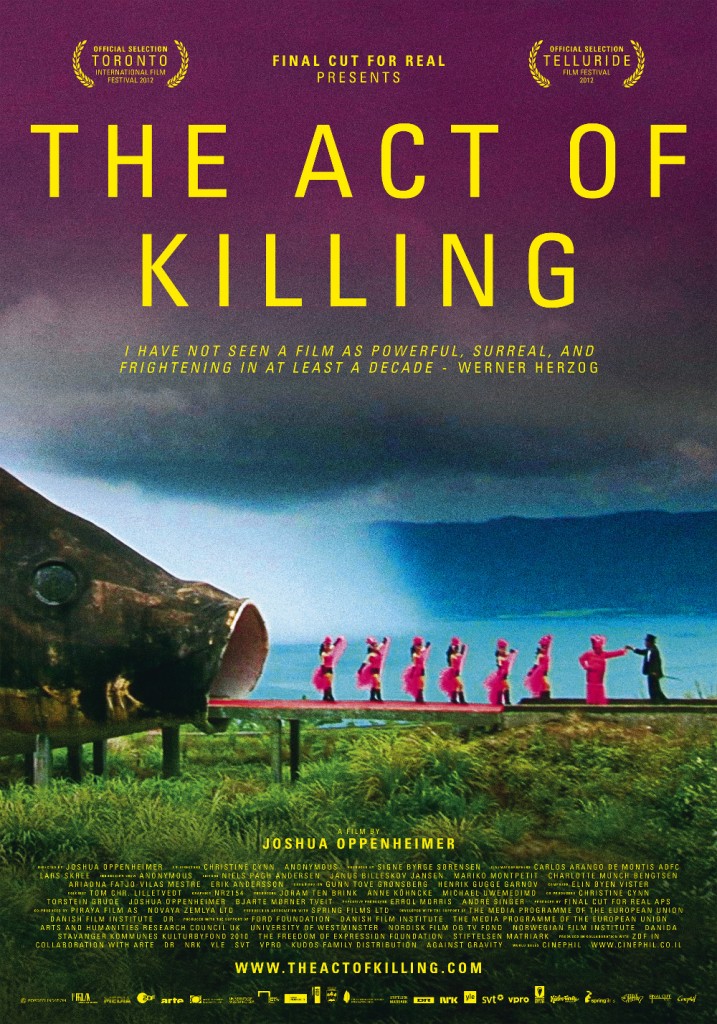
REVIEW: The Act of Killing (2013)


In 1965, a military coup crippled Indonesia. Begun apparently to thwart a communist coup in October, the military, under General Suharto, slaughtered half a million people with the active support of both the USA and the UK. Suharto violently suppressed all opposition and led a corrupt government. Thatcher visited in 1985, later writing in “The Downing Street Years”, “though there have been serious human rights abuses, particularly in East Timor, this is a society which by most criteria ‘works.’” This was Indonesia’s invasion and occupation of East Timor between 1975 and 1999, which killed a further one hundred thousand people. Since a society ‘works’ despite human rights abuses, Callaghan, Thatcher and others continued to sell Suharto arms. The murderers in Indonesia live on with impunity and they are still in power – still able to intimidate their neighbours and still honoured on national television for crushing the communists. Essentially, they are mass murderers who won, their crimes ignored (two and a half million killed) and their country running along thanks to the support of the capitalist West.

The Act of Killing follows a number of these murderers, particularly Anwar Congo, a self-proclaimed gangster and sadistic murderer, who looks back on his crimes with pride and nostalgia. They were leaders of their local Pancasila Youth paramilitary death squad. Initially, we see Congo and his old colleagues describe their killings and their love of cinema. These two interests go uncomfortably hand-in-hand when Congo describes going to see an Elvis film and then swaggering across the road to kill more prisoners. The documentary follows them as they attempt to recreate their tortures and killings, turning genocide into spectacle, offering insights into their thoughts and motivations.

The film’s main novelty is the fact that it contains interviews with wholly unrepentant murderers and a lot of the most shocking scenes are both evil and banal. These people make jokes about their murderers (one recounts an incident wherein he walked down a street, stabbing any Chinese person he found and he is sure to finish with a punch line) and are frequently honoured as war heroes and patriots. In a break during filming, one killer boasts of how many women he used to rape during a raid of a village and, in particular, his pursuit of fourteen-year olds to a group of laughing cohorts. However, as the film progresses and the re-enactments, ranging from gangster movie pastiches to musical numbers, continue, the façade cracks and some of the murderers, particularly Congo, begin to express regrets.

This is not to say that the film lacks contemporary insight since many of these ‘gangsters’ – frequently translated as ‘free men’ – are still active. One even stands for election into a corrupt government. We see them travelling through their neighbourhoods, extorting money from local businesses and forcing mostly quiet and distant people, for fear of showing disobedience, into participating in their epic, violent visions. One actor reveals himself to be a child of one of the murdered and yet participates nonetheless. These scenes are disturbing and enraging and they also point to the ongoing lack of justice in Indonesia, but they are also part of where The Act of Killing falters.

The film is very short on context. The text at the opening of the film is brief and not very detailed. It is also unclear whether director Joshua Oppenheimer initiated the project of re-enactments or whether he is merely following a pre-existing phenomenon. As a result, we are given very little insight into Oppenheimer’s dealing with these people and, hence, his own culpability with the evil we see and hear. Congo and his friends are clearly acting for Oppenheimer’s camera but what about the local people and the business owners who are filmed being threatened. Is Oppenheimer’s camera observing or instigating? When we see neighbourhood children (with, very possibly, relatives who are/were victimised by the Pancasila Youth) crying, clearly disturbed by the violent nature of the re-enactments that are being filmed, may our own outrage not justifiably be directed at Oppenheimer for encouraging Congo et al.?

Similarly, there are too many scenes that feel a little too convenient. At the film’s end, Congo, having shown a re-enactment of one of his tortures to his grandchildren, suddenly starts to show real remorse. He says that he now understands how the victims were feeling since he had the same feelings during the filming. Now, and only now does Oppenheimer challenge him – saying that it is incomparable since Congo was being tortured for film and his victims were being tortured for real. Then, we cut back to the rooftop were Congo strangled so many of his victims to re-do a too-light hearted previous demonstration of his methods. Suddenly, Congo seems to be violently, physically suffering from the enormity of his guilt, loudly retching and visibly shaken. This sequencing is unexpectedly moving and offers a harrowing reminder that these mass murderers are not, after all, monsters. However, since Oppenheimer hides the nature of the documentary’s production, these scenes feel manipulated and deeply untrustworthy. Conclusions are too easily drawn and their honesty and ultimate truth is difficult to come by. It is not clear if we are seeing everything and if the editing choices were made in the pursuit of verisimilitude or merely a good story and drama.

The Act of Killing is valuable in demonstrating what Indonesia is today but also the kind of state that the West is prepared to support for their own economic interests. It is valuable for its undeniably real scenes – such as the talk show honouring the murderers broadcast on national Indonesian television and interrupted by frequent applause from the audience for each barbarity mentioned, a clip that really has to be seen to be believed. It is awkward formally and depends on withholding, manipulation and subterfuge much more than is comfortable. Its key message is damaged thanks to its untrustworthy and unsophisticated presentation. However, this message, either explicit or implicit, of full impunity for murderers in Indonesia and of the West’s culpability in mass slaughter, is worth telling again and again.

See also: Into The Abyss: A Tale of Life, A Tale of Death (2012)

Monday, 8 October 2012

REVIEW: El Bulli: Cooking In Progress (2010)


El Bulli: Cooking In Progress is a documentary, directed by Gereon Wetzel, about the now-closed Spanish restaurant elBulli and its head chef Ferran Adrià. The restaurant dealt in avant-garde cuisine and the film details the process behind the food, from its conception through to its presentation.

The documentary reveals a year in the life of the restaurant and the key people involved, starting with the closing of the restaurant at the end of the summer season. Adrià and a team of his senior chefs, including Oriol Castro and Eduard Xatruch, spend the next few months testing out new “concepts”, cooking them a number of different ways and recording the results. Later, as June and the re-opening approach, a swarm of new recruits are brought in to assist with these large operations. We then see the restaurant in action, dealing effectively and quickly with the many different orders, while Adrià sits and meticulously tests the quality of each dish.

El Bulli: Cooking In Progress is a type of process documentary, not unlike Sophie Fiennes’ 2010 portrait of Anselm Kiefer and his work, Over Your Cities Grass Will Grow. In both films, the camera, in a detached yet observational handheld style, focuses primarily on the work, or the craft of making art. With crisp, clean digital imagery, these films document the process of creating art. However, while Fiennes’ film allowed at least one tell-all interview with its subject, Wetzel refuses to do anything other than document. Or so he would like us to believe. There are a series of moments that feel staged, including a rather too-clean match-on-action (when a cut between two different shots is bridged by a movement in order to give the impression of continuity), a technique of ‘invisible’ editing primarily used to Hollywood. Some exchanges between the chefs seem scripted, particularly a sequence late in the film in which Adrià talks to the assembled assistants and explains what elBulli is all about. It is a revealing moment but not a particularly believable one.

El Bulli: Cooking In Progress, though cold and detached, is clearly deeply passionate about the elBulli restaurant and haute cuisine in general. The film is deeply serious in its presentation of the process of cooking at elBulli. Without any doubt, it considers cooking an art and food an art form, just as much as painting, sculpting or cinema. When the food is ready to be served, it resembles more a piece of modern art, with a series of photographs of the meals shown over the end credits giving the impression of an exhibition. The film may well have a case to make and it may make you think about food and the nature of art and maybe even film, but not for very long. Similarly, the conclusions one might come to will be of little interest. The film’s treatment is rather facile, but the major problem with El Bulli: Cooking In Progress is that it smacks too much of snobbery.

Ferran Adrià is not so interested in whether his food tastes nice and he certainly is not concerned about giving his customers a meal - the portions are incredibly miniscule no matter how many courses there might be. Like modern art, the benefits are more cerebral. In his pep talk, Adrià says that the main thing is that the food give an emotional or intellectual response, that it shock and surprise. Unlike art, however, food serves a basic need, one that is not open to the vicissitudes of mental processes. As a result, at the risk of sounding like a philistine, it is difficult to agree with Ferran Adrià or with El Bulli: Cooking In Progress. Not that the film tries to convince. Behind the supposedly undoctored reality, which is never achievable whatever the aesthetics, of the film’s continuous documentation, there is a sense of smugness. It is preaching to the converted, safe in the knowledge that anyone who is unimpressed will either have given up long ago or will keep quiet. Instead of being intriguing or even fascinating as it could well have been, particularly as a Godardian exercise in boundary-breaking, the film is hopelessly didactic, overlong and po-faced.

As a side note, the film is also often barely comprehensible, particularly early in the film, when they are trying to put new “concepts” into practise. The film cuts quickly through a series of close-ups of different foods, handheld shots of the chefs cooking them, tasting them and adjusting them, but without any sense of time passing. These sequences are nearly impossible to follow in narrative terms, with the inedible food seen in the “Here’s one we made earlier” type moments nearly indistinguishable from the foods that are either finished or unfinished. Similarly, Adrià has an incredibly stony face, which often makes it difficult to gauge whether any of these trials have been successful or not. The film is also surprisingly unfocussed, giving a lot of attention to the repercussions of a faulty hard drive as if data management is of the utmost importance in a busy restaurant.


El Bulli: Cooking In Progress preaches to the converted and prefers not to look too critically at the idea of haute cuisine. It is pretentious and somewhat unapproachable as well as totally unconvincing. There is an air of snobbery throughout, which is hard to see past. Ultimately, the film has very little worth or appeal. 


Friday, 29 June 2012

REVIEW: The Turin Horse (2012)


  The Turin Horse (A Torinói ló) is a Hungarian/Swiss/French/ German co-production co-directed by Béla Tarr (Damnation and Werckmeister Harmonies) and his wife Agnes Hranitzky. Tarr has claimed that this will be his last film and that it is the summation of his work bringing together all his techniques, themes and preoccupations, but has this demanding but fascinating filmmaker bowed out with a bum note?
  The Turin Horse is 154 minutes long and composed entirely of only 30 shots, a typical Tarr device. Aside from the beginning, an anecdote told in voiceover about Nietzsche’s mental breakdown after seeing the cruel whipping of a stubborn horse, the film follows the daily routines of Ohlsdorfer (János Derzsi) and his daughter (Erika Bók). We see them on six apparently consecutive days as they get up, dress (Ohlsdorfer’s daughter dressing him as he is lame in one arm), saddle up their horse, eat, clean up and stare expressionlessly out the window at their bleak and wind torn land. We see these activities repeated several times though each time with slight variations in camera angle and point of view. Eventually, and for no apparent reason, their horse refuses to work and then to eat and drink, which is the beginning of the end for Ohlsdorfer and his daughter.
  Apart from one awkward sequence involving a visitor from the town, the wider world is almost entirely absent. Apart from the opening shot, a staggering long take that circles around the horse as it drags a cart across a twisting and rocky road, the camera barely leaves the house, only travelling as far as their nearby shed and well. Throughout the film, their house is being constantly beaten by an almost cataclysmic gale. Ohlsdorfer and his daughter are isolated in their house, constantly acting out their daily routines and silently trudging through the daily grind. When their horse refuses to co-operate, their slow decline into destitution is horribly detailed and movingly inescapable.
  The film is a grim, slow and thematically complex work, revealing Tarr’s tendency towards symbolism and philosophy, but one that is thoroughly engrossing and visually dynamic. Nietzsche’s breakdown haunts the film, though it never impacts upon the film’s slight plot, creating instead a sense of the darkness, desperation and futility of life. The world outside is a void and the film often hints at what might be a coming apocalypse, especially as water and even light begin to diminish. At one point, Ohlsdorfer and his daughter attempt to escape only to be driven back by what are apparently even worse conditions just over the hill. When they return, they never speak about what they have seen. The film is almost entirely hopeless, ending with a harrowing shot that is eloquent of loss and the acceptance of the end despite being, like the rest of the film, incredibly muted.
  However, the film is not entirely devoid of hope. In fact, the film is deeply rewarding, acting as a reminder that the basic essentials of life are so all consuming yet so simple. This is revealed in the relationship between Ohlsdorfer and his daughter. Their silence may initially seem cold yet, as the film progresses, it becomes clear that their relationship is strong yet simple, almost transcending words. In the performance of their daily tasks, they move silently around each other, one picking up a task just as the other has completed the one before it, in a way that is vaguely reminiscent of a choreographed dance number. Similarly, their treatment of the horse seems initially to be merely functional, almost cruel, until we see the daughter in particular regard it with a lot of sadness and tenderness. The camera too treats the horse with respect, particularly in the harrowing opening shot which details the horse’s ordeals and when it frequently frames the horse in soul-searching close-ups just as it does Ohlsdorfer and his daughter. Ultimately, the film is deeply compassionate – although it does not entirely partake of the characters’ desperation and sadness, it does regard them non-critically and sympathetically.
  Similarly, the film often lingers on some staggeringly beautiful images, all composed with the utmost care and skill, yet with the appearance of a remarkable spontaneity and deeply evocative of an almost mystical world. It is hard to be entirely depressed by a film of much frequent beauty. In one startling moment, Ohlsdorfer’s daughter stares out of the window at us, her face morphing into that of her father as the image is obscured by the debris of the roaring gale. At another moment, Ohlsdorfer and his daughter paused during their dinner to contemplate a sudden and eerie change in the sound of the wind, which powerfully evokes a malign force just outside their window. Coupled with these images, and many others also, is the sense that the film works entirely subjectively on each member of the audience. The film is deeply rewarding, becoming almost a personal and solo journey through the film’s long running time, where each feeling raised is due more to one’s own preoccupations and insights than those of an all-seeing director.
  The Turin Horse is a beautifully realized and poetic film and it is a deeply fascinating and involving work. The film’s performances are brilliantly evocative despite the film’s lack of dialogue. The film may not have many encouraging things to say about life, but it does reveal much that is worth living for, if only to see a great work of art by an artist who has a highly evolved and thematically complex voice and a genuine dedication to their chosen medium.

Thursday, 8 March 2012

REVIEW: Heimat - A Chronicle of Germany (1984)

  At 925 minutes, Edgar Reitz’s Heimat – A Chronicle of Germany stands as one of the most ambitious television productions ever made. This 15 and a half-hour monolith was filmed over two years with a huge cast and covers German history from 1919 through to 1982.

Beginning during the immediate aftermath of WWI, the series begins with the return of Paul Simon (Michael Lesch, later Dieter Schaad) to his rural home, the small town of Schabbach in the Rhineland. Paul has been released from a French prisoner of war camp, still suffering from the effects of the war.

Paul is soon at odds with the conservative views of the townspeople, deciding to pursue his interest in radio communications rather than continue in his father’s footsteps and go into blacksmithing. As well as this, he begins an affair with Apollonia (Marliese Assmann), a maid in the local inn, a suspected gypsy because of her black hair. The townspeople also believe that she has had an abortion and frequently investigate the surrounding area. Though they are clearly in love, Paul is too afraid to elope with her and, instead, marries Maria (Marita Breuer), the daughter of the local Mayor, Alois (Johannes Lobewein).

Years later, with two sons, Anton and Ernst (respectively, Rolf Roth and Ingo Hoffmann, and later, Mathias Kniesbeck and Michael Kausch), by Maria, Paul comes across the naked body of the dead woman in the forest. The discovery is a scandal in the town, though it doesn’t last for long. Not long afterwards, Paul goes for a beer and disappears from Schabbach…

Above is a brief description of the first episode of the 11-part series, covering the years 1919 to 1929, which does little to show the breadth of this series. In total, the series follows three families – the Simons, the Wiegands and the Schirmers – creating a vast tapestry of a small village growing into a bustling town, crowded with people and running through many decades. In fact, possibly the most fascinating thing about the series is watching the growth of Schabbach, which goes from being small, cut-off and extremely rural to busy, modern and ever expanding. The house of the Simons remains recognisable despite the modern trappings that surround it, the forge beside it surpassing the years despite the homegrown industry becoming an anachronism.

It is difficult to find a main character in the series, as each episode shifts or expands its focus. In the first episode, Schabbach is antiquated and suffocating, as seen through Paul’s eyes, though, in subsequent episodes, it will become a haven from the modern world and a place of beauty. Similarly, there is no apparent authorial presence throughout the series. One episode may be about forbidden love and teenage angst only for the next one, set years later, to be about loss and regret over past mistakes. Reitz, either as director or co-writer, does not judge, something that can either feel authentic or unsettling depending on your outlook when the series tackles the Nazis. Reitz is interested only in presenting a portrait of a town and its people in the process of transition as the years pass. Hence, one character may appear ruthless, even demonic, in one episode and sad, pathetic or funny in another.

The final episode, by way of a conclusion, presents all of its surviving characters feeling the quick passing of the years. The deaths of the past generation weigh heavily on them, as well as on us as most of them would have featured prominently in the first half of the series. Ultimately, an awkward and unconvincing impressionistic ending notwithstanding, the series is a tribute to life; it’s unexpectedness and the wisdom and memories you gain throughout its duration.

Good as the series is as drama, it is also a fascinating tribute to filmmaking. The series is filled with lyrical but probing tracking shots that recall the work of Tarkovsky. There are several interludes throughout the series, some more successful than others, which add a type of eerie poetry to the series, making it more than just an average, everyday soap opera. Reitz gets a lot from the simple image of a coffin abandoned on the road during a storm or a sheet hovering over a war memorial following its unveiling.

Heimat – A Chronicle of Germany is a massive summing-up of the German Heimat genre, nostalgic films set in rural landscapes and usually following a family, and a likely attempt to reclaim the genre from the Nazi propaganda with which it became associated. Mirroring Werner Herzog’s attempt to bridge the gap between the German cinema of the 1920s with the present (then the 1970s and the 1980s) with his remake of Nosferatu, Heimat – A Chronicle of Germany tries to re-map the history of German cinema, a glossing over of the Nazi propaganda films of the 1930s and the 1940s. Whether you agree with this approach or not, the series does remain a powerful and frequently riveting drama. As a side note, quite why the series jumps between black and white and colour and back again is anyone’s guess.

Despite a difficult and fiercely televisual score, Heimat – A Chronicle of Germany is a great series. Each episode adds to the entire project, which covers 63 years and features 140 speaking parts. Played out in front of you are the lives of several characters, their highs and lows, their births and deaths all within the constant growth of the town of Schabbach. The length of the series, far from becoming an endurance, becomes a necessary part of what makes the series work. With no major plot or authorial voice, the series unravels and complicates itself much like life. The series is also packed with great performances and, thanks to great make-up, the cast visibly age in front of you – making it a series as dramatic as it is melancholic.